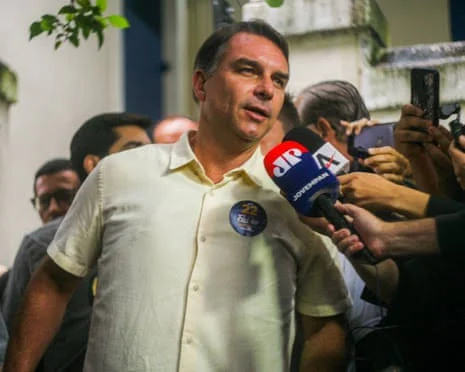
The political landscape in Brazil has been thrown into further disarray following the dramatic departure of Senator Flavio Bolsonaro, who has reportedly fled to the United States in the wake of his defeat in the recent presidential election. The senator, a prominent figure in the Liberal Party and son of former President Jair Bolsonaro, allegedly bypassed a Supreme Court mandate requiring him to surrender his travel documents. This maneuver marks a significant escalation in the ongoing tensions between the Brazilian judiciary and the Bolsonaro political faction, signaling a deepening crisis for the nation’s democratic institutions.
Sources close to the Bolsonaro family, as well as reporting from major Brazilian outlets including Metrópoles and Folha de S. Paulo, have confirmed that the senator departed Brazil in the early hours of October 27, 2026. According to these reports, he is accompanied by his wife and two daughters. The clandestine nature of his departure, coupled with his failure to comply with a court-ordered deadline to relinquish his passport, has prompted immediate calls for his arrest and the issuance of an Interpol Red Notice by members of the Workers’ Party (PT).
Chronology of Events and Escalating Tensions
The events leading to Senator Bolsonaro’s flight trace back to the conclusion of the presidential polls held on Sunday, October 25. Despite clear results indicating a victory for Luiz Inácio Lula da Silva, the Bolsonaro campaign maintained a stance of non-concession. By Monday, the atmosphere in Brasilia had grown volatile as the Supreme Court moved to restrict the travel of key figures involved in the campaign, citing concerns over potential flight risks and ongoing investigations into electoral interference.
The following timeline details the rapid deterioration of the situation:
- Sunday, October 25: Election day concludes with results favoring Lula da Silva. Flavio Bolsonaro publicly challenges the integrity of the vote, citing unsubstantiated claims of voter irregularities.
- Monday, October 26: The Brazilian Supreme Court issues a formal order requiring the senator to surrender his passport. Flavio Bolsonaro releases a video statement on social media, claiming, "I never thought about leaving the country."
- Monday Night: Reports emerge suggesting a failed attempt to exit via Argentina, where a private jet was allegedly scheduled to depart from Puerto Iguazú.
- Tuesday, October 27: The morning deadline for passport submission passes without compliance. By evening, news outlets confirm that a flight carrying the senator and his family is en route to Florida.
The Legal and Diplomatic Implications
The decision by Flavio Bolsonaro to seek political asylum in the United States—a move reportedly signaled to the incoming administration—presents a complex diplomatic challenge. If the senator formally requests asylum, the U.S. government will be forced to weigh its bilateral relationship with Brazil against the international legal obligations and extradition treaties that typically govern such cases.
Legal analysts point out that the senator’s refusal to hand over his passport constitutes a direct act of defiance against the Brazilian judiciary. For the Supreme Court, this is not merely a procedural breach but a challenge to the rule of law. The request from PT lawmakers for an Interpol Red Notice suggests that the Brazilian government intends to pursue the senator through international channels, which could lead to a protracted legal battle in the United States courts.
Historical Precedent: The Bolsonaro Family Legacy
The current situation is heavily colored by the political history of the Bolsonaro clan. Flavio’s father, Jair Bolsonaro, famously departed Brazil for the United States following his own election loss in 2022. That departure was similarly marked by a refusal to concede and was viewed by many as an attempt to evade the mounting legal pressures that awaited him at home.
Unlike his son, Jair Bolsonaro eventually returned to Brazil to face the judiciary. His subsequent conviction and sentencing to 27 years in prison for his role in plotting a coup served as a watershed moment for Brazilian democracy. The fact that the younger Bolsonaro is now following a similar flight path—albeit under different charges—suggests a recurring pattern of utilizing international borders as a shield against domestic judicial accountability. The Liberal Party’s eventual acknowledgment of Lula’s victory on Monday stands in stark contrast to the individual actions of the candidate, highlighting a growing rift within the party’s hierarchy.
Supporting Data: The Electoral Landscape
The 2026 election was characterized by intense polarization and high voter turnout, reflecting the deep-seated divisions within Brazilian society. Data from the Superior Electoral Court (TSE) indicated a significant margin of victory for the Workers’ Party, yet the rhetoric from the Bolsonaro camp remained focused on questioning the reliability of the electronic voting system.
The following table summarizes the key metrics surrounding the recent electoral cycle:
| Metric | Details |
|---|---|
| Total Registered Voters | Over 160 Million |
| Voter Participation Rate | 79.4% |
| Core Contention | Alleged discrepancies in regional tabulations |
| Judicial Oversight | Mandatory passport surrender for high-profile figures |
The persistence of these electoral disputes, even after the Liberal Party issued a statement recognizing the results, suggests that the "Bolsonarismo" movement remains a potent, if increasingly isolated, force in Brazilian politics.
Official Responses and Public Sentiment
The reaction from the international community and the Brazilian government has been one of urgency. Representatives of the Workers’ Party have characterized the senator’s flight as an admission of guilt, arguing that only those with something to hide would flee the country in such a manner.
"The law applies to every citizen, regardless of their standing in the Senate," said a spokesperson for the ruling coalition. "By choosing to ignore the Supreme Court, the senator has effectively placed himself outside the protection of the democratic process."
Conversely, supporters of the Bolsonaro movement have taken to social media to characterize the judicial orders as "political persecution." They argue that the pressure on the family is a coordinated effort by the judiciary and the political left to neutralize the conservative opposition. This narrative has created a volatile environment on the ground, with sporadic protests breaking out in major cities across Brazil.
Broader Impact: Democracy in the Crosshairs
The departure of Flavio Bolsonaro is more than just a headline; it is a symptom of a broader struggle for the integrity of democratic processes in South America’s largest nation. When political elites feel compelled to flee the country rather than face the scrutiny of their own legal system, it erodes the public’s trust in the institutions that are meant to ensure accountability.
The implications for Brazil’s future are profound. If the government fails to secure the return of the senator, it risks appearing weak in the eyes of the electorate. If the U.S. government grants asylum, it could cause a significant strain in the relationship between Washington and Brasilia, potentially alienating the current administration and disrupting regional trade and security cooperation.
As the situation unfolds, the focus will likely shift to the U.S. Department of State and the U.S. Department of Justice, which will play the pivotal roles in determining whether Flavio Bolsonaro remains in the United States or is returned to face the pending charges in his home country. For now, the senator remains in transit, and Brazil remains in a state of watchful waiting, bracing for the next chapter in a political saga that continues to defy traditional democratic norms.
The silence from the Bolsonaro camp in the hours following the departure has only heightened the uncertainty. With the Liberal Party now attempting to distance itself from the more radical elements of the campaign, the political landscape is expected to undergo a significant realignment in the coming months. Whether this departure marks the end of the Bolsonaro era or merely the beginning of a long-distance political campaign remains to be seen. What is clear, however, is that the events of October 27 have cemented their place in the annals of Brazil’s complex and often tumultuous political history.