Aliko Dangote, Africa’s richest individual, has captured the attention of global financial markets by projecting that shares in the Dangote Petroleum Refinery and Petrochemicals could eventually skyrocket to N10,000 ($7.33) each. The bold valuation forecast accompanies what is slated to be Africa’s largest-ever initial public offering (IPO), setting off intense discussions among institutional investors, retail market participants, and economic analysts alike.
While the projected price point offers a compelling wealth-creation narrative for prospective shareholders entering the market at the initial offer price of N525 ($0.38) per share, it also prompts critical evaluations regarding market capitalization dynamics, long-term inflationary realities, and the massive operational scale required to achieve such historic milestones.
The Initial Public Offering: Structure and Timeline
The historic equity offering involves the issuance of 4.1 billion new ordinary shares at an offer price of N525 per share. Through this massive flotation, the company aims to raise approximately $1.58 billion (N2.15 trillion), based on the official exchange rate utilized in the company’s comprehensive prospectus.
The timeline for the public offering has been meticulously mapped out to ensure a seamless market entry. The subscription window is scheduled to officially open on September 14, and will run through October 13. Following the culmination of the offering period, allotment processes and regulatory clearances are expected to pave the way for the shares to commence active trading on the Nigerian Exchange (NGX) by late November.
Prior to the launch of this landmark IPO, the Dangote Petroleum Refinery had approximately 120.13 billion issued shares. The introduction of the 4.1 billion new shares will elevate the total issued share count to roughly 124.23 billion, not factoring in any potential over-allotment options that may be exercised. At the baseline offer price of N525 per share, the post-offer market valuation of the enterprise stands at an impressive $47.8 billion (N65.2 trillion), cementing its status as an absolute heavyweight within the African corporate landscape.
Decoding the N10,000 Ambition and Market Capitalization Realities
During a recent public presentation, Dangote highlighted the long-term appreciation potential of the refinery’s equity, noting that a day will come when the stock trades at N10,000. To illustrate the magnitude of this ambition, he pointed out that an initial investment of N5 million could theoretically expand into a holding worth more than N50 million.
Financial analysts, however, emphasize that this projection represents a long-term strategic vision rather than a short-term, measurable financial forecast, as no specific timeline was provided for achieving the N10,000 target. The mechanics of such a valuation shed light on the sheer scale of growth required. If the company’s expanded share base were valued at N10,000 per unit, the total market capitalization of the Dangote Petroleum Refinery would surge past $910 billion based on prospectus exchange rates.
Such a staggering valuation would propel the Nigerian enterprise into the upper echelon of the world’s most valuable publicly traded corporations. In global terms, a $910 billion market capitalization would place the refinery well above virtually every other publicly traded international oil company and independent refiner, trailing only energy titan Saudi Aramco.
Nevertheless, market economists caution that nominal share price milestones must be analyzed through the lens of macroeconomic factors. Reaching a N10,000 share price within a compressed five-year window would yield an entirely different real-terms return compared to the same nominal price being attained after 15 or 20 years of cumulative currency depreciation and domestic inflation. Furthermore, potential future corporate actions—including secondary share offerings, stock splits, and foreign exchange fluctuations—will heavily influence whether the valuation can be realized in real purchasing power.
Financial Performance and Premium Valuations
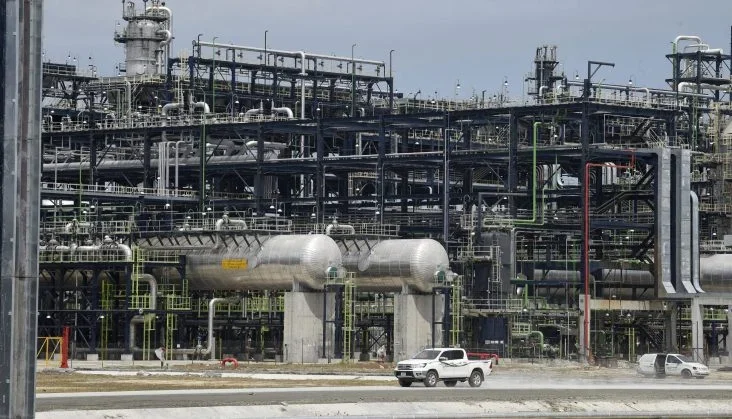
The Dangote Refinery has evolved far beyond its initial phase as an ambitious heavy-infrastructure construction project. Today, the mega-facility is fully operational, actively exporting refined petroleum products, and generating substantial corporate profits.
According to financial figures disclosed in the IPO prospectus, the refinery recorded an impressive $13.91 billion in revenue during the first half of the year. Profit after tax reached $1.82 billion, marking a dramatic turnaround from the $476 million loss reported for the entirety of the previous fiscal year. This financial rebound has been bolstered by strong international refining margins, driven in part by geopolitical disruptions and capacity constraints in key energy hubs like the Middle East.
The refinery’s diversified product slate—comprising gasoline, diesel, aviation fuel, and petrochemical inputs—is distributed across African domestic markets, alongside export destinations in Europe and the United States. This integration of refining, petrochemical manufacturing, massive fuel storage terminals, and dedicated marine export infrastructure justifies a premium valuation in the eyes of many institutional backers.
However, prospective investors are being asked to buy into an enterprise priced at nearly $48 billion from day one, which stands notably higher than several long-established global refining peers. For comparison, industry data indicates that Turkey’s Tüpraş, which operates four refineries with a combined processing capacity comparable to Dangote’s single-train facility, has historically traded at a valuation of approximately $12 billion. Similarly, US-based HF Sinclair, boasting a daily crude processing capacity of roughly 678,000 barrels, has commanded a market value of around $16 billion.
While direct comparisons fail to account for Dangote’s advanced integration, vast scale, and strategic positioning at the heart of Africa’s fastest-growing economies, they underscore that the IPO offer price already prices in substantial expectations for sustained future earnings.
The $14.3 Billion Expansion Strategy and Associated Risks
The most compelling justification for the refinery’s long-term valuation growth lies in management’s aggressive capital expenditure roadmap. The company has announced plans to invest $14.3 billion to double its crude oil processing capacity from the current 700,000 barrels per day to an astounding 1.4 million barrels per day by 2029. Additionally, the firm’s polypropylene production capacity is slated to expand to 2.4 million tonnes annually by 2030.
Financing this monumental expansion will require capital expenditures that dwarf the proceeds generated by the current IPO. After accounting for administrative and issuance expenses, the net proceeds from the 4.1 billion share offering are expected to contribute approximately N2.11 trillion toward the program. Consequently, the refinery will need to secure the remaining capital through a combination of retained earnings, commercial bank loans, international trade finance facilities, strategic partnerships, or subsequent equity rounds.
This heavy capital requirement introduces distinct operational and financial risks for new shareholders:
- Debt Servicing Pressures: Aggressive borrowing to fund construction could escalate financial expenses, potentially constraining free cash flow and limiting near-term dividend distributions.
- Equity Dilution: Issuing additional tranches of shares in the future to raise capital could dilute existing shareholders’ percentage ownership, though value creation may still occur if the expanded assets generate proportionally higher earnings.
- Execution Timelines: The original construction of the refinery faced considerable delays and cost overruns, ultimately tallying an investment of roughly $20 billion. Ensuring that the upcoming 2029 expansion stays on schedule and within budget will be a critical test for corporate management.
Evaluating Dividend Prospects and Currency Hedging
For many African investors, one of the most attractive attributes of the Dangote Refinery IPO is the prospect of receiving dividend distributions linked to the company’s robust dollar-denominated revenues. In economies plagued by persistent currency volatility and domestic depreciation, holding equity tied to hard-currency export earnings offers a vital financial hedge.
However, the IPO prospectus clarifies that dollar-linked dividend distributions represent corporate intent rather than a binding contractual guarantee. Actual dividend payouts will remain strictly contingent upon net distributable profits, available operating cash flows, compliance with regulatory statutes, the covenants of ongoing financing agreements, and the capital preservation demands of the massive ongoing expansion program.
Management retains the discretion to distribute dividends in Nigerian Naira, US Dollars, or any other approved currency, depending on prevailing macroeconomic conditions and foreign exchange availability. Given the capital-intensive nature of the $14.3 billion expansion initiative, corporate leadership may prioritize reinvestment, debt reduction, and working capital buffers over aggressive early dividend payouts.
Strategic Implications for African Capital Markets
The launch of the Dangote Petroleum Refinery IPO marks a watershed moment for the Nigerian Exchange and the broader African financial ecosystem. By offering retail and institutional investors a direct stake in a world-class industrial asset, the offering is expected to deepen local capital markets, boost domestic liquidity, and encourage broader public participation in wealth-building equities.
A theoretical appreciation from the initial N525 offer price to the targeted N10,000 milestone represents a staggering nominal increase of approximately 1,805%. While such historic returns are theoretically achievable over long investment horizons—particularly in inflationary emerging markets—financial experts remind investors to look beyond nominal share prices.
Ultimately, the long-term success of the investment will not be measured solely by the final destination of the stock price, but by the fundamental drivers of corporate performance: sustainable earnings per share, disciplined capital allocation, reliable operational execution, and resilient cash flow generation in the face of evolving global energy markets. As subscription windows open, market participants will weigh the undeniable scale and strategic dominance of the refinery against the valuation premiums and execution risks inherent in Africa’s most ambitious corporate undertaking.