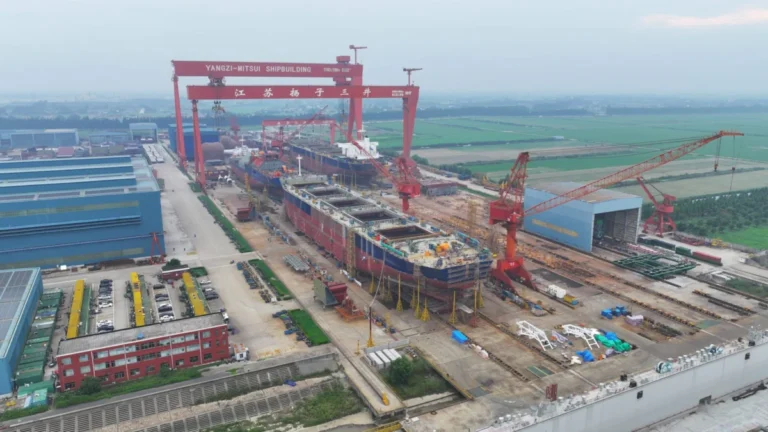
The Dangote Group is orchestrating a monumental shift in its maritime logistics strategy, turning its gaze toward the People’s Republic of China—the undisputed global leader in commercial shipbuilding—to support a staggering sixfold increase in its annual vessel movements. As the conglomerate spearheads the ambitious expansion of its industrial empire, centered around Africa’s largest petroleum refinery, its annual maritime traffic is projected to surge from approximately 300 vessel calls to nearly 1,800.
This strategic pivot was revealed by Devakumar Edwin, the Group Vice President for Oil and Gas at Dangote Industries, during the prestigious Nigeria Chamber of Shipping’s 2026 Members’ Evening held in Lagos. Speaking before industry stakeholders, maritime regulators, and financial leaders, Edwin underscored the urgent necessity for robust capital injection into Nigeria’s domestic shipping ecosystem. However, due to structural capacity constraints and a distinct shortage of indigenous vessel availability, the conglomerate is compelled to look outward, cementing partnerships with Chinese shipbuilders to secure the necessary maritime fleet.
The impending maritime expansion underscores a pivotal moment for African industrialization. By taking greater control of its supply chain, the Dangote Group aims to insulate its vast export and distribution network from regional transport bottlenecks, thereby cementing its status as a dominant force in global maritime trade and intra-African commerce.
Scaling New Heights: The Industrial Drivers Behind the Maritime Boom
The catalyst for this maritime expansion lies in the sweeping scale of Dangote’s diversified industrial portfolio. While the multi-billion-dollar Lekki-based refinery serves as the crown jewel of this logistical overhaul, the conglomerate’s overarching shipping needs are propelled by its expansive operations spanning cement manufacturing, sugar refining, flour milling, fertilizer production, and petrochemicals.
At present, the Dangote Refinery operates with a design capacity of 700,000 barrels per day. However, the company has embarked on a aggressive $14.3 billion expansion program designed to double this output to an astounding 1.4 million barrels per day by 2029. This massive scaling of petroleum refining will be complemented by a proportional rise in petrochemical yields, producing a surplus of refined products intended not only for domestic consumption in Nigeria but for export markets spanning across West Africa, Central Africa, and international destinations.
To distribute these massive volumes efficiently, Dangote requires an unprecedented volume of maritime transport. Crude oil feedstocks must be imported from international and regional origins, while finished products—ranging from diesel and gasoline to urea fertilizer and bagged cement—must be ferried across coastal trade routes. Relying solely on third-party charter vessels or land-based transit has proven increasingly untenable, prompting the group to pursue the acquisition and construction of its own dedicated fleet.
The Logistics Bottleneck: Why Dangote Looked Beyond African Shores
The decision to source vessels from China highlights a glaring systemic gap within Nigeria’s domestic maritime and shipping industries. Although the country boasts a strategic coastline and an active Chamber of Shipping, local shipowners and indigenous operators have historically struggled to secure the long-term financing, insurance, and institutional support required to build or acquire modern, high-capacity commercial fleets.
Recent operational challenges have starkly exposed these vulnerabilities. Reports from earlier trading cycles revealed that Dangote Industries encountered severe difficulties in securing adequate shipping capacity to transport a routine 1,000-metric-tonne industrial shipment from Nigeria to neighboring Ghana. Such regional trade routes, which should serve as the lifeblood of the African Continental Free Trade Area (AfCFTA), remain choked by logistical inefficiencies.
Furthermore, land transport alternatives present prohibitive cost barriers. Hauling goods via regional road networks subjects exporters to steep customs duties, transit taxes, and bureaucratic delays imposed by neighboring transit nations such as Benin and Togo. These friction points artificially inflate the final delivery cost of Nigerian manufactured goods, rendering them less competitive in regional markets.
Addressing these realities at the Lagos gathering, Devakumar Edwin pointedly highlighted the structural paradox facing the domestic shipping sector. "Without assured cargo and supporting infrastructure, new vessel owners struggle and businesses fail, even when finance is available," Edwin noted. He issued a passionate appeal to commercial lenders, institutional investors, and policymakers to look beyond pure vessel financing and invest comprehensively in the broader maritime ecosystem—including vessel management, maritime insurance, regulatory compliance frameworks, and long-term charter agreements.
China’s Dominance as the Global Shipbuilding Titan
With domestic shipyards lacking the immediate capacity to fulfill Dangote’s specialized fleet requirements, the conglomerate’s alignment with Chinese shipbuilders is a pragmatic response to global market realities. China currently stands uncontested at the summit of the global maritime manufacturing sector.
According to data compiled by the United Nations Conference on Trade and Development (UNCTAD), Chinese shipyards accounted for an overwhelming 54.6% of total global shipbuilding output. This staggering market share outpaced the combined production of historical shipbuilding powerhouses South Korea and Japan. Furthermore, industry data at the start of 2025 indicated that Chinese shipyards held nearly two-thirds of the entire global shipbuilding orderbook, solidifying their monopoly on commercial vessel construction—from giant crude carriers (VLCCs) and product tankers to dry bulk carriers and container ships.
By engaging with these yards, Dangote positions itself to procure modern, fuel-efficient, and technologically advanced vessels tailored to the precise specifications of its diverse product lines. Whether commissioning specialized chemical tankers for petrochemical exports or bulk carriers for cement and fertilizer, partnering with Chinese maritime manufacturers grants the Nigerian conglomerate immediate access to scale, reliability, and competitive pricing that cannot currently be replicated locally.
Financing Growth: The Upcoming Refinery IPO
The massive capital expenditure required for both the $14.3 billion refinery expansion and the corresponding maritime fleet acquisition is supported by a sophisticated financial strategy. Central to this strategy is the Dangote Group’s plan to launch an Initial Public Offering (IPO) for its flagship refinery, targeting a capital raise of approximately $1.63 billion.
The impending public listing is expected to unlock substantial liquidity, providing the financial runway necessary to execute long-term infrastructural investments. By transitioning from private financing to public capital markets, the group ensures it retains the financial resilience required to absorb the capital-intensive nature of shipbuilding and fleet management.
Broader Economic Implications and Future Outlook
The implications of Dangote’s pivot toward international shipbuilding extend far beyond corporate balance sheets, carrying profound weight for Nigeria’s macroeconomic landscape and Africa’s trade integration.
-
Supply Chain Resilience: By owning or directly chartering a dedicated fleet of up to 1,800 annual vessel calls, Dangote insulates its production cycles from external shipping shocks, global charter rate volatility, and port congestion. This vertical integration guarantees uninterrupted delivery schedules for critical energy and industrial products.
-
Catalyzing Regional Trade: The enhanced maritime capacity directly supports the operational ideals of the AfCFTA. By establishing reliable, cost-effective maritime corridors connecting Nigerian ports to West and Central African destinations, the Dangote Group can significantly drive down the cost of cross-border trade, making intra-African commerce more viable than ever before.
-
Pressure on Local Infrastructure: The projected surge to 1,800 vessel calls per year places an immense responsibility on Nigerian port authorities to modernize maritime infrastructure. Dredging shipping channels, upgrading port handling equipment, and streamlining customs clearance procedures will be critical to accommodating this massive influx of maritime traffic without creating severe bottlenecks at the Lekki port corridor.
-
A Wake-Up Call for Indigenous Maritime Policy: While Dangote’s immediate recourse to Chinese shipyards is driven by necessity, industry analysts view this development as a stark warning to Nigerian policymakers and financial institutions. If the domestic financial sector fails to develop competitive frameworks to finance local vessel acquisition, Nigerian capital will continue to flow outward, leaving indigenous operators on the sidelines of the continent’s most ambitious industrial expansion.
As the Dangote Group marches toward its 2029 production targets, its masterstroke in maritime logistics serves as a defining blueprint for modern African enterprise. By combining domestic industrial might with global shipbuilding partnerships, the conglomerate is not merely expanding its own operational horizon—it is fundamentally reshaping the geography of African maritime trade.