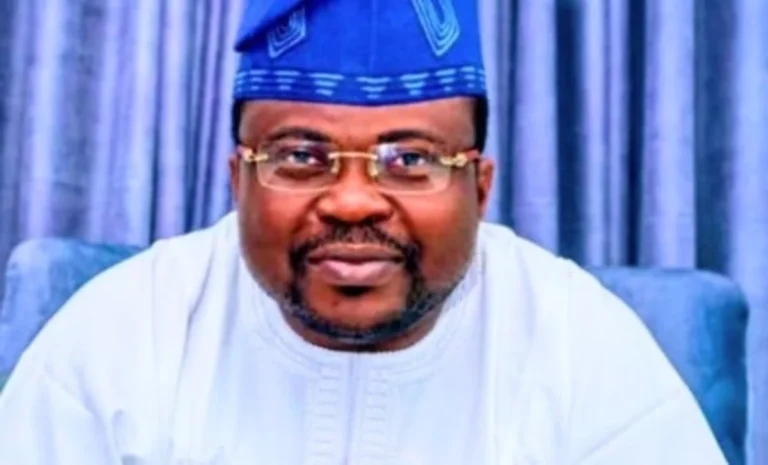
The quest for transformative governance and sustainable national development in Nigeria has once again taken center stage as political actors begin strategic alignments ahead of the forthcoming 2027 general elections. In Oyo State, the Allied Peoples Movement (APM) senatorial candidate for Oyo Central, Ambassador Olufemi Ajadi Oguntoyinbo, has issued a resolute call to action to the younger demographic. Speaking directly to the energy, intellect, and numerical dominance of the youth, Ajadi has challenged them to transcend the confines of social media commentary and sideline complaining by actively integrating themselves into the formal structures of political parties.
This clarion call was delivered on Friday during a high-profile Youth Stakeholders Engagement convened by the Agency for Youth Development. The strategic gathering, which brought together official representatives from approximately 900 registered youth-based associations across Oyo State, took place at the historic Ministry of Local Government Training Hall located in Ibadan, the state capital. The event served as a critical melting pot for discussions centered on youth empowerment, economic participation, policy formulation, and the urgent imperative of generational shift in political leadership.
By addressing representatives from nearly a thousand distinct youth groups, Ajadi tapped into an expansive grassroots network. His central thesis was stark and unsparing: the persistent socioeconomic challenges and systemic bad governance plaguing Nigeria for decades are, to a significant extent, symptoms of youth absenteeism in the corridors of power. According to the APM chieftain, the demographic majority that young people represent has not translated into proportional political influence because of apathy, disillusionment, and a historical reluctance to participate in party politics.
Main Facts of the Engagement
The Youth Stakeholders Engagement in Ibadan was structured to diagnose the multifaceted problems affecting young Nigerians in Oyo State and chart a viable path forward. Key stakeholders in attendance included civil society actors, student union leaders, youth entrepreneurs, vocational artisans, and representatives of various cultural and religious youth organizations.
Ambassador Ajadi, serving as the keynote voice at the event, zeroed in on the structural disconnect between the governed and the governing. He articulated that while older generations continue to dominate the political landscape, the actual intellectual capital, physical vitality, and innovative drive required to build a modern economy reside squarely with the youth. However, he cautioned that possessing these attributes in isolation is insufficient. Without securing the levers of political power through active membership in political parties, voting, and running for office, the youth will remain perpetual spectators to decisions that dictate their future.
The discourse also ventured into practical socioeconomic hurdles. Representatives of the 900 associations used the platform to highlight critical issues such as chronic youth unemployment, inadequate skills acquisition frameworks, limited access to capital for small and medium-scale enterprises (SMEs), and the systemic exclusion of young minds from policy-formulating committees at both state and local government tiers. In response, Ajadi emphasized that true empowerment cannot be handed down as a benevolent gift from the political elite; rather, it must be claimed through organized political participation and legislative advocacy.
Background Context and Political Landscape of Oyo State
To fully understand the gravity of Ambassador Ajadi’s message, one must examine the socio-political terrain of Oyo State within the broader context of Nigerian politics. Oyo State has historically been a critical battleground in Nigeria’s southwestern political zone, known for its high level of political consciousness, robust intellectual tradition, and active citizenry.
Ahead of the 2027 general elections, political parties are already jostling for strategic positioning. The Independent National Electoral Commission (INEC) has maintained a continuous voter registration framework, while political parties are refining their mobilization strategies to capture the critical youth vote. Demographically, Nigeria remains one of the youngest nations globally, with citizens under the age of 30 constituting over 70 percent of the population. In Oyo State, this demographic reality translates to millions of potential voters whose collective ballot can unilaterally swing electoral victories across executive and legislative positions.
Despite this immense numerical advantage, historical voter turnout patterns among the youth have often been lower than expected, dampened by historical cynicism regarding electoral integrity, economic hardship, and perceived unfulfilled campaign promises from past administrations. Events like the Youth Stakeholders Engagement are thus designed to bridge this trust deficit, offering a platform where emerging political actors can rebuild credibility and demonstrate a genuine commitment to youth-centric governance.
Chronology of Events Leading to the 2027 General Elections
The buildup to the 2027 general elections follows a distinct timeline defined by legal frameworks, party primaries, and intensified civic mobilization efforts:
Phase One: Post-2023 Evaluation and Structural Realignment (2023–2024)
Immediately following the conclusion of the fiercely contested 2023 general elections, political parties across Nigeria embarked on post-mortem analyses. Civil society organizations and political actors alike identified voter apathy and inadequate civic education as major bottlenecks. Concurrently, new coalitions and political platforms began courting the youth demographic.
Phase Two: Grassroots Mobilization and Stakeholder Engagements (2024–2025)
As the electoral cycle progresses into its midpoint, stakeholders such as the Agency for Youth Development in Oyo State have stepped up institutional dialogues. Workshops, town halls, and stakeholder engagements—such as the one held at the Ministry of Local Government Training Hall—are currently dominating the political calendar. These sessions aim to translate raw youth energy into structured political demand.
Phase Three: Party Primaries and Candidate Unveiling (Expected Late 2026)
As the clock ticks closer to 2027, political parties are expected to solidify their internal democratic processes, culminating in candidate nominations. Figures like Ambassador Ajadi are positioning their respective platforms as inclusive alternatives that prioritize youth inclusion right from the ticket-allocation stage.
Phase Four: General Elections (Scheduled for Early 2027)
The culmination of the electoral timeline will witness millions of Nigerian voters heading to the polls to elect the president, governors, federal lawmakers, and state legislators. The extent to which the messages delivered in 2024 and 2025 resonate will be empirically tested at the ballot box.
Supporting Data and Demographic Realities
Empirical data underscores the urgency of youth inclusion in Nigerian governance. According to data from the National Bureau of Statistics (NBS) and demographic research institutions, Nigeria’s median age is approximately 18 years, making it one of the youngest populations globally. Furthermore, youth unemployment and underemployment rates have hovered at concerning levels over the past decade, driving migration trends (popularly known as the "Japa" syndrome) and economic vulnerability.
In Oyo State specifically, youth populations concentrated within urban centers like Ibadan, Ogbomoso, Oyo, Iseyin, and Saki represent the backbone of the informal economy, digital entrepreneurship, and creative industries. Yet, political representation has traditionally skewed toward older demographics. Analysts point out that closing this representation gap is not merely a matter of social justice, but an economic imperative. Policies formulated by leaders who understand modern digital economies, tech-driven entrepreneurship, and globalized labor markets are critical for steering Oyo State toward sustainable prosperity.
Official Responses and Bold Electoral Predictions
While the primary focus of the engagement was civic participation, Ambassador Ajadi also utilized the platform to articulate the ambitious political projections of the Allied Peoples Movement (APM) in Oyo State. With an eye fixed firmly on the 2027 ballot, Ajadi expressed absolute confidence in the party’s capacity to sweep executive and legislative positions across the board.
In a declaration that underscored the competitive posture of the APM, Ajadi reeled off a comprehensive list of envisioned victories. He asserted that the party’s presidential ticket, alongside legislative and sub-national contenders, is primed for sweeping success.
"Presidential candidate of APM, Engineer Seyi Makinde, all our Senate candidates, all our House of Representatives candidates, State House of Assembly candidates, our governor, Hon. Bimbo Adekanmbi, and our local government chairmen and councillors are going to win the elections. We are taking it all, by the grace of God," Ajadi declared to the gathering of youth leaders.
This bold projection highlights the fluid and dynamic nature of Nigerian political coalitions, where cross-party alignments, strategic realignments, and shifting loyalties frequently redefine the electoral calculus ahead of major national polls. Political analysts note that while such sweeping declarations are commonplace during pre-election campaigns, their actual realization depends heavily on rigorous grassroots organizing, party unity, and the credibility of the candidates presented to the electorate.
Broader Impact and Policy Implications
The implications of Ambassador Ajadi’s call to action extend far beyond the immediate confines of the Ministry of Local Government Training Hall in Ibadan. By challenging the youth to move past complaints and step directly into the arena of partisan politics, the discourse touches upon the core tenets of democratic consolidation in Nigeria.
First, increased youth participation in political parties can fundamentally alter the internal party democracy of Nigeria’s political structures. When young people populate party secretariats, convention floors, and policy committees, the thematic focus of campaigns naturally shifts toward issues that directly impact their demographic—such as educational reform, digital infrastructure development, job creation, transparency in public finance, and security.
Second, the engagement highlights the vital role of independent civic agencies and non-governmental bodies in bridging the gap between political actors and the electorate. The Agency for Youth Development, by organizing a forum connecting representatives of 900 youth associations with a prominent political figure, demonstrated how structured dialogue can foster accountability. Rather than waiting for politicians to dictate the terms of engagement, youth groups are increasingly setting the agenda, demanding specific policy commitments in exchange for electoral support.
Finally, the success of these mobilization efforts will ultimately be measured by tangible outcomes. As participants at the Ibadan event deliberated on skills acquisition, empowerment frameworks, and policymaking influence, the consensus among observers is that political rhetoric must be matched with actionable blueprints. For the youth of Oyo State, the journey toward 2027 represents a critical window of opportunity to convert demographic weight into undeniable political capital, ensuring that the future of governance reflects the aspirations of the generation that will live longest with its consequences.