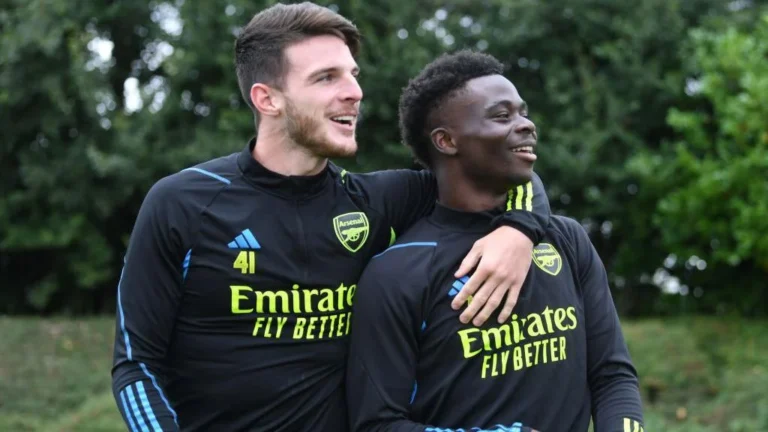
The modern landscape of professional sports has increasingly blurred the lines between the private lives of elite athletes and the unrelenting scrutiny of the digital public sphere. Arsenal and England midfielder Declan Rice, a central figure in contemporary football, has recently offered a candid look into the psychological pressures necessitated by this hyper-connected era. In a revealing interview featured in the latest edition of GQ Magazine, where he was honored as one of the publication’s Men of the Year, the 27-year-old midfielder detailed his deliberate withdrawal from social media platforms, citing the profound mental toll that online vitriol can impose on high-profile figures and their families.
The Catalyst for Withdrawal: A Pattern of Harassment
The decision for Rice to scale back his digital presence was not a sudden impulse but rather a measured response to sustained, targeted harassment. The primary focus of this scrutiny involved his long-term partner, Lauren Fryer. In recent years, Fryer became the subject of intense, often cruel, online commentary regarding her appearance. The toxicity reached a breaking point in 2024, prompting Fryer to deactivate her Instagram account entirely—a move that highlighted the pervasive and often unchecked nature of social media bullying.
For an athlete whose performance on the pitch is already subject to rigorous public analysis, the intersection of personal attacks on family members presents a complex challenge. Rice’s decision to maintain a private domestic life while navigating the demands of elite competition has become a blueprint for how many modern athletes are beginning to manage their public image. While Rice still maintains an Instagram presence, his departure from the platform formerly known as Twitter (X) three years ago serves as a definitive boundary.
A Chronology of Digital Disengagement
The timeline of Rice’s distancing from social media tracks with his ascent to the upper echelons of the Premier League. As his profile grew from a West Ham United prospect to a marquee signing for Arsenal and a cornerstone of the England national team, the volume of noise surrounding his personal life expanded proportionally.
- 2021: Rice makes the strategic decision to delete his X (then Twitter) account, identifying the platform as a significant source of "toxicity" that provided no tangible benefit to his professional or personal well-being.
- 2024: Following a surge in malicious and disparaging comments directed at his partner, Lauren Fryer, the couple faces a public relations crisis driven by anonymous online accounts. Fryer subsequently removes her digital footprint to protect her mental health.
- 2025: In his GQ Men of the Year feature, Rice publicly addresses these events, framing his digital habits as a necessary mental health intervention.
"I’ve not been back on the app since," Rice stated during the interview. "You could be having a great morning. You read one thing, and it just ruins your whole day. I feel like that’s one of my strongest points—the ability to block out noise and not deal with that kind of stuff."
The Psychology of Digital Negativity
The impact of social media on professional athletes is a growing field of study within sports psychology. According to various reports from the Professional Footballers’ Association (PFA), instances of targeted abuse against players have risen by over 40% in the last five years. The mechanisms of this abuse—often facilitated by the anonymity afforded by platforms like X—create an environment where players are constantly exposed to disparagement.
Rice’s assertion that a single negative interaction can "ruin a whole day" aligns with psychological research regarding the "negativity bias," a phenomenon where human beings are more likely to weigh negative information more heavily than positive or neutral stimuli. For an athlete whose success is contingent on focus, emotional regulation, and confidence, the disruption caused by social media is not merely a nuisance; it is a professional hazard.
Broader Implications: The Next Generation
Beyond his own experiences, Rice expressed significant concern regarding the socialization of the next generation. As a father to four-year-old Jude, the midfielder has become acutely aware of how the digital age is reshaping developmental milestones.

"Screen time, for me, isn’t a big thing," Rice noted. "I think social media for kids is 100 per cent a problem. I don’t feel like there’s as much personality now as there was a few years ago."
His observation mirrors wider societal debates regarding the erosion of authentic human connection in favor of curated digital personas. By questioning the ubiquity of social media usage among youth, Rice joins a growing chorus of public figures who are advocating for a more balanced, offline existence. This perspective is particularly resonant coming from an individual whose career success is so heavily tied to the very platforms he critiques.
The Role of Football Clubs in Digital Protection
The burden of managing online abuse is increasingly shifting from the individual player to the institutions they represent. Arsenal, like many top-tier clubs, has implemented sophisticated digital monitoring services to flag and report abusive content directed at their players. However, as Rice’s experience demonstrates, institutional intervention is often reactive. The proactive strategy—disengagement—remains the most effective method for individual preservation.
The PFA and various governing bodies, including the Premier League, have repeatedly called upon tech companies to implement stricter verification processes to reduce the prevalence of anonymous hate speech. Despite these requests, the fundamental architecture of most social media platforms remains structurally predisposed to engagement-driven conflict, meaning that players are often left to police their own environments.
Analysis: The Cost of Connectivity
From an analytical perspective, Rice’s choice to opt out of the digital fray represents a significant shift in the athlete-fan relationship. Traditionally, social media was marketed as a tool for "engagement" and "brand building." However, for many elite athletes, the return on investment—in terms of mental health and personal safety—has plummeted.
The phenomenon of "The Filtered Life" is creating a divide between those who succumb to the pressures of constant digital presence and those who, like Rice, prioritize psychological detachment. For the modern Premier League star, the ability to "block out the noise" is now considered a fundamental tactical skill, as vital to their career longevity as their physical fitness or technical proficiency.
Conclusion: A New Standard for Elite Performance
Declan Rice’s candid reflection serves as a stark reminder that beneath the jerseys and the accolades, professional footballers are subject to the same human vulnerabilities as anyone else. By prioritizing his mental health and the stability of his family over the ephemeral validation of social media, Rice is setting a precedent that may influence how younger players navigate their own rise to stardom.
His trajectory—from a highly active digital participant to a selective user—reflects a maturing understanding of the environment in which modern sports exist. As the discourse surrounding athlete mental health continues to evolve, the industry may find that the most valuable asset an athlete possesses is not their presence on a platform, but their ability to choose where they direct their attention. In an era where digital noise is constant, silence, as demonstrated by Rice, has become a powerful and necessary tool for sustained success.