The fixture, held under the crisp afternoon air of Jos, served as a poignant reminder of the fine margins that define the Nigeria Premier Football League (NPFL). While the scoreline ultimately reflected a comfortable victory for the "Peace Boys," the tactical narrative told a more complex story of missed opportunities and the relentless pursuit of perfection by a coaching staff determined to elevate the club’s status from survivalists to title contenders.
A Tale of Two Halves at the New Jos Stadium
The match began with Plateau United dictating the tempo, pinning Inter Lagos back into their defensive third. The home side displayed superior technical fluidity, yet the final third remained a graveyard for ambition during the opening 45 minutes. Repeatedly, the hosts breached the opposition’s defensive structure, only to falter at the precipice of the goal. Whether through wayward decision-making or a lack of composure in the high-pressure moments, the deadlock persisted, leaving the home crowd in a state of growing apprehension.
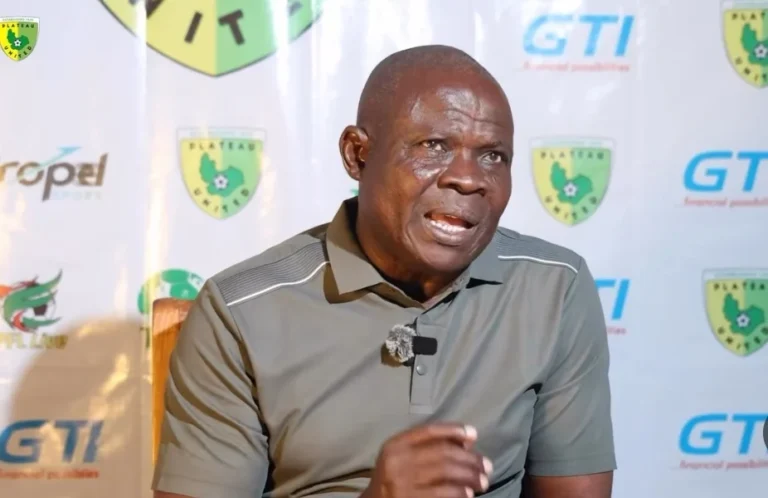
The breakthrough finally arrived in the second half, shifting the momentum in favor of the hosts. Gideon Monday broke the stalemate, injecting a sense of relief into the stadium, before Jibrin Ibrahim doubled the advantage. This second-half surge proved sufficient to seal the three points, but for Technical Adviser Gbenga Ogunbote, the performance was far from complete. In a post-match assessment, Ogunbote was quick to deflect from the euphoria of the win, focusing instead on the systemic wastefulness that characterized the first half.
The Statistical Reality of Finishing
Ogunbote’s post-match comments shed light on a broader technical malaise affecting the domestic league. By his estimation, the anxiety of scoring often leads to rushed execution, a psychological hurdle that many players across the NPFL currently struggle to clear. Statistically, the conversion rate of chances in the NPFL has historically been a point of contention for analysts. Teams that dominate possession but fail to convert high-probability chances often find themselves vulnerable to counter-attacks—a risk that could prove costly as the league progresses toward the mid-season mark.
The manager’s insistence on "working until we get it right" highlights a shift in training methodology. The focus is no longer just on tactical shape or physical conditioning, but on the cognitive processing speed of the attackers in the final 18-yard box. By addressing these inefficiencies, Ogunbote aims to alleviate the mounting pressure on his defense, ensuring that matches are settled early, thereby allowing for greater tactical rotation and fatigue management for his core players.
From Relegation Battles to Title Aspirations
The broader context of Plateau United’s 2024/2025 campaign is rooted in a total cultural transformation. Just one year ago, the club was embroiled in a desperate fight for survival, navigating the treacherous waters of the relegation zone. The contrast between that period and the current state of the squad is stark. Sitting in second place after six matchdays, the team is now exhibiting the consistency of a side that expects to win, rather than one hoping to merely survive.
Ogunbote, who has navigated many of the league’s most demanding clubs, has been instrumental in this turnaround. He explicitly categorized the previous season as a "rescue mission"—a period characterized by reactive football and high-stress management. In contrast, the current season is framed as a strategic project. The goal is no longer to avoid the bottom of the table, but to compete for the championship. This shift in organizational objective has permeated the locker room, fostering a culture of accountability where even a 2-0 victory is analyzed with a critical lens to ensure future success.
Sustaining the Unbeaten Run
Plateau United’s current streak is arguably the most impressive narrative in the early stages of the season. Having gone five matches without a loss—a run comprising three victories and two draws—the club has established itself as a formidable force at the New Jos Stadium. This stability is the bedrock upon which successful title bids are built.
However, the technical adviser remains acutely aware of the pitfalls of momentum. He cautioned his squad and the fan base against complacency, noting that the NPFL is a "marathon," not a sprint. The historical data of the league suggests that early-season form is rarely indicative of the final standings unless paired with depth and the ability to grind out results during the second half of the season when fatigue and injuries inevitably set in.
Ogunbote’s approach to this unbeaten streak is rooted in pragmatism. He refuses to entertain talk of winning the league in October, focusing instead on the "level playing field" required for his players to maintain their current performance levels. His call for continued support from the fans is a tactical move as much as an emotional one; in the NPFL, the home crowd often serves as the 12th man, and maintaining a positive connection with the supporters in Jos is essential for the club’s long-term sustainability.
Tactical Implications and Future Outlook
Looking ahead, the implications of Plateau United’s current trajectory are significant. As the league enters the next phase of the schedule, the "Peace Boys" will likely face more rigid defensive setups from opponents looking to disrupt their flow. If the team can solve its finishing issues, they possess the structural integrity to remain in the top three throughout the winter months.
The integration of young talent, combined with the steady hand of an experienced tactician like Ogunbote, provides a blueprint for other clubs struggling with identity. The focus on "work in progress" suggests that the best of Plateau United is yet to come. Should they improve their clinical edge, they will not only secure more comfortable victories but will also send a psychological message to the rest of the league: they are no longer a team to be taken lightly, but a primary contender for the ultimate prize.
The chronology of their recent success reflects a team that is learning to master its own destiny. From the draw at Doma to the victory over Inter Lagos, the evolution is visible. While Ogunbote remains the primary voice of caution, the facts speak for themselves. With a reinforced defense, a growing sense of confidence, and a manager who refuses to accept "good enough," Plateau United has effectively signaled its intention to be a permanent fixture at the top of the NPFL table.
As the squad prepares for their upcoming fixtures, the training ground will undoubtedly feature extensive drills on shot selection and off-the-ball movement. The challenge for the players will be to internalize the technical instructions provided by their manager and translate them into the high-stakes environment of matchday. For the supporters in Jos, the current season represents a return to the club’s glory days, and for the technical staff, it is an opportunity to cement their legacy by transforming a side that once feared relegation into one that commands the respect of the entire division.
In the final assessment, the 2-0 victory over Inter Lagos is a microcosm of the current state of Nigerian football. It was a match defined by the tension between potential and execution. By acknowledging the flaws in the victory, Gbenga Ogunbote has demonstrated the type of leadership required to turn a promising start into a historic season. The road ahead remains long, and the challenges will only grow in intensity, but for now, the Peace Boys of Plateau United are moving in the right direction.