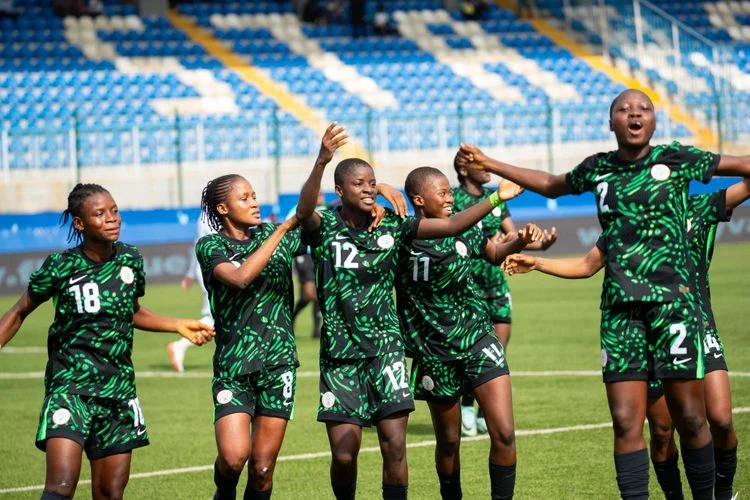
Nigeria’s U-17 women’s national football team, affectionately known as the Flamingos, have etched their names in the annals of African football history by securing a magnificent 3-1 victory over powerhouse Brazil in the semi-finals of the FIFA U-17 Women’s World Cup. Displaying tactical discipline, physical resilience, and clinical finishing, Coach Akeem Busari’s squad dismantled the South American giants at the prestigious Mohammed VI Football Complex in Rabat, Morocco.
This monumental triumph propels Nigeria into the ultimate match of the global tournament, where they will face formidable Asian opponents, Japan, in what promises to be a thrilling championship showdown. The victory not only guarantees the Flamingos their best-ever finish in the history of the competition but also serves as a testament to the rapid developmental strides being made in Nigerian youth women’s football. As the nation celebrates this historic milestone, attention now turns to the grand finale scheduled for November 7, 2026, where the Flamingos hope to cap off their fairytale run by lifting the coveted world trophy on North African soil.
A Tactical Stalemate Gives Way to Second-Half Fireworks
The high-stakes semi-final encounter began with both sides displaying cautious optimism, fully aware of the defensive vulnerabilities that could be exploited at this advanced stage of the tournament. The first forty-five minutes proved to be a tactical chess match, characterized by intense midfield battles, disciplined defensive blocks, and fleeting attacking opportunities for both the Nigerian and Brazilian flanks.
Brazil, renowned for their technical flair and historical pedigree in international football, attempted to dictate the tempo of the game through structured possession and swift transitions. However, the Nigerian defensive unit, marshaled expertly by the backline, stood resolute, closing down spaces and denying the South American forwards any meaningful sights at goal. Goalkeeper and defenders alike communicated effectively to thwart early crosses and long-range efforts, ensuring that the scoreboard remained untouched as the referee blew the whistle for halftime.
The tactical deadlock, however, was shattered in dramatic fashion shortly after the interval. The second half witnessed a complete transformation in the Flamingos’ attacking intensity, as they began to exploit gaps in the Brazilian defense with blistering pace and precise passing combinations.
The breakthrough arrived in the 56th minute when dynamic forward Queen Joseph, wearing the number seven jersey, capitalized on a brilliantly orchestrated attacking move. Receiving a sublime, defense-splitting assist from teammate Oluwakemi Adegbuyi, Joseph showed incredible composure inside the penalty area, slotting the ball past the onrushing Brazilian goalkeeper to break the deadlock and send the Nigerian bench into rapturous celebrations.
Building on Momentum: The Bashiru Masterclass
Rather than sitting back to defend their slender lead, the Nigerian girls maintained relentless pressure, pinning the South Americans deep into their own half. The tactical adjustments made by Coach Akeem Busari during the interval were paying rich dividends, as the Flamingos consistently won second balls and dominated possession in critical areas of the pitch.
In the 71st minute, the pressure culminated in a second goal that firmly put Nigeria in the driver’s seat. Awawu Bashiru, who had been a constant menace to the Brazilian defense throughout the match, found herself in the right place at the right time. Seizing upon a loose ball inside a crowded penalty box, Bashiru unleashed a clinical strike that bypassed the desperate dive of the goalkeeper, doubling Nigeria’s advantage and casting doubt on a Brazilian comeback.
Not content with a two-goal cushion, the Flamingos continued to hunt for more, displaying a ruthless streak that has defined their campaign in Morocco. The defining moment of the match arrived in the 80th minute, courtesy of another brilliant team move. Oluebube Umejiaku, displaying exceptional vision and awareness in the final third, delivered a pinpoint pass to the path of the relentless Bashiru. Showing supreme confidence and technical execution, Bashiru made no mistake from close range, guiding her shot into the back of the net to register her second goal of the match and Nigeria’s third, effectively sealing the victory and extinguishing any hopes of a Brazilian revival.
Despite the comprehensive deficit, the young Brazilian side demonstrated the fighting spirit traditional to their footballing heritage. In the 89th minute, Greise Kelly managed to breach the Nigerian defense, pulling a goal back for her team with a well-taken finish. However, the late strike proved to be nothing more than a consolation, as the referee’s full-time whistle sounded shortly thereafter, confirming a historic 3-1 triumph for the West African representatives.
The Road to the Semi-Finals: A Campaign Built on Resilience
The Flamingos’ journey to the final has been nothing short of extraordinary, marked by narrow margins, tactical adaptability, and immense mental fortitude. To reach the final four, Nigeria had to navigate a grueling quarter-final fixture against a tenacious Venezuela side on Sunday.
That encounter proved to be a definitive test of character. For the majority of the match, both teams cancelled each other out, with defenses holding firm against waves of attacks. Just as extra time loomed large, the turning point arrived in the 89th minute. Oluebube Umejiaku was upended inside the penalty box following a surging run, leaving the referee with no choice but to point to the spot. Up stepped captain Azeezat Oduntan, who displayed nerves of steel to convert the high-pressure penalty, securing a dramatic 1-0 victory and sending Nigeria through to the semi-finals for only the second time in the history of the FIFA U-17 Women’s World Cup.
Prior to this year’s tournament, Nigeria’s best performance at the global youth stage came during the 2022 edition held in India, where the Flamingos defied the odds to reach the semi-finals before ultimately claiming the bronze medal after a thrilling penalty shootout victory over Germany. By surpassing that milestone and reaching the championship match in Morocco, the current generation has officially cemented their legacy as pioneers of Nigerian women’s football.
Brazil, on the other hand, arrived at the semi-final stage after navigating their own share of adversity. The South American side had staged a remarkable comeback in the quarter-finals, overturning a deficit to defeat China 2-1. Prior to that, they survived a titanic battle against Poland in the Round of 16, where an action-packed 3-3 draw at the end of regulation time necessitated a nerve-wracking penalty shootout. Brazil triumphed 8-7 in that marathon spot-kick contest, but their defensive frailties were ultimately exposed by a clinical and energetic Nigerian outfit.
Awaiting the Grand Finale: Nigeria Versus Japan
With the hurdle of Brazil successfully cleared, the Flamingos now turn their full attention to the ultimate prize. Standing between Nigeria and the world title is a formidable Japanese side known for their technical precision, tactical discipline, and relentless work ethic.
Japan booked their ticket to the final in equally dramatic fashion, enduring a tense encounter against North Korea. After a tightly contested 1-1 draw at the end of regular and extra time, the Asian powerhouse held their nerve during the subsequent penalty shootout, prevailing 4-1 to secure their place in the championship match.
The impending final between Nigeria and Japan represents a fascinating clash of styles: the explosive pace, physicality, and direct attacking flair of the West Africans versus the intricate passing, positional discipline, and tactical organization of the Asian champions. Football pundits and analysts anticipate a tactical masterpiece when both sides step onto the pitch at the Mohammed VI Football Complex.
Implications and the Broader Impact on Nigerian Football
The historic qualification of the Flamingos to the final of the FIFA U-17 Women’s World Cup carries profound implications for the development of the sport within Nigeria and the wider African continent. For years, Nigerian female football teams have punched above their weight on the global stage, often hampered by structural and financial constraints yet continually producing world-class talent through sheer passion and raw ability.
This milestone achievement is expected to serve as a massive catalyst for investment in grassroots women’s football infrastructure across the country. Stakeholders within the Nigeria Football Federation and regional sports ministries have continually emphasized the need for sustained development pathways, and a global final appearance provides undeniable leverage to advocate for increased funding, better training facilities, and more competitive domestic leagues for young female athletes.
Furthermore, the individual brilliance displayed by players such as Queen Joseph, Awawu Bashiru, Oluebube Umejiaku, and captain Azeezat Oduntan will undoubtedly attract the attention of international scouts and top-tier European clubs. Such exposure not only changes the individual trajectories of these young athletes but also elevates the global market value and reputation of Nigerian talent.
As the countdown to Saturday, November 7, 2026, begins, millions of football fans across Nigeria and the diaspora are rallying behind the Flamingos. Win or lose in the final, this generation of players has already secured immortal status by demonstrating that with adequate preparation, unwavering determination, and tactical acumen, African youth teams can conquer the summit of world football. All eyes are now set on Morocco, where the Flamingos stand just ninety minutes away from football immortality.