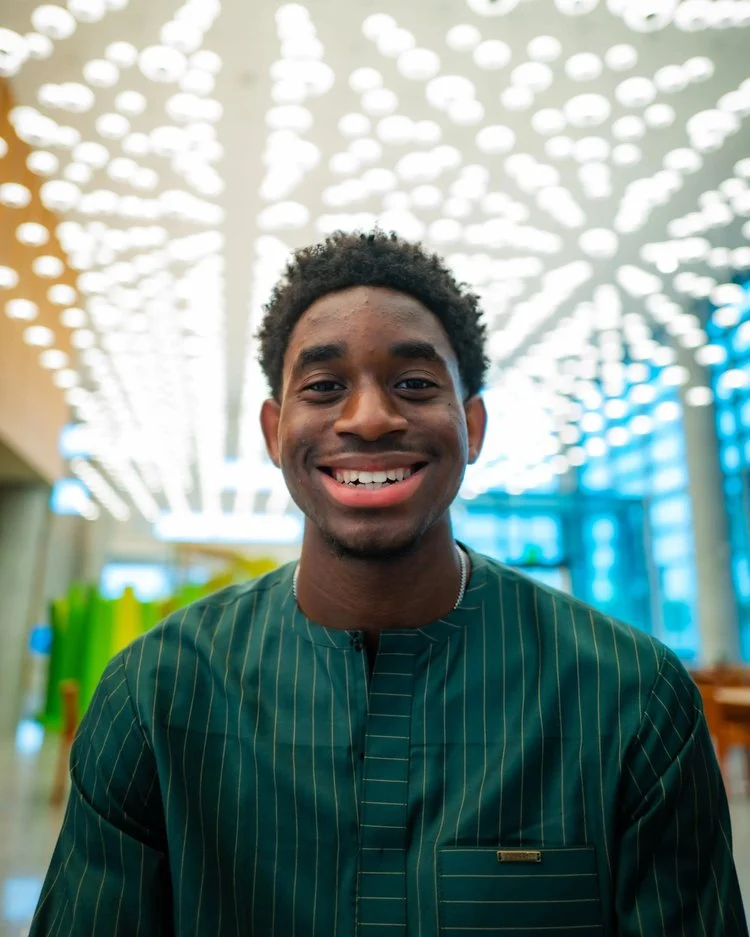
The remarkable trajectory of Daniel Umemezie, from a curious 13-year-old immigrant arriving in the United States from Nigeria to becoming the National Youth Poet Laureate at the age of 18, reads like a contemporary epic. His story is not merely one of individual achievement but a profound narrative illustrating the transformative power of language, the resilience of the immigrant spirit, and the boundless potential of youth when encouraged to explore their multifaceted talents. Bestowed with the nation’s highest honor for a young poet in April, Umemezie now stands as a beacon for aspiring writers and a compelling voice in the ongoing dialogue about identity, community, and the future.
A Swift Ascent to National Recognition
Daniel Umemezie’s journey to the National Youth Poet Laureate title, an accolade co-presented by Urban Word NYC, the Library of Congress, and the National Endowment for the Arts, was extraordinarily rapid. Within just five years of his arrival on American soil, he earned a distinction that places him in a lineage of influential young poets, most notably Amanda Gorman, who served as the inaugural National Youth Poet Laureate in 2017 before captivating the world with "The Hill We Climb" at President Joe Biden’s 2021 inauguration. This rapid ascent underscores not only Umemezie’s innate talent but also the fertile ground for artistic expression and recognition that exists within the American cultural landscape for diverse voices.
The National Youth Poet Laureate program itself, established to identify and celebrate young literary talent, seeks to empower youth voices that address critical societal issues through the art of poetry. Winners are selected based on their literary merit, leadership skills, and commitment to civic engagement. Umemezie’s selection highlights his powerful command of language and his dedication to using his platform for broader social impact. The title comes with significant responsibilities, including extensive travel across the United States for poetry readings, workshops, and public engagements, making him an ambassador for youth literacy and artistic expression.
"I’m still relatively shell-shocked," Umemezie admitted during an interview with Fred de Sam Lazaro of the PBS NewsHour, reflecting on the magnitude of the honor. "It’s all bundled into this emotion of excitement and honour." Beyond the personal triumph, Umemezie views his platform as an opportunity to champion a cause deeply important to him: the validation of youth voices. "I want to see a change in society where youth are taken seriously," he affirmed, advocating for young people to be granted the space to articulate their perspectives on complex issues ranging from politics and religion to sexuality and war. For Umemezie, poetry is the quintessential medium for this freedom of expression, a space "to be free from whatever you might think holds you back."
The Genesis of a Polymath: Early Life in Nigeria
Daniel Umemezie’s story did not begin on an American stage, but in Nigeria, where his insatiable appetite for knowledge and creativity first took root. Long before the accolades and public attention, he was a boy captivated by the world around him. While many children might have gravitated towards outdoor play, young Daniel often found solace and stimulation within the modest library of his preacher father. It was here that a seemingly ordinary object, a dictionary, became an early muse. Not for its definitions alone, but for its pictures, which ignited his imagination and fostered a deep love for words and their myriad forms. "I would read the dictionary because our dictionary had pictures in it," he recalled. "I loved to read. I loved to find out all the different words, all the different ways you could say a certain thing."
This early fascination with language was merely one facet of his burgeoning creativity. His curiosity refused to be confined to books. Music became another profound avenue of exploration; he mastered the piano and drums before eventually becoming proficient in nine musical instruments. His artistic pursuits expanded further to include painting, drawing, crocheting, knitting, and even architecture. Each creative discipline was, for Daniel, another lens through which to comprehend and interpret the world. His mother, an astute observer of his unique intellectual drive, often remarked on his relentless pursuit of understanding. "He has always been that kind of child that is hungry for knowledge," she shared. "Sometimes you just feel like his mind works around the clock." This perpetual state of inquiry, a defining characteristic, laid the groundwork for his future achievements.
A Journey of Identity and Reinvention: The Immigrant Experience
The pivotal moment that reshaped Daniel’s destiny occurred when he was 13. His mother secured a nursing position in the United States, prompting the family to embark on a journey across continents. This migration, from familiar streets and communal rhythms of Nigeria to an entirely new environment, was not merely a geographical shift; it was a profound journey of identity, memory, and reinvention. It marked the transformation of a curious Nigerian boy into one of America’s most compelling young poetic voices.
Their initial destination was Texas, followed by a settlement in Cedar Falls, Iowa. Like countless immigrants before him, Daniel quickly encountered the phenomenon of culture shock. The subtle yet significant differences between his homeland and his new country were initially disorienting. He noted seemingly mundane disparities that carried surprising emotional weight, such as the formality of apologies or the shift from pens to pencils in academic settings. "It is a bit of a shock when you grew up with a group of people, a group of friends, and you have to move," he reflected. "You leave all of that behind to start a new life and meet new people."
For many young immigrants, these experiences can lead to uncertainty and a fragmented sense of self. However, Daniel found an unexpected anchor in poetry. Writing became a crucial bridge, connecting the country he had left behind with the country that was slowly becoming home. This embrace of a dual identity ultimately inspired one of his most celebrated poems, a poignant exploration of his bicultural existence: "I come from two Nigerias and they do not wrestle in my ribs," he writes. "They take turns breathing, one lung each." This powerful metaphor captures the harmonious coexistence of his two worlds.
His poetry delves into the complexities of these "two Nigerias": one overflowing with vibrant language, laughter, and communal warmth, the other grappling with the harsh realities of unreliable electricity, dilapidated infrastructure, and governmental failures. He paints vivid pictures of generators whose "coughing engines" punctuate neighborhoods and "potholes receiving prayers instead of repairs." Yet, his work consistently eschews bitterness, concluding with a memorable metaphor: "Home, for Daniel, is no longer simply a country. It is breath itself." This perspective insists that both Nigeria and America can coexist and thrive within one human heart, an affirmation that resonates deeply within the contemporary discourse on immigrant identity.

The Accidental Poet and the Power of Memory
Daniel’s breakthrough into the world of poetry came almost by chance. During his sophomore year in high school, an English teacher recognized his latent talent and encouraged him to enter a local poetry competition. This single victory proved to be a catalyst, opening a cascade of opportunities. He soon earned the title of Cedar Valley Youth Poet Laureate, followed by Iowa Student Poet Ambassador, before ultimately reaching the national stage. This serendipitous beginning highlights the critical role of mentorship and encouragement in nurturing young talent.
When asked about the wellspring of his creative inspiration, Daniel consistently returns to the concept of memory. "A lot of my writing is based on memory," he explained, encompassing "memory of place, memory of people, memory of things, memory of objects, memories that I do not even have." His understanding of memory transcends individual recollection; he views it as a shared, collective experience. "It is not a one-way street," he asserted. "You make a memory with someone, and the person makes a memory with you." This profound perspective imbues his poems with unusual emotional depth, transforming autobiographical experiences into universal reflections.
For Daniel, poetry is as much about discipline as it is about inspiration. He maintains a rigorous writing practice, his phone buzzing with unexpected lines that strike him, often in the dead of night, and his notebooks overflowing with works in progress. He strives to write at least one poem daily, a testament to his dedication to the craft. His work frequently explores the interplay between silence and speech, challenging conventional notions by asking, "What if silence is not absence, but an actor and his drama?" This intellectual curiosity, evident since his dictionary-reading days, continues to define his approach to art.
Bridging Worlds: Poetry, Engineering, and Future Visions
Remarkably, Daniel Umemezie’s ambitions extend far beyond the realm of literature. While his poetic voice has garnered national acclaim, science captivates him with equal intensity. Upon graduating from high school in May, he made a conscious decision not to pursue creative writing in university. Instead, he enrolled in aerospace engineering at Iowa State University, demonstrating a commitment to a path that many might consider diametrically opposed to poetry.
Yet, for Daniel, these seemingly disparate fields are deeply interconnected. He and three friends have already co-founded a company dedicated to developing drone technology, specifically designed to assist in disaster relief operations. This entrepreneurial spirit, coupled with his scientific pursuit, illustrates a holistic approach to problem-solving and innovation. While one dream propels him towards the skies, the other delves into the intricacies of the human heart, but Daniel envisions a future where both can converge. He harbors the aspiration of earning a master’s degree from the prestigious Iowa Writers’ Workshop—a program renowned for producing Pulitzer Prize winners and U.S. Poet Laureates—while simultaneously advancing his work in engineering.
To many observers, the worlds of poetry and aerospace engineering appear to be polar opposites. However, Daniel perceives no contradiction. He posits that both disciplines demand imagination, critical thinking, and a commitment to solving complex problems. This integrated worldview perhaps explains how the Nigerian boy who once read a dictionary for its pictures has evolved into one of America’s brightest young literary voices, poised to make significant contributions across multiple fields.
Implications and Broader Impact
Daniel Umemezie’s story carries profound implications for several spheres. For the literary world, his unique voice, steeped in a dual cultural heritage, enriches American poetry by offering fresh perspectives on identity, migration, and belonging. His ability to articulate the complexities of his Nigerian and American experiences without demanding a choice between them offers a powerful model for understanding biculturalism in an increasingly globalized world.
For immigrant communities, particularly youth, Umemezie serves as an inspiring role model. His journey demonstrates that the challenges of adaptation can be channeled into creative expression and that one’s heritage can be a source of strength, not division. His advocacy for youth voices also resonates widely, particularly at a time when younger generations are increasingly engaged in social and political activism, seeking platforms to express their concerns and propose solutions.
Furthermore, Umemezie’s decision to pursue aerospace engineering alongside his literary endeavors challenges conventional notions of specialization. His path highlights the growing recognition of the value of interdisciplinary thinking and the potential for synergy between the arts and sciences. In an era demanding innovation across all sectors, individuals who can bridge creative and analytical modes of thought are invaluable. His trajectory suggests that the most impactful solutions often emerge from minds that embrace diverse forms of knowledge and expression.
Daniel Umemezie embodies the quiet power of curiosity, the enduring legacy of parents who fostered learning, and the profound journey of migration that deepens, rather than diminishes, one’s connection to home. He carries Nigeria wherever he goes—not as baggage, but as an integral part of his being, as vital as breath itself. Five years after arriving in America as a teenager with an uncertain future, he has become the nation’s foremost youth poet, a living testament to the idea that talent knows no borders and that words, when spoken with honesty and depth, can travel farther and resonate more profoundly than any passport. Indeed, Daniel Umemezie has already traveled as far as his poetry, and his ambition, can take him, with an even more expansive journey ahead.