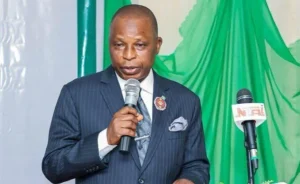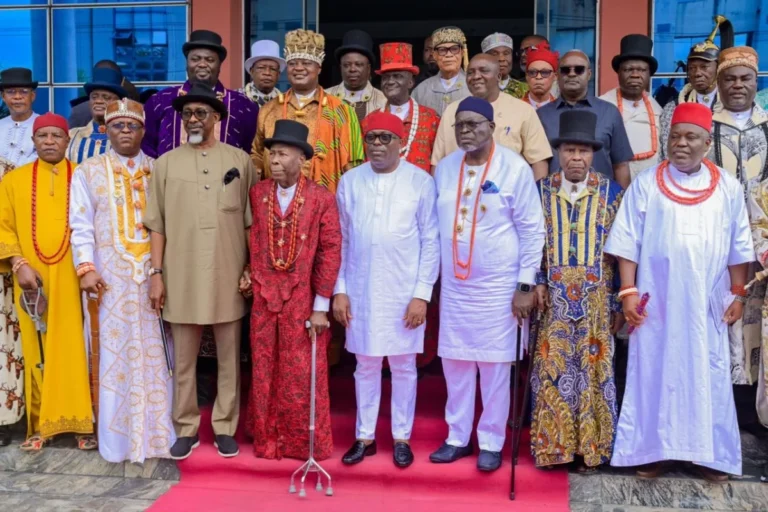
As Nigeria moves closer to the 2027 general elections, the political atmosphere in Rivers State has become increasingly charged, prompting Governor Siminalayi Fubara to issue a stern call for neutrality and decorum among the state’s traditional leadership. Addressing the 126th, 127th, and 128th combined quarterly meeting of the Rivers State Council of Traditional Rulers in Port Harcourt on Wednesday, the Governor underscored the critical role of the monarchy in maintaining the fragile peace of the oil-rich state.
The gathering, which brought together the most influential royal fathers from across the state’s 23 local government areas, served as a platform for the state government to delineate the expectations for the upcoming electoral cycle. Governor Fubara’s address was marked by a clear emphasis on the duty of traditional rulers to transcend partisan affiliations, prioritizing the collective stability of Rivers State over individual political interests.
The Context of the Political Season
The call for neutrality is particularly significant given the history of political volatility in Rivers State. As a key economic hub in Nigeria, the state often experiences heightened tension during election cycles, characterized by intense competition between major political parties and factions. The traditional institution, which wields considerable influence at the grassroots level, is often viewed by political actors as a strategic partner to gain legitimacy or mobilize voters.
Governor Fubara, aware of these dynamics, urged the monarchs to act as arbiters of justice rather than conduits for political division. He noted that as the nation enters an active political season, the risk of communal crisis increases, and it is the responsibility of the royal fathers to act as buffers, ensuring that the democratic process does not lead to the breakdown of law and order in their respective domains.
The Burden of Leadership and Oath of Office
During his address, the Governor reminded the council members of the solemn oaths they swore upon their ascension to their respective stools. He argued that the constitutional framework governing the traditional institution was designed to insulate monarchs from the vagaries of partisan politics, allowing them to remain fathers to all citizens regardless of political persuasion.
"Your actions should not be what would lead to the division and multiple crises that we cannot manage as a government," Fubara remarked. He emphasized that the survival of the state’s development agenda depends heavily on the maintenance of peace at the community level. The Governor framed his own governance style as a model, asserting that he has consistently placed the interest of the state above his personal or political considerations—a principle he challenged the traditional rulers to emulate.
Addressing the Welfare Conundrum
Beyond the political discourse, the meeting provided an opportunity to address long-standing grievances regarding the welfare of traditional rulers. In recent years, members of the council have frequently requested improved financial packages and better administrative support from the state government.
Governor Fubara addressed these concerns with a level of transparency that appeared designed to clear the air. He clarified that the delays in meeting certain welfare demands were not a result of government negligence, but rather the consequence of the Council’s internal administrative challenges, which had previously hindered the implementation of promised reforms.
Furthermore, the Governor touched upon the issue of stipends paid to traditional rulers through Local Government Councils. He explained that these payments are statutory benefits enshrined in the Nigerian constitution. Consequently, they are not subject to the unilateral discretion of a state governor. By clarifying this, Fubara sought to manage expectations while reaffirming his commitment to his previous promises. He concluded this segment of his address by reiterating his reputation as a "man of his word," assuring the monarchs that all outstanding commitments would be honored before the end of his current tenure next year.
The Role of Traditional Rulers in Conflict Resolution
The Chairman of the Rivers State Council of Traditional Rulers and Paramount Ruler of Apara Kingdom, HRM Chike Amadi Worlu Wodo, provided a response that acknowledged the government’s efforts to sustain a harmonious relationship with the traditional institution.
Eze Wodo’s remarks highlighted the practical utility of the traditional office. He noted that in a state as diverse as Rivers, the traditional ruler is the first point of contact for dispute resolution. Whether dealing with complex chieftaincy tussles, persistent land ownership disputes, or domestic family conflicts, the monarchs operate in a strategic position that the formal judiciary often cannot reach. By mediating these issues at the local level, traditional rulers act as a primary defense against the escalation of violence that could otherwise require state intervention.
Historical Perspective: The Evolution of the Council
The Rivers State Council of Traditional Rulers has historically been a stabilizing force. Since its inception, the body has undergone various reforms to adapt to the changing political landscape. The current administration’s focus on the "combined" nature of this quarterly meeting suggests a need for efficiency in addressing a backlog of issues, reflecting both the urgency of the political climate and the necessity of improved administrative coordination.
Historically, the relationship between the Rivers State government and the traditional institution has been cyclical—fluctuating between periods of close cooperation and moments of friction when political interests diverge. Governor Fubara’s recent outreach signifies an attempt to solidify this relationship, ensuring that the traditional leadership remains aligned with the state’s developmental objectives.
Implications for the 2027 Election Cycle
The implications of the Governor’s speech are far-reaching. By publicly calling for neutrality, Fubara is attempting to set a "rules of engagement" document for the next two years. If the traditional rulers adhere to this directive, it could significantly lower the temperature in rural communities, where the influence of a monarch can determine the outcome of grassroots political mobilization.
However, the challenge remains the deep-seated political divisions that permeate every layer of society in the state. Analysts observe that while the Governor’s call is timely, the pressure on traditional rulers from political godfathers and local interest groups will be immense. The ability of the monarchs to resist this pressure will be the true test of their commitment to the "neutrality" requested by the state house.
Economic and Social Stability
The stability of Rivers State is inextricably linked to the functionality of its traditional institutions. As the state government continues its focus on infrastructure and economic growth, the role of traditional rulers in securing these investments—by preventing communal unrest—cannot be overstated.
The Governor’s emphasis on the "body and soul" approach to governance suggests that the administration is looking to create a unified front. By bringing the traditional rulers into the fold, the government hopes to create a climate of stability that encourages both local and foreign investment. Should the traditional rulers fail to maintain the peace, the state risks losing the momentum gained in its recent development initiatives.
Looking Ahead
As the meeting concluded, the tone was one of cautious optimism. The Governor’s pledge to fulfill his promises before leaving office provides a timeline for the Council to resolve its internal affairs and work more closely with the state government.
For the people of Rivers State, the cooperation between the government and the traditional council is a barometer for the state’s future. If the two institutions can maintain a relationship based on mutual respect and a shared commitment to peace, the upcoming 2027 elections may prove to be less disruptive than previous cycles.
Ultimately, the onus rests on the royal fathers to navigate the treacherous waters of Nigerian politics with the wisdom their titles suggest. As the political season intensifies, the state will be watching to see if the message delivered at this quarterly meeting translates into tangible peace on the ground, or if the siren call of partisan politics proves too strong for the traditional institution to ignore. The next few months will likely see further engagements between the government and community leaders, as the state prepares for a defining period in its political history.