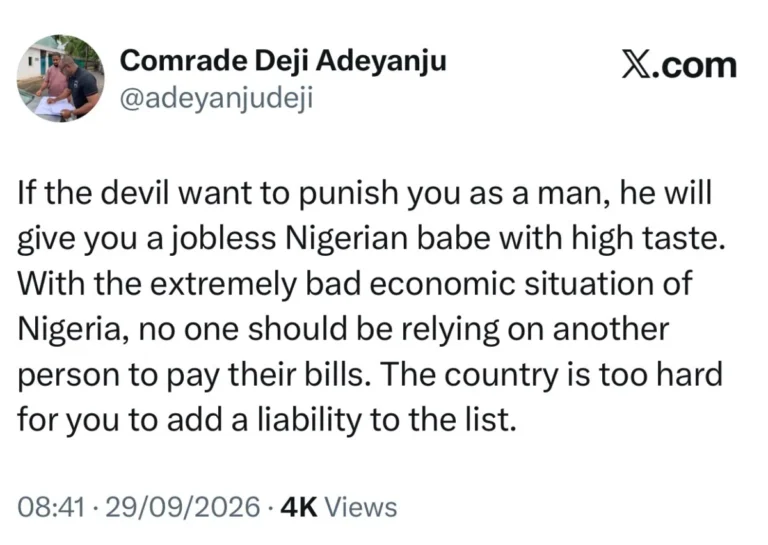
The social media landscape in Nigeria was ignited on September 29, 2026, following a candid and controversial statement by prominent activist and legal practitioner Deji Adeyanju regarding the intersection of economic hardship and modern romantic relationships. Adeyanju, known for his vocal commentary on socio-political issues, took to the platform X (formerly Twitter) to assert that entering into a relationship with an unemployed partner who maintains expensive lifestyle expectations constitutes a significant personal liability.
The activist’s remarks, which quickly garnered widespread attention, framed the current economic climate in Nigeria as the primary driver for his stance. Adeyanju argued that the prevailing inflation and the rising cost of living have made individual financial self-sufficiency a necessity rather than an option. According to his post, the combination of a stagnant job market and high-maintenance expectations creates a volatile dynamic that can derail a man’s economic stability.
The Economic Context of the Commentary
To understand the resonance of Adeyanju’s statement, one must consider the macroeconomic environment in Nigeria as of late 2026. The country has been navigating a period of fiscal adjustment, characterized by volatile currency fluctuations, double-digit inflation, and a high unemployment rate. These factors have placed immense pressure on household budgets, forcing a shift in how Nigerians perceive financial interdependence.
Data from the National Bureau of Statistics (NBS) and various economic think tanks over the preceding quarters have highlighted a widening gap between wage growth and the cost of basic commodities. As the purchasing power of the Naira remains under pressure, the traditional "provider" model in relationships—often associated with cultural norms in Nigeria—has come under intense scrutiny. Adeyanju’s commentary reflects a growing segment of the population that believes the "traditional" expectation of a sole male breadwinner is increasingly incompatible with the current realities of the Nigerian economy.
Chronology of the Discourse
The discourse initiated by Adeyanju did not emerge in a vacuum. It follows a year-long trend of social media debates concerning the "soft life" culture, the rise of the gig economy, and the changing expectations of Gen Z and Millennial Nigerians.
- Q1 2026: Online debates began to intensify regarding the sustainability of lavish lifestyles amid persistent inflationary trends.
- Mid-2026: Increased visibility of "financial autonomy" campaigns on social media platforms, emphasizing the importance of dual-income households.
- September 29, 2026: Deji Adeyanju publishes his commentary on X, triggering a viral wave of discourse.
- Post-September 29, 2026: The topic trends across multiple platforms, with influencers, relationship counselors, and economic analysts weighing in on the sociological implications of his statement.
Sociological Analysis of Financial Dependencies
Sociologists observing the Nigerian digital space suggest that Adeyanju’s comments highlight a clash between traditional gender roles and the demands of a modern, struggling economy. Historically, Nigerian culture has placed a premium on men providing for their partners, regardless of the woman’s employment status. However, as the cost of living continues to climb, this expectation is being reframed as a "liability" by those who argue that fiscal responsibility must be the foundation of any long-term partnership.
The term "high taste" mentioned in Adeyanju’s post serves as a proxy for the influence of social media—specifically platforms like Instagram and TikTok—which often curate a narrative of luxury and material acquisition. When an individual is unemployed but remains tethered to these digital benchmarks of success, the financial burden on their partner becomes unsustainable. The ensuing tension often leads to relationship breakdowns, a phenomenon that Adeyanju frames as a "punishment."

Reactions and Counter-Arguments
The reaction to Adeyanju’s post has been polarized. Supporters of his perspective argue that he is merely stating a "hard truth" that many are afraid to voice. They contend that in a country where even middle-class families struggle to meet basic needs, romantic partners should be viewed as teammates working toward a common financial goal, rather than dependents.
Conversely, critics of the statement argue that the framing is reductionist and potentially misogynistic. They suggest that the focus on "jobless babes" ignores structural systemic failures in the Nigerian labor market, where highly qualified individuals remain unemployed due to a lack of vacancies and poor investment in human capital. These critics posit that blaming individuals for their lack of employment ignores the reality of a stunted economy where job creation has not kept pace with population growth.
Furthermore, some relationship experts have pointed out that financial disparity does not automatically equate to a toxic relationship. They argue that transparency and shared values are more critical than the current employment status of either partner. In their view, the issue is not necessarily the "high taste" of the partner, but the lack of communication regarding financial boundaries and long-term economic planning.
The Broader Implications for Nigerian Society
The debate sparked by Adeyanju is indicative of a broader transformation in Nigerian social contracts. As the country moves toward a more digitized and globalized economy, the traditional structures that once governed marriage and dating are being tested.
- Financial Literacy as a Prerequisite: There is a growing call for financial literacy to be integrated into social expectations. The discourse suggests that young Nigerians are increasingly prioritizing financial compatibility over traditional courtship rituals.
- Economic Resilience: The focus on "not adding a liability" highlights an emerging culture of self-preservation. Individuals are becoming more cautious about whom they align with, fearing that the economic instability of a partner could jeopardize their own long-term savings and investments.
- The Impact of Social Media: The "high taste" mentioned in the article is a byproduct of the attention economy. Influencer culture and the digital exhibition of wealth create pressure points that do not necessarily align with the economic realities of the average citizen.
Fact-Based Economic Outlook
While Adeyanju’s post was framed as personal advice, it serves as a macro-level warning regarding the state of the Nigerian economy. For a household to remain afloat, experts suggest that a dual-income stream is no longer a luxury but a fundamental necessity for survival. When one party in a relationship is entirely reliant on the other, the household is inherently fragile.
With Nigeria’s GDP growth rate hovering within a modest range and the manufacturing and service sectors facing input cost hurdles, the labor market remains highly competitive. The "jobless" status of many young Nigerians is often a result of systemic underemployment rather than personal choice. Therefore, the "punishment" described by Adeyanju could be viewed as a symptom of a larger, systemic economic malaise that impacts every facet of social life.
Conclusion
The viral post by Deji Adeyanju serves as a snapshot of the contemporary Nigerian psyche—a society grappling with the friction between aspirational living and the stark reality of economic austerity. Whether one views his comments as a necessary dose of reality or a harsh critique of vulnerable individuals, the conversation underscores a pivotal shift in how Nigerians perceive relationships.
As the country navigates the challenges of the late 2020s, the discourse surrounding personal finance and romantic partnerships is likely to remain a focal point. The emphasis on individual agency, fiscal responsibility, and the rejection of unsustainable dependencies reflects a generation attempting to secure its future in an era of unprecedented economic uncertainty. While the debate continues, the underlying consensus remains clear: in a challenging economic landscape, financial prudence and mutual contribution are increasingly viewed as the cornerstones of stability.