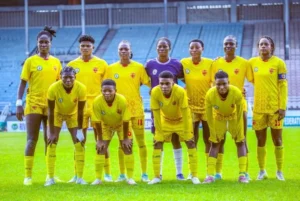
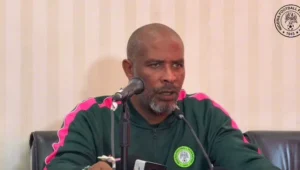
The Nigeria Premier Football League (NPFL) matchday six encounter between Ranchers Bees and Rivers United at the Sani Abacha Stadium in Kano ended in a frustrating 0-0 stalemate, a result that has ignited a fresh debate regarding the quality of officiating in the domestic top flight. Following the final whistle on Monday, Ranchers Bees Technical Adviser Usman Abd’Allah did not mince words, characterizing the match as a missed opportunity hampered by questionable officiating decisions that he believes deprived his side of a deserved victory.
The contest, which was played in a high-stakes atmosphere, saw Ranchers Bees dominate key phases of the game. However, the inability of the officiating crew to penalize what the home side described as two clear infringements inside the Rivers United penalty area became the primary talking point. For Abd’Allah, the result represented a significant setback in his team’s early-season campaign, highlighting a recurring grievance that has plagued various clubs throughout the current NPFL calendar.
A Controversial Afternoon in Kano
The match began with both teams displaying tactical discipline, but as the intensity rose, so did the friction between the players and the match officials. Ranchers Bees, seeking to consolidate their position in the league standings, pushed forward with intent. In two specific instances during the second half, the technical bench of Ranchers Bees erupted in protest, claiming that Rivers United defenders had committed fouls that warranted spot-kicks.
The referee’s refusal to point to the spot left the home side feeling aggrieved. During his post-match press conference, Abd’Allah expressed a mix of professional restraint and deep-seated frustration. "I think we lost two points. We only have one, which is better than having none. Everyone can see what happened in the game. I have to commend the players despite everything," he stated, acknowledging his team’s effort while simultaneously highlighting the perceived injustice.
Abd’Allah’s remarks underscored a broader cynicism regarding the state of officiating in Nigeria. "This is where the Nigerian league is at the moment. Sometimes, it is beyond football. You can see two penalties that were not awarded to us. If you look at the game, the referee was totally biased. Again, I don’t want to dwell too much on that because the harm has already been done. The points cannot be recovered," he added.
The Broader Context: Stadium Displacement and Competitive Integrity
A significant factor compounding the frustration within the Ranchers Bees camp is their current status as a displaced side. Due to ongoing issues regarding their home ground in Kaduna, the club has been forced to play their "home" fixtures at the Sani Abacha Stadium in Kano. For any professional football club, the loss of a true home advantage—characterized by familiar turf, local crowd support, and the psychological comfort of one’s own base—is a massive competitive disadvantage.
Abd’Allah highlighted this displacement as a major hurdle, noting that the team has felt like perennial travelers throughout the first six matchdays of the season. "Probably when we go back to our home in Kaduna, it will help us because we are like playing away. We have played six matches already this season, and it feels like the same thing," he explained.
The psychological impact of playing in a neutral venue, coupled with officiating that the club deems unfavorable, creates a hostile environment for the players. Abd’Allah expressed concern that if visiting teams can benefit from such officiating, the fundamental purpose of league competition—to reward the best performance on the pitch—is undermined.
Analyzing the NPFL Officiating Landscape
The grievances aired by Usman Abd’Allah are not isolated incidents but rather part of a larger, systemic conversation within the NPFL. Throughout the 2023/2024 and ongoing 2024/2025 seasons, the Referees Appointment Committee and the NPFL board have faced persistent calls for reform. Critics often point to a lack of accountability, where referees accused of bias or gross incompetence rarely face public disciplinary measures that satisfy the aggrieved parties.
Abd’Allah addressed this cycle of frustration directly: "Even if you punish the referee, our club has already been punished by him. We can’t get the full points." This sentiment reflects the helplessness felt by coaches who invest weeks of tactical preparation into a match, only to see the outcome decided by officiating errors that remain uncorrected.
However, the Ranchers Bees manager was careful to frame his frustration within the bounds of professional conduct. He explicitly stated that he did not intend to incite violence or suggest that his players should abandon their pursuit of success. Instead, he emphasized resilience. "We will go back and not give up. This type of intimidation will not make us give up. We are still pushing, and we will see what we can do. We will go to Kwara and try to recover the lost points here," he asserted, signaling his intention to shift focus to their upcoming away fixture.
Statistical Reality and Tactical Outlook
Mathematically, the 0-0 draw leaves Ranchers Bees in a precarious position as they look to climb the table. In the highly competitive NPFL, where points at home are considered essential for survival and top-half finishes, dropping points at a neutral venue like Kano is a blow that necessitates an immediate response.
Historically, the transition from the mid-table to the top tier of the NPFL is defined by consistency. Ranchers Bees’ performance against a formidable side like Rivers United suggests that the squad possesses the technical quality to compete with the league’s elite. The team’s ability to generate two clear-cut penalty situations indicates that their offensive movement and positioning are sound. The challenge now lies in the psychological management of the squad by the coaching staff. If the players feel that the "system" is stacked against them, it can lead to frustration-based cards, loss of concentration, and a breakdown in team discipline.
Looking Ahead: The Path to Rectification
As the NPFL moves into the seventh matchday, the pressure on the officiating crew to maintain neutrality and accuracy will only intensify. The league body, in conjunction with the Nigeria Football Federation (NFF), has frequently promised to implement VAR (Video Assistant Referee) or improved officiating standards, though these remain long-term goals due to infrastructure and financial constraints.
For Usman Abd’Allah, the immediate focus is the upcoming clash against Kwara United. The ability to recover points on the road is a hallmark of a serious title contender or a resilient mid-table team. By publicly addressing the officiating concerns, Abd’Allah has effectively put the league authorities on notice, ensuring that the performance of the officials in his team’s upcoming games will be under heightened scrutiny from fans and media alike.
The situation also highlights the importance of the club’s return to Kaduna. Once the stadium infrastructure in Kaduna meets the requirements for NPFL certification, the "home" advantage will likely provide the emotional and logistical boost the team needs to turn draws into wins. Until then, Ranchers Bees must navigate the challenges of being "nomads" in their own league, while hoping that the standard of officiating improves to a level that ensures the integrity of the game is upheld, regardless of the venue.
Conclusion
The comments from Ranchers Bees’ Technical Adviser reflect a broader, enduring tension in Nigerian football. While the game itself ended in a scoreless draw, the repercussions of the officiating performance will be felt in the coming weeks. The club now faces a critical junction: they must either channel their frustration into a more clinical performance on the pitch or risk falling further behind in the league standings.
For the NPFL, the incident serves as a reminder that transparency, accountability, and the standard of officiating are the pillars upon which the credibility of the league rests. As Ranchers Bees look toward their next challenge in Kwara, the hope among supporters and stakeholders alike is that the focus will return to the quality of the football played on the grass, rather than the decisions made by those tasked with overseeing it. The road ahead for the Bees is arduous, but with a clear tactical vision and a resilient squad, the hope for a successful season remains firmly intact.