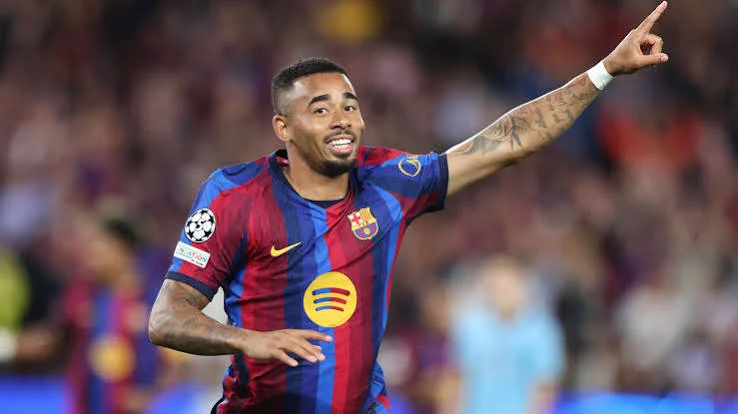
The internal competition within the FC Barcelona attacking unit has reached a new level of intensity as the club navigates a demanding domestic and European schedule. Gabriel Jesus, who has recently integrated into the tactical setup under Hansi Flick, finds himself in a challenging position as he looks to displace the high-flying Raphinha. The Brazilian winger has been arguably the standout performer for the Catalan giants in the opening phase of the 2024/2025 season, establishing a standard of productivity that currently anchors the team’s offensive output.
The Rise of Raphinha: A Statistical Phenomenon
Raphinha’s start to the current campaign has been nothing short of transformative. In his first six competitive appearances, he has directly contributed to 11 goals, recording eight goals and three assists. This blistering pace has not only solidified his position in Flick’s starting XI but has also made him a focal point of Barcelona’s attacking transitions. His ability to operate across the front line, combined with a newfound clinical edge in front of goal, has earned him widespread acclaim from pundits and supporters alike.
For a player of Gabriel Jesus’s caliber, observing such a streak from the bench requires a high level of professional maturity. The former Manchester City striker, who arrived at the Camp Nou following a notable stint in the Premier League, acknowledges the sheer merit behind Raphinha’s current status. In a recent interview with the Catalan outlet Tot Costa, Jesus was candid about the reality of his situation, emphasizing that he harbors no resentment toward his teammate’s success, but rather views it as a benchmark for his own return to form.
Gabriel Jesus’s Strategic Patience
The narrative surrounding Gabriel Jesus has shifted from a search for consistent playing time to a calculated pursuit of impact. During his time at Arsenal, Jesus recorded 32 goals and 18 assists across 123 appearances. While those numbers reflect his ability to contribute to build-up play and pressing systems, his tenure in North London was often punctuated by injury setbacks and fluctuating roles. Now, within the structure of Hansi Flick’s system at Barcelona, Jesus is recalibrating his objective.
"Rapha is scoring goals. He plays every game, he deserves it," Jesus stated during the Tot Costa broadcast. His words suggest an understanding of the meritocratic nature of Flick’s management style. The German manager, known for his rigorous fitness requirements and high-pressing tactical philosophy, demands total commitment from his squad. For Jesus, the path back to the starting lineup is not paved by complaining about limited minutes, but by maximizing the efficiency of his appearances.
"I’m going to try to compete and wait for my opportunity to play more and get more minutes," Jesus added. "I want to score goals and help, and I don’t want to do it when it’s 2 or 3 or 4-0; I want to score important goals." This specific remark highlights his desire to be a "difference-maker" in high-leverage situations—the type of goals that secure points in tight matches or break stalemates in high-stakes fixtures.
Chronology and Context: The Evolution of the Barcelona Attack
The tactical landscape at Barcelona has undergone significant shifts since the departure of Xavi Hernandez and the arrival of Hansi Flick. Flick’s arrival marked a transition toward a more direct, vertical style of football that relies heavily on the versatility of the forward line.
- 2022: Gabriel Jesus makes a high-profile move from Manchester City to Arsenal, aiming to lead a young, ambitious squad.
- 2023-2024: Injuries hinder Jesus’s consistency in London, leading to increased competition within the Arsenal squad as Kai Havertz and other attacking options emerge.
- Summer 2024: Following a tactical realignment, Barcelona moves to bring in experienced depth to bolster their attacking options, leading to the recruitment of Jesus.
- August 2024: The season commences, and Raphinha immediately seizes the initiative, outperforming internal expectations to become the team’s primary creative engine.
- September 2024: Gabriel Jesus begins to integrate into the matchday squad, navigating the transition to La Liga football while adjusting to Flick’s intense training regime.
The current situation is emblematic of the "squad depth" challenge facing top-tier European clubs. While having two high-quality Brazilian forwards in the same team is a luxury, it creates an inevitable selection dilemma for the manager. Hansi Flick’s history at Bayern Munich and the German national team suggests he prefers a fluid frontline, but he is also unlikely to disrupt a chemistry that is currently yielding such high goal-scoring returns.
Analytical Perspective: Implications for the Season
From a tactical standpoint, the competition between Jesus and Raphinha could be mutually beneficial for Barcelona. The need to keep his starting spot motivates Raphinha to maintain his high standards, while the presence of a seasoned professional like Jesus provides a safety net and a tactical alternative should the team face defensive-minded opponents who require a different type of physical presence in the box.
Jesus’s specific desire to score "important, decisive goals" points toward his awareness of his reputation as a "clutch" player. Throughout his career, he has often been praised for his tactical intelligence and his ability to hold up the ball under pressure—traits that are distinct from Raphinha’s pace and dribbling-heavy style. If Flick can find a way to rotate these players effectively—or even deploy them in tandem in specific scenarios—Barcelona’s attack could become one of the most formidable in Europe.
Furthermore, the pressure on Jesus to perform is amplified by the expectations of the Barcelona faithful. The club’s recent history is littered with expensive signings who failed to adapt to the specific demands of the Camp Nou. For Jesus, proving that he can provide impact in the final 15 minutes of a tight Champions League match or a Clasico is more valuable than padding his statistics in blowout victories.
Managerial Strategy and Squad Management
Hansi Flick’s management style is often characterized by clear communication and high accountability. Players who demonstrate a professional attitude during periods of reduced playing time are typically the first to be rewarded when rotation is required due to injuries or fatigue. By publicly supporting Raphinha while affirming his own competitive drive, Jesus has effectively managed the media narrative, shielding himself from unnecessary controversy and positioning himself as a team-first player.
This approach is essential in a modern locker room where ego management is as critical as tactical planning. As Barcelona moves into the heart of the campaign, the fixtures will become more frequent and the physical toll on the players will increase. It is in this window of fatigue that Jesus expects his opportunity to arrive. His commitment to remaining "patient" is not merely a diplomatic statement; it is a strategic decision to ensure he is physically and mentally prepared to deliver when his name is finally called to start.
Ultimately, the competition between these two forwards serves as a microcosm of Barcelona’s broader ambitions for the season. As the team seeks to challenge for both domestic honors and European glory, the depth of their bench will be tested. If the internal culture remains one of healthy competition rather than individual frustration, the winners will be the club and its supporters. The upcoming months will reveal whether Gabriel Jesus can bridge the gap and turn his patience into the kind of decisive, high-impact performances that he has promised to deliver.