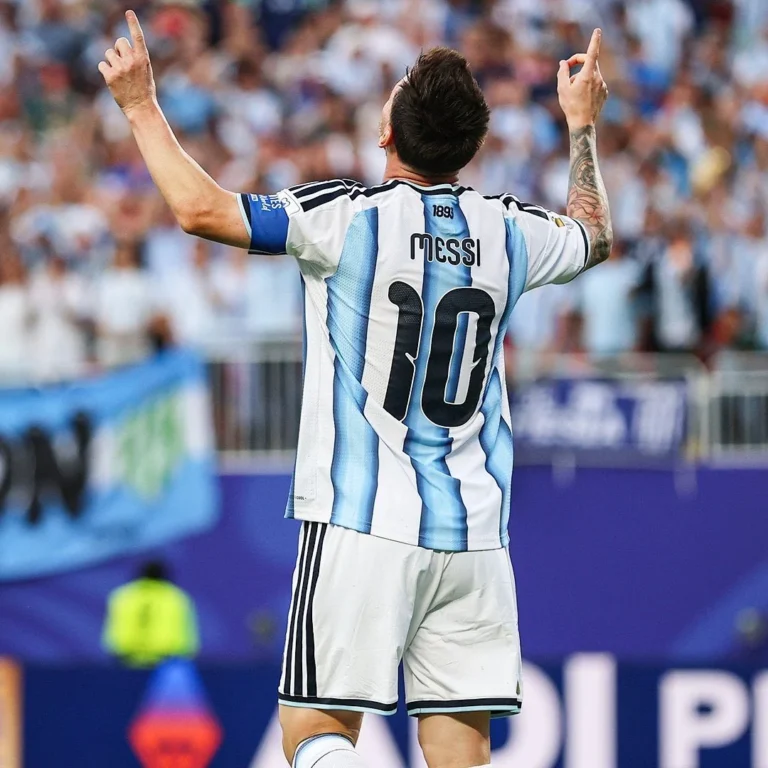
The global football community stands on the precipice of an emotional milestone as Lionel Messi, arguably the most influential figure in the modern game, prepares for his final chapter in the iconic sky-blue and white of Argentina. On October 6, at the historic Estadio Monumental in Buenos Aires, the 39-year-old forward will make his 208th and final international appearance in a commemorative friendly against Benin. To mark the culmination of a storied two-decade journey, Messi has unveiled a bespoke national team jersey, blending the classic aesthetic of the Albiceleste with gold-accented details that signify his unique legacy.
The reveal, shared via his official social media channels, featured a poignant caption: "Último partido… Una camiseta para toda la vida" (One last match… A jersey for a lifetime). The garment maintains the traditional vertical stripes but features his name and the legendary No. 10 rendered in metallic gold, alongside the symbolic Sun of May, serving as a tribute to the nation he led to the pinnacle of world football.
A Chronology of a Legendary Career
To understand the magnitude of this farewell, one must look back at the arc of a career that began in relative obscurity on the international stage. Messi’s senior debut occurred in August 2005 against Hungary—a match that lasted less than a minute due to a controversial red card. What followed was a trajectory marked by immense pressure, agonizing near-misses, and eventual redemption.
- 2005: Senior international debut under José Pékerman.
- 2008: Led the Argentina Olympic team to gold in Beijing.
- 2014: Reached the FIFA World Cup final in Brazil, losing 1-0 to Germany in extra time.
- 2016: Suffered a second consecutive Copa América final loss, leading to a brief, temporary retirement from the national team.
- 2021: Secured his first major senior trophy by defeating Brazil at the Maracanã in the Copa América final.
- 2022: Captured the elusive FIFA World Cup in Qatar, cementing his status as the greatest of his generation.
- 2024: Successfully defended the Copa América title, securing back-to-back continental dominance.
- 2026: Final international appearance scheduled for October 6 in Buenos Aires.
This timeline reflects not only the statistical accumulation of 125 goals but the psychological resilience required to lead a football-obsessed nation through cycles of intense scrutiny and, ultimately, glorious triumph.
Statistical Dominance and Historical Context
Messi’s contribution to Argentina goes far beyond the goal count. With 207 caps to his name, he stands as the most capped player in Argentine football history and one of the most prolific scorers in the history of international football. His role evolved over the years, transitioning from a dynamic, pace-driven winger under coaches like Alfio Basile and Diego Maradona, to the central orchestrator and tactical fulcrum under Lionel Scaloni.
The shift toward the "Scaloni era" proved vital. By constructing a tactical framework that allowed Messi to focus his energy in the final third while providing defensive stability, the Argentine Football Association (AFA) enabled the captain to reach his peak in his mid-30s. Statistically, the years between 2021 and 2024 represent his most efficient period, characterized by a higher assist-to-goal ratio and a greater involvement in build-up play, which proved decisive in tournament-knockout scenarios.
The Farewell Logistics: A Monumental Occasion
The AFA has carefully orchestrated the final international window to ensure a dignified and celebratory send-off. While Argentina is scheduled to face Bolivia on September 30 and Burkina Faso on October 3, team management has confirmed that Messi will be held back from these fixtures. The strategic decision is to preserve his physical condition for the October 6 spectacle against Benin.
The choice of the Estadio Monumental is symbolic. As the home of River Plate and the largest stadium in South America, it provides the capacity required to accommodate the massive demand for tickets from fans eager to witness the final minutes of the Messi era. Analysts note that the match against Benin is not merely a friendly; it is a cultural event, with broadcasting rights being sold globally to markets in Europe, Asia, and North America, highlighting the enduring commercial and cultural footprint of the captain.
Reactions and Official Stances
While official statements from the AFA have been measured, the sentiment among the coaching staff is one of profound reverence. Sources close to the national team camp indicate that manager Lionel Scaloni has been working closely with Messi to ensure the farewell is managed on his terms.
"The decision to step away is deeply personal," noted an internal source within the AFA. "Leo has given his youth, his health, and his absolute commitment to this badge. The goal for October 6 is not the result; it is the celebration of a journey that defined the identity of modern Argentine sport."
Teammates, past and present, have also begun to express their tributes. Former colleagues who played alongside Messi during the "drought years"—the period between 2005 and 2020 where the team failed to win a senior trophy—have spoken about the weight of expectation Messi carried. The consensus among the squad is that the current group has a duty to ensure that the captain’s final match is treated with the same intensity as a World Cup final.
The Broader Implications: Life After the No. 10
The retirement of Messi raises immediate questions regarding the future of the Argentine national team. The "post-Messi" era is a transition that many feared for years, yet the current squad, featuring a new generation of talent, appears better prepared than previous iterations.
- Tactical Realignment: Without the ability to rely on Messi’s singular brilliance to break down low-block defenses, Argentina will likely shift toward a more possession-based, collective approach, relying on the depth of their midfield, which includes world-class talents like Enzo Fernández and Alexis Mac Allister.
- Commercial Impact: The AFA faces the task of maintaining its global brand value. Messi has been the primary driver of merchandise sales and broadcasting revenue for two decades. The federation is already looking at long-term commercial strategies to bridge the gap left by his departure.
- The "Inheritance" of the No. 10: A significant point of discussion in the Argentine press is whether the No. 10 jersey should be retired in honor of Messi. While FIFA regulations make the permanent retirement of numbers difficult in international competition, there is a strong push from fans for the AFA to symbolically set it aside for a period of mourning or reverence.
Sociological Significance
The farewell of Lionel Messi is more than a sports story; it is a sociological phenomenon in Argentina. During periods of economic volatility and political polarization, the national football team has served as a unifying force. Messi’s journey—specifically his return to the national team after his brief retirement in 2016—mirrored the nation’s own struggle to overcome obstacles.
When he finally lifted the World Cup in 2022, it was viewed by many sociologists as a moment of national catharsis. The jersey he wears on October 6 is expected to become an instant collector’s item, representing the final piece of a puzzle that has occupied the national consciousness for over 20 years.
Looking Toward the Final Whistle
As the date approaches, the atmosphere in Buenos Aires is one of anticipatory grief mixed with celebration. The preparations at the Estadio Monumental are exhaustive, with reports of special pre-match ceremonies, tributes from former legends, and a high-security protocol to manage the expected influx of international media and fans.
For Messi, the match against Benin will be the conclusion of 20 years of relentless effort. Whether he adds to his 125-goal tally or simply orchestrates the play, the significance of the event remains fixed. He leaves behind not just a record-breaking career, but a standard of excellence that has redefined the expectations for every player who will don the shirt in the future.
As the sun sets over the River Plate on October 6, the footballing world will turn its gaze to the Monumental, recognizing that they are witnessing the end of an era. The jersey, with its gold lettering and the Sun of May, will be tucked away as a relic of a time when one man, with a ball at his feet, captured the heart of a nation and the admiration of the world. The era of the "Little Maestro" is closing, but the legacy of the No. 10 is permanently etched into the history of the sport.