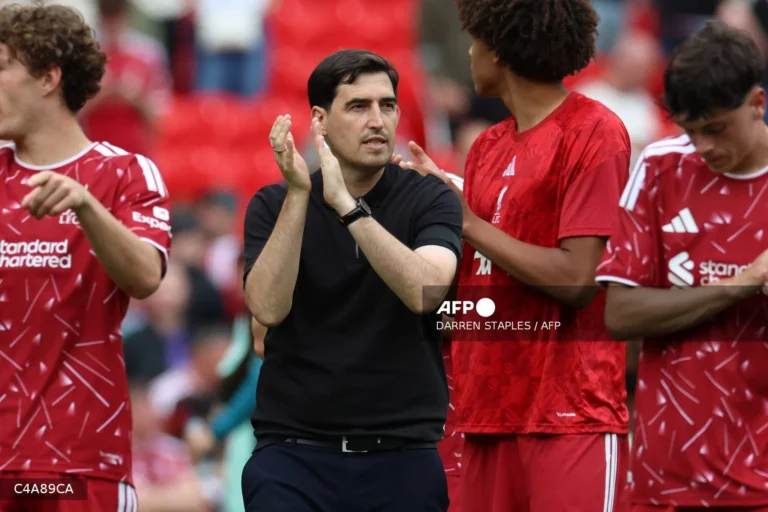
The Premier League has once again found itself engulfed in a fierce officiating controversy following Liverpool’s narrow 1-0 defeat to Arsenal. Speaking in the wake of the high-stakes encounter, Liverpool manager Andoni Iraola voiced deep frustration over the application of VAR and on-field refereeing standards, boldly declaring that he will now instruct his players to hit the ground when fouled inside the penalty area to secure the decisions they deserve.
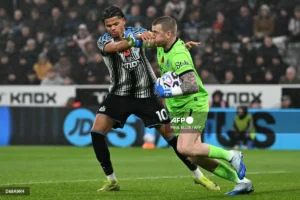
The flashpoint of Iraola’s anger centers on a contentious first-half incident involving Liverpool striker Alexander Isak and Arsenal defender Jurrien Timber. As Bradley Barcola whipped a dangerous cross into the penalty box, Timber blatantly grabbed Isak’s shirt, visibly hindering the Swedish forward’s momentum as he attempted to attack the ball. Because Isak honorably fought to stay on his feet rather than exaggerating the contact or diving, referee Andy Madley waved play on.
A subsequent review by Video Assistant Referee Stuart Attwell upheld the on-field decision, ruling that the contact was insufficient to overturn the call. The match ultimately slipped away from Liverpool, leaving Iraola to question the perverse incentives currently dominating English top-flight football, where honesty from attacking players is seemingly penalized by officials.
The Controversial Incident and the Anatomy of the Non-Call
The match at Anfield was defined by razor-thin margins, but none generated as much post-match debate as the 34th-minute penalty appeal. Replays clearly demonstrated Jurrien Timber clamping his hand onto Alexander Isak’s jersey, stretching the fabric as the forward tried to carve out space for a header.
In a post-match interview with Match of the Day, Iraola did not mince words regarding the sequence of events. He argued that the officiating crew fundamentally mismanaged the situation due to the player’s refusal to teatralize the foul.
"There is a clear grab of the shirt," Iraola stated. "Alex was just in front of him, he was going to head in front of the goal but couldn’t because he grabbed the shirt. If he goes to the floor, they call the penalty 100%. It should be like this, but it is what it is. Next time, the managers should tell Alex to go to the floor, otherwise they won’t call it."
When pressed further on whether he would actively change his coaching instructions to Isak and the rest of the Liverpool squad, Iraola’s response was unequivocal. "The answer is you have to dive, if you don’t dive they won’t call it," he remarked, confirming that he will instruct his players to go down in similar future scenarios.
This candid admission highlights a growing weariness among Premier League managers regarding how contact is evaluated in the box. Iraola pointed out the catch-22 facing modern forwards: remain honest and risk being denied clear goals and penalties, or go to ground easily and face accusations of simulation from pundits and referees alike.
Expert Analysis and PGMOL Under the Microscope
The incident has sparked widespread debate among former officials and football analysts regarding the threshold for a penalty under current Premier League guidelines.

Darren Cann, a former Premier League assistant referee, weighed in on the controversy during his analysis for BBC Sport. While acknowledging that Timber took an enormous gamble by clutching the forward’s jersey, Cann explained the logic behind the refereeing team’s reluctance to point to the spot.
"Timber takes a huge risk by grabbing the shirt. It could easily have been given on another day," Cann noted. "It’s right on the limit. It has to be sustained holding—some will say it was sustained, some will say it wasn’t. But it’s interesting that Isak didn’t even appeal."
This interpretation underscores a recurring grey area in the laws of the game: the requirement for "sustained holding." Critics, however, argue that demanding a player must also dramatically collapse to the turf before a holding offense is recognized reduces the integrity of the sport and undermines the Premier League’s stated objective of allowing physical, flowing football while still punishing illegal defensive tactics.
Further compounding Liverpool’s grievances during the match was a second rejected penalty appeal when Dutch forward Cody Gakpo went down under pressure from Christos Tzolis. Much like the Isak incident, the refereeing team deemed the contact negligible, leaving the Merseyside club empty-handed and furious at the final whistle.
Iraola admitted that any prospective apology from Professional Game Match Officials Limited (PGMOL) would offer little consolation. In modern football, retroactive admissions of human or technological error do little to alter league standings or recover lost points in a fiercely competitive title race.
Broader Implications for Premier League Officiating
Iraola’s explosive comments have reignited long-standing conversations regarding the cultural and systemic issues surrounding penalty box decisions in the Premier League. For seasons, managers, players, and supporters have voiced frustration over a perceived lack of consistency among referees and VAR operators.
By openly admitting that he must now coach his players to simulate or exaggerate contact to earn legitimate fouls, Iraola has thrown down a public gauntlet to football’s lawmakers. The commentary touches on a perverse incentive structure within the sport:
- The Honest Player Penalty: Strikers who try to stay on their feet to score are frequently punished for their integrity if the ball eludes them.
- The Reward for Exaggeration: Players who embellish minimal contact are statistically far more likely to win fouls and penalties, validating the old adage that "if you don’t go down, you don’t get the whistle."
- VAR Disconnect: Despite the introduction of technology designed to eliminate clear and obvious errors, subjective interpretations of "sufficient contact" and "sustained holding" continue to create friction.
As the 2026/2027 Premier League campaign progresses, the spotlight will inevitably turn back to PGMOL and its referees. If managers genuinely feel compelled to coach simulation just to level the playing field, the league faces a major credibility crisis regarding how matches are officiated inside the 18-yard box.
For Liverpool, the immediate focus must return to bouncing back from the disappointing Arsenal defeat. However, Iraola’s bold stance ensures that the conversation surrounding diving, defensive holding, and refereeing transparency will dominate sports headlines for weeks to come.