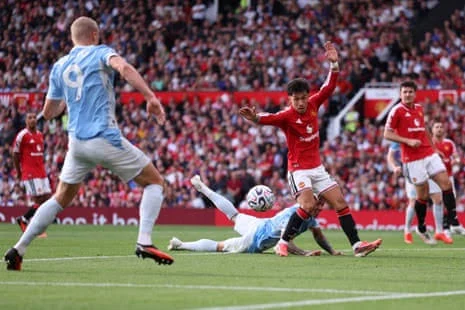
The atmosphere at Old Trafford on Sunday evening was heavy with a mix of frustration and disbelief as Manchester United succumbed to a 1-0 defeat against arch-rivals Manchester City. The result, decided by a solitary goal from Erling Haaland, has been eclipsed by a heated post-match debate surrounding the efficacy and consistency of the Video Assistant Referee (VAR) system. At the center of the controversy was a pivotal officiating decision that allowed Haaland’s strike to stand, despite claims that Enzo Fernández was in an offside position and actively interfering with the play.
Manchester United manager Michael Carrick, appearing visibly incensed during his post-match press conference, did not mince his words regarding the officiating standards. Describing the explanation provided for the goal as "staggering," Carrick questioned the structural integrity of a system designed to assist referees, yet one that he believes is failing to produce accurate outcomes.
Chronology of a Disputed Goal
The decisive moment occurred in the second half of a tightly contested derby. As Manchester City pushed forward, a ball was played into the penalty area. Enzo Fernández, positioned in an offside location, appeared to occupy the defensive line, drawing the attention of United defender Lisandro Martínez. As Martínez moved to address the threat posed by Fernández, space was created behind him, allowing Erling Haaland to exploit the gap and slot the ball past the goalkeeper.
The referee initially signaled for play to continue, and a lengthy VAR review ensued. The officials at Stockley Park examined multiple camera angles to determine whether Fernández’s proximity to the play constituted "active interference." After several minutes of deliberation, the on-field decision was upheld. The ruling suggested that Fernández was not sufficiently involved in the play to warrant an offside call, despite his physical positioning influencing the defensive setup of the United backline.
The Player Perspective: Lisandro Martínez Speaks Out
The frustration felt by the coaching staff was mirrored by the players on the pitch. Lisandro Martínez, who was directly involved in the tactical movement that led to the goal, described the sequence of events as a clear "injustice."
"I think it was offside," Martínez stated in the aftermath. "What I can’t understand is the rules. He was there. I went to him because he was there in front of me; that’s why Haaland was free at the back. It is so hard, because you lose a derby, you lose three points at home. It is unacceptable."
Martínez’s comments highlight a recurring friction between modern tactical positioning and the interpretation of the offside rule. In the Premier League, the interpretation of "interfering with play" remains one of the most subjective areas of officiating. Critics argue that when an offside player forces a defender to change their path or commit to a tackle, they are, by definition, interfering. The PGMOL (Professional Game Match Officials Limited) guidelines, however, continue to offer a more narrow interpretation, focusing on direct contact with the ball or impeding an opponent’s ability to play it.
The VAR System Under Scrutiny
The Premier League introduced VAR at the start of the 2019-20 season with the explicit promise of eliminating "clear and obvious errors." However, the 2023-24 campaign has been marked by a series of high-profile controversies that have reignited the debate over the system’s role in the game.
Carrick’s critique of the "layers" behind the referees reflects a growing sentiment among managers that the technology has introduced more complexity than clarity. "I just don’t get it, I really don’t get it," Carrick remarked. "I can’t understand how we’re trying to help referees, putting so many layers behind them, so many people, bodies and screens, and they can’t make the right decision. It’s worrying if that’s how the game is seen by those who are officiating it."
From an analytical standpoint, the reliance on subjective interpretation within the VAR booth often leads to inconsistent outcomes. When a decision rests on whether a player "intended" to interfere or whether they "impacted" a defender, the variance between individual officials becomes the deciding factor. For Manchester United, this represents a significant point of contention, as the loss in the derby impacts their standing in a highly competitive league table where every point is crucial for European qualification.
Broader Implications for the Premier League
This incident is unlikely to be an isolated case. As the season progresses, the pressure on the PGMOL to standardize the application of the laws of the game will only intensify. The perception of injustice, as voiced by Martínez, can have a demoralizing effect on squads who feel that their efforts on the pitch are being undermined by off-field interventions.
Furthermore, the economic and prestige-based stakes of the Manchester derby mean that officiating errors are magnified. The Premier League prides itself on being the most competitive league in the world, attracting top-tier talent and global viewership. When the legitimacy of a match result is called into question by a controversial VAR decision, it impacts the credibility of the competition itself.
Statistical Context and Performance Analysis
Data from the current season suggests that while VAR has corrected numerous factual errors—such as incorrect offside calls based on geometry—it has struggled to provide transparency in cases of tactical interference. Manchester United’s performance in this match, despite the loss, showed signs of tactical cohesion. Carrick noted that he was proud of the team’s effort, stating, "I can’t be too critical of the players, and I won’t be because I think we’ve done a lot of good things. Today we didn’t quite find what we needed."
The defeat leaves Manchester United in a precarious position regarding their seasonal targets. Having dropped points in crucial fixtures, the squad is under pressure to find consistency. The mental toll of losing a derby due to a decision perceived as incorrect can linger, and the onus is now on the technical staff to rally the players for the upcoming fixtures.
Conclusion: The Path Forward
The aftermath of this derby serves as a microcosm of the challenges facing modern football. The technological advancement of the game has outpaced the evolution of its rules, leaving players, managers, and fans in a state of perpetual frustration. While the goal stands in the record books as a victory for Manchester City, the conversation surrounding the match will remain dominated by the role of the officiating team.
For Michael Carrick and his side, the focus must now shift toward the future. While the grievance regarding the VAR decision is significant, the reality of the league table necessitates a prompt return to form. The question remains, however, whether the PGMOL will initiate a review of the "interference" rule following the intense backlash from Old Trafford. As it stands, the footballing community remains divided, with the lines between technological progress and human error continuing to blur.
As the league continues to navigate these complexities, the demand for greater transparency—perhaps through post-match audio releases or clearer explanations from officials—will continue to grow. Until then, clubs like Manchester United must contend with the reality that, in the high-stakes world of the Premier League, the margin between success and failure is often decided by a screen, a whistle, and a subjective interpretation of the rules.