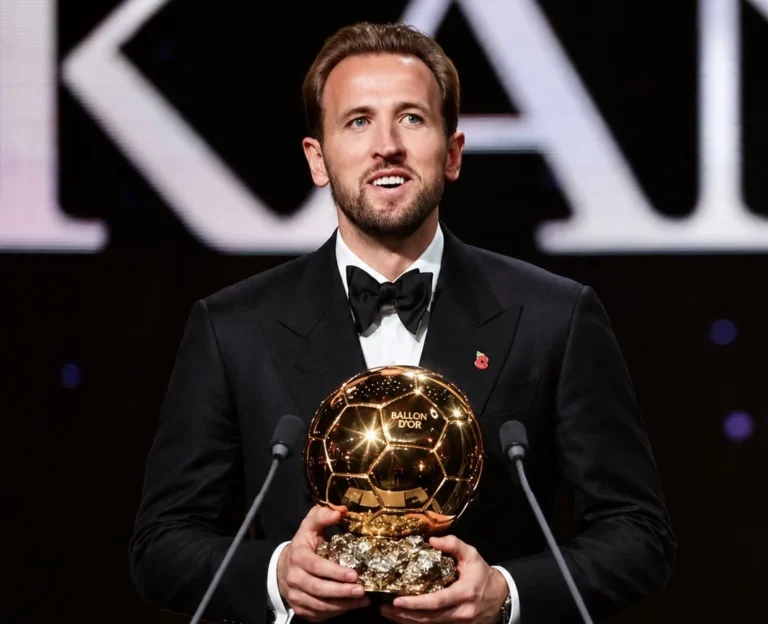
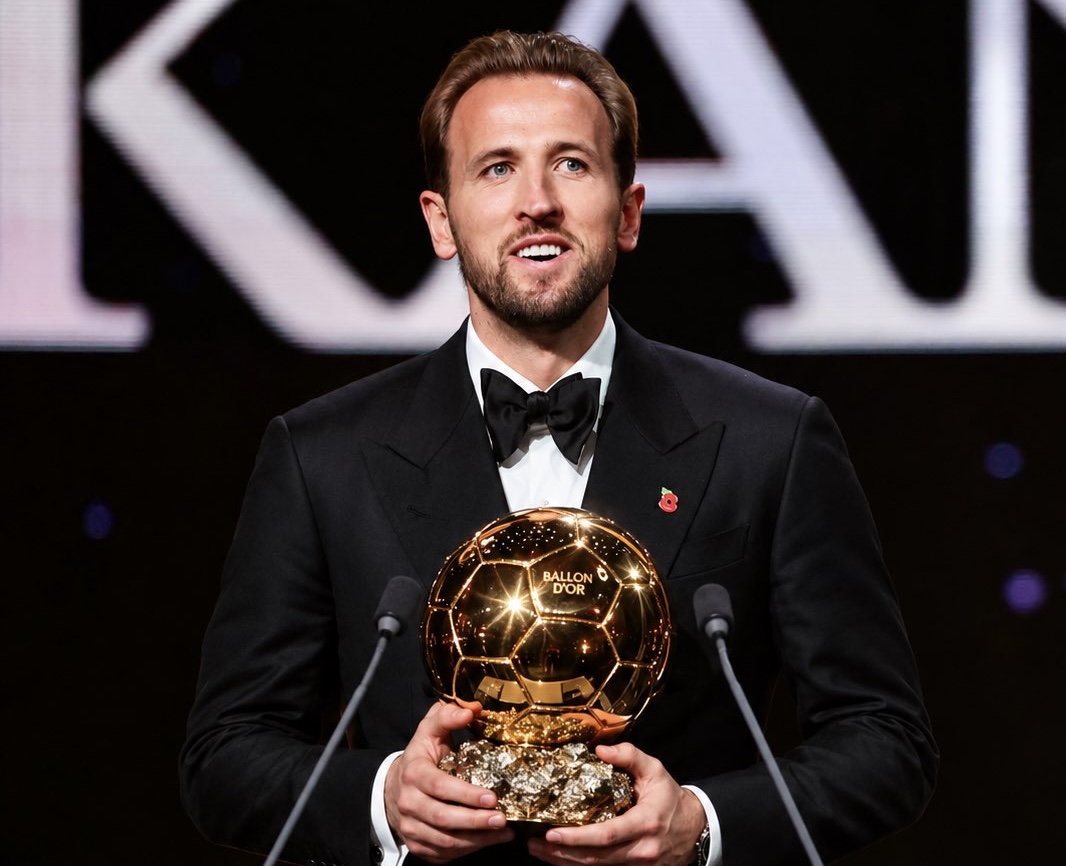
Harry Kane has officially been crowned the world’s best footballer, securing the prestigious Ballon d’Or at a gala ceremony in London. This monumental achievement marks the first time an English player has claimed the coveted Golden Ball since Michael Owen’s triumph in 2001. At 33 years of age, the Bayern Munich talisman has not only cemented his status as the most prolific striker in modern football but has also etched his name into the annals of history alongside the greatest players to ever grace the pitch.
The accolade serves as a significant milestone for English football, ending a 23-year drought during which the nation’s top talents frequently featured in the top ten but struggled to capture the top prize. Kane’s victory brings him into an elite circle of five Englishmen who have held the award, joining the ranks of Stanley Matthews (1956), Bobby Charlton (1966), Kevin Keegan (1978 and 1979), and Michael Owen (2001). Furthermore, the win marks a resurgence for Bayern Munich, as Kane becomes the first player from the Bavarian giants to receive the honor since the legendary Karl-Heinz Rummenigge in 1981.
A Season of Unprecedented Statistical Dominance
Kane’s path to the Ballon d’Or was paved by a campaign of statistical anomalies. During his most recent season, the England captain recorded an astonishing 61 goals in 51 club matches. This figure set a new all-time record for a single campaign in Bayern Munich’s storied history, eclipsing the achievements of club legends like Gerd Müller and Robert Lewandowski. When accounting for his contributions on the international stage with the Three Lions, his total climbed to 73 goals and eight assists in 65 appearances.
Analytical models and football historians note that such output is rare in the modern era, where defensive tactical discipline often suppresses goal tallies. In fact, throughout the history of Europe’s top five leagues—the Premier League, La Liga, Serie A, the Bundesliga, and Ligue 1—only one player has ever managed to surpass Kane’s single-season goal haul. This sheer volume of output acted as the primary driver for the voting panel, which included journalists, coaches, and international captains from across the globe.
The Paradox of the Trophy-Less Triumph
The significance of Kane’s victory is amplified by the fact that he achieved this individual accolade without securing a major team trophy during the voting period. While the Ballon d’Or has historically favored players who lead their teams to Champions League or World Cup glory, the voters prioritized Kane’s individual impact.
Throughout the campaign, Kane’s teams fell short in critical high-stakes environments, notably suffering heart-breaking exits in both the World Cup and the Champions League semi-finals. Despite these setbacks, the consensus among experts was that no other individual possessed the same level of consistent influence over a match’s outcome. His ability to link play, orchestrate transitions, and maintain clinical finishing in the penalty box proved to be the deciding factor, suggesting a shift in how the football community evaluates greatness: moving away from team success as a prerequisite toward a focus on individual performance excellence.
Chronology of the English Ballon d’Or Drought
The journey to this moment has been a long one for the English game. Since Michael Owen lifted the trophy in 2001, the English Premier League has dominated the global landscape, yet its domestic players have often been overlooked in favor of continental superstars like Lionel Messi, Cristiano Ronaldo, and Luka Modrić.
- 1956: Sir Stanley Matthews becomes the inaugural winner of the award.
- 1966: Sir Bobby Charlton is recognized for his pivotal role in England’s World Cup win.
- 1968: George Best, representing Northern Ireland, wins the award during a golden era for Manchester United.
- 1978/79: Kevin Keegan secures consecutive titles, establishing English dominance in the late 70s.
- 2001: Michael Owen secures the award following a prolific season with Liverpool.
- 2002–2023: A twenty-two-year period of disappointment for English nominees, featuring high-profile finishes for players such as Frank Lampard, Steven Gerrard, and Jude Bellingham, none of whom could cross the final threshold.
The Bayern Munich Connection
For Bayern Munich, the arrival of Harry Kane was intended to revitalize their attacking structure following the departure of Robert Lewandowski. The success of this acquisition is now undeniable. By becoming the first Bayern player in over four decades to win the Ballon d’Or, Kane has validated the club’s transfer strategy and reinforced their position as a premier destination for global talent.
Observers within the Bundesliga note that Kane’s adaptation to the German style of play was immediate. His capacity to drop deep into midfield to facilitate play—a trait developed during his later years at Tottenham Hotspur—provided Bayern with a tactical versatility that made them nearly impossible to defend against for the majority of the season.
Broader Implications for the Sport
The awarding of the Ballon d’Or to Kane sends a clear message to the footballing world: individual brilliance, when sustained at an elite level, will not be ignored. This decision may influence future voting cycles, potentially rebalancing the scales between those who win "the most" and those who "do the most."
From an English perspective, the victory serves as a psychological boost for the national team. With Kane leading by example, the younger generation of English talent, including the likes of Jude Bellingham and Phil Foden, can look to their captain as proof that the pinnacle of the sport is accessible to English players, regardless of the team honors achieved in a single calendar year.
Moreover, the ceremony in London highlighted the shift in the sport’s center of gravity. Hosting the event in the UK emphasized the Premier League’s influence on the global game and the continued growth of the Bundesliga, which is now home to the world’s most recognized player.
Official Reactions and Future Outlook
While official comments from the awarding body, France Football, emphasized the "unanimous recognition of a complete striker," the response from the football community has been largely one of validation. Peer recognition remains the highest form of praise, and in the weeks leading up to the announcement, several legendary figures had already tipped the striker for the award.
As Harry Kane looks toward the next chapter of his career, the Ballon d’Or stands as the crown jewel of an already illustrious resume. With the pressure of the "trophy-less" narrative now silenced by the weight of this gold trophy, the striker enters the coming season with a renewed sense of purpose. Whether or not he can lead Bayern Munich or England to team glory in the future, his legacy as one of the most consistent and lethal strikers in the history of the sport is now undisputed. The 2024 ceremony will be remembered as the night the English game finally reclaimed its seat at the top table of world football, anchored by a player whose sheer statistical dominance could no longer be denied.