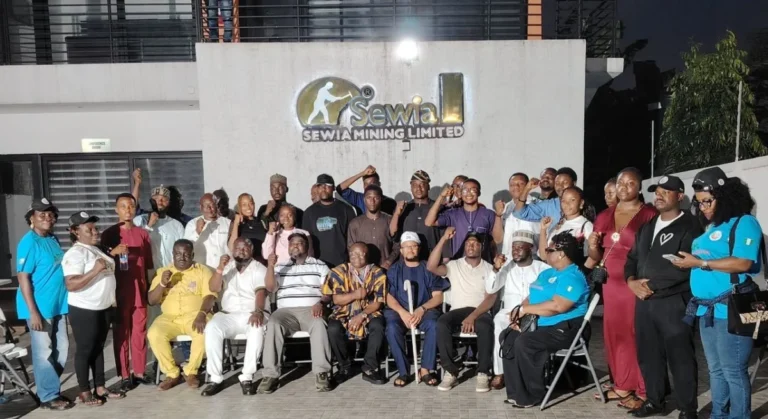
In a landmark engagement bridging the gap between academia and heavy industry, the National President of the National Association of Nigerian Students (NANS), Comrade Akinteye Babatunde Afeez, led a high-powered delegation of student leaders on an immersive working visit to the Sewia Mining & Refinery facility located in Accra, Ghana. The strategic tour was designed to provide student representatives with firsthand exposure to the complexities of gold processing, precious-metals refining, and the broader solid minerals value chain.
The visit successfully transcended traditional classroom boundaries, offering the student leaders a rare, behind-the-scenes look at the technical and commercial operations underpinning West Africa’s booming extractive sector. A major highlight of the diplomatic and industrial outreach was a generous financial commitment totaling ₦15 million announced by the President and Chief Executive Officer of Sewia Mining & Refinery, Hon. Olatunde Gideon Igbasan. The substantial intervention package comprises ₦10 million earmarked for NANS Nigeria and ₦5 million designated for NANS Ghana, intended to directly bolster student welfare, research, and institutional development initiatives across both jurisdictions.
Chronology and Background of the Industrial Outreach
The industrial visit was conceptualized months prior as part of NANS’s broader agenda to shift the focus of student unionism from traditional militant activism toward developmental advocacy, economic literacy, and capacity building. As African governments increasingly emphasize the diversification of their economies away from oil and gas toward solid minerals, student bodies have recognized the urgent need to align educational outcomes with emerging industrial demands.
The delegation arrived in Accra early in the week, commencing their itinerary with preparatory briefings on international mining standards, regulatory compliance, and environmental sustainability. The core of the visit culminated on the refinery floor, where the NANS executives observed end-to-end industrial procedures. The itinerary featured a live, high-precision gold-smelting demonstration, illustrating the transition of raw ore into refined bullion. This practical exposure aimed to demystify the metallurgical sciences and spark entrepreneurial interest among the student leadership, many of whom study disciplines ranging from engineering and geology to the social sciences and humanities.
Following the facility tour, a formal interactive session convened executives of Sewia Mining & Refinery and the visiting student leaders. The dialogue focused heavily on the structural transformation required to maximize Africa’s mineral wealth for the benefit of its burgeoning youth population.
Industry Perspectives: Redefining Africa’s Mineral Wealth
Receiving the delegation, Hon. Olatunde Gideon Igbasan delivered a compelling address challenging young Africans to recalibrate their career ambitions. He urged them to look past conventional, saturated white-collar career paths and position themselves strategically to capture the immense value emerging from the continent’s vast subterranean resources.
Igbasan offered a sharp critique of the historical economic model that has long dominated Africa’s extractive sectors, arguing passionately that raw mineral exportation is no longer a viable pathway to sustainable prosperity. Instead, he advocated for a paradigm shift centered on responsible mining practices, stringent supply chain traceability, localized value addition, and domestic industrialization.
"We are sitting on enormous mineral wealth in Africa," Hon. Igbasan stated during the interactive session. "The future is not simply to extract and export our resources, but to make them traceable, process them, add value, and build industries around them. That is how we create jobs for our young people and generate sustainable revenue for our countries."
Expanding on this thesis, the CEO pointed out that Africa’s vast deposits of gold, lithium, cobalt, and other strategic energy transition minerals possess the capacity to anchor a robust, multi-layered industrial ecosystem. He underscored that the modern mining value chain extends far beyond physical extraction and geology, encompassing vital support sectors such as mineral processing engineering, logistics, environmental compliance, digital technology integration, and precious-metals trading.
Furthermore, Hon. Igbasan expressed Sewia Mining & Refinery’s institutional readiness to bridge the industry-academia divide by establishing structured internship programs, practical training pipelines, and targeted mentorship schemes for West African undergraduates and recent graduates.
Data and Economic Implications of the Mineral Sector
To contextualize the significance of the NANS visit, industry analysts frequently point to the underutilized potential of the African solid minerals sector. According to recent data from the African Development Bank and regional mining commissions, Africa holds roughly 30 percent of the world’s mineral reserves, including 40 percent of global gold reserves and significant shares of critical tech-metals. Despite these figures, the continent captures only a fraction of the downstream economic value due to deficient local refining capacities and a lack of integrated industrial policies.
The initiative by Sewia Mining & Refinery to directly invest ₦15 million into student welfare and capacity building highlights a growing corporate social responsibility (CSR) trend among forward-thinking African enterprises. By targeting student organizations, the refinery is investing upstream in human capital development. Observers note that empowering student leadership fosters a culture of economic pragmatism, ensuring that the next generation of policymakers, entrepreneurs, and workforce participants enters the labor market with a clear understanding of industrial economics.
Official Responses and Awards of Excellence
In recognition of his visionary leadership, philanthropic commitment to youth development, and proactive engagement with student bodies, the NANS national leadership bestowed upon Hon. Igbasan a prestigious Award of Excellence. The plaque was presented by Comrade Akinteye Babatunde Afeez amidst applause from both company executives and student delegates.
In a separate presentation, the Ghana Chapter of NANS honored the CEO with a Patron Award. This distinction specifically acknowledged his steadfast support for cross-border student solidarity, academic welfare, and his deliberate efforts to create institutional bridges between the private sector and student communities in West Africa.
Comrade Akinteye, speaking on behalf of the delegation, expressed profound gratitude to Hon. Igbasan for the financial endowment and the educational value of the refinery tour. He noted that the N15 million grant would be judiciously managed to fund critical student support programs, enterprise training workshops, and welfare interventions designed to alleviate current economic pressures faced by undergraduates in Nigeria and Ghana.
Broader Impact and Future Outlook
The convergence of student leadership and heavy industry at the Sewia facility underscores a critical question facing the African continent: How can a young population—projected to make up over 40 percent of the global youth by 2050—participate meaningfully in the high-value industries driving the future global economy?
This visit provided a compelling blueprint for answering that question. By forging stronger structural linkages between educational institutions, organized student movements, and industrial giants, young people gain crucial pre-graduation exposure that textbooks alone cannot provide. The experience reinforced the reality that formal academic qualifications must be paired with demonstrable practical competencies, technical literacy, and entrepreneurial adaptability.
As the NANS delegation returned to their respective campuses, the overarching takeaway from the Accra engagement remained clear: Africa’s economic transformation will not be achieved through passive observation, but through active, skilled participation in the value-addition processes of its natural wealth. Initiatives like the Sewia-NANS partnership serve as a vital catalyst in preparing African youth to take ownership of their continent’s industrial destiny.