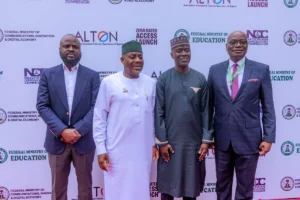
Academic and administrative activities across Nigeria’s 115 Federal Unity Colleges are facing an unprecedented and total shutdown as key labour organizations enforce a strict boycott of the 2026/2027 academic session resumption date. The Association of Senior Civil Servants of Nigeria (ASCSN), alongside the Joint Congress of Unions of the Federal Ministry of Education, has dug in its heels, issuing a categorical ultimatum to the Federal Government. According to the coalition of workers and educators, the gates of all Federal Government Colleges (FGCs), Federal Government Girls’ Colleges (FGGCs), and Federal Science and Technical Colleges (FSTCs) will remain locked until two non-negotiable conditions are met: an immediate suspension of the controversial concession process for King’s College, Lagos, and a formal, transparent invitation to a round-table dialogue with union leadership.
The brewing industrial crisis directly challenges the reopening directives issued by the Minister of Education, Dr. Tunji Alausa, who had earlier assured parents and guardians that academic institutions would resume operations smoothly. Instead of complying with the ministerial directives, labour leaders have instructed their members nationwide to treat official resumption orders as null and void. Describing the industrial action as "total, absolute, and unchanged," the unions have urged teaching and non-teaching staff to ignore attendance registers, administrative threats, or punitive measures from ministry officials, setting the stage for a high-stakes standoff between organized labour and the Federal Ministry of Education.
Background Context of the Impasse
The genesis of the current nationwide shutdown lies in a deep-seated disagreement over the management, financing, and future ownership structure of Nigeria’s premier secondary educational institutions. Federal Unity Colleges, established decades ago with the primary mandate of fostering national integration and providing affordable, high-quality secondary education to exceptional students from diverse ethnic and socioeconomic backgrounds, have increasingly struggled with infrastructural decay, underfunding, and bureaucratic bottlenecks.
In response to these systemic challenges, the Federal Executive Council (FEC) recently granted approval to hand over the historic King’s College, Lagos, under a concession arrangement, reportedly involving alumni bodies and private sector partners. The government presented the move as a strategic public-private partnership (PPP) designed to inject private capital, modernize dilapidated facilities, and restore the legendary institution to its former global glory.
However, the decision caught the leadership of the education sector unions off guard. According to the ASCSN and the Joint Congress of Unions, the ministry bypassed an existing joint committee that had been specifically established to brainstorm and formulate sustainable strategies for addressing infrastructure deficits across all unity schools. By unilaterally opting for a concession model for King’s College without consulting the primary stakeholders—the workers who run the institutions—the government triggered deep mistrust. Labour leaders argue that this bypass violates established industrial relations protocols and foreshadows a broader agenda to commercialize and privatize public education in Nigeria.
Chronology of Events Leading to the Strike
The escalation from policy disagreement to a total nationwide shutdown follows a rapid sequence of events that unfolded over the preceding weeks:
- Initial Policy Announcement: The Federal Executive Council greenlights the concession agreement for King’s College, Lagos, citing the need for private sector intervention to salvage failing school infrastructure.
- Union Pushback and Formation of Joint Committee Demands: Labour unions express immediate displeasure, noting that the administration sidelined a collaborative committee tasked with finding home-grown solutions to infrastructural decay.
- Escalation of Tensions: Informal discussions between ministry officials and union representatives stall as the government insists on proceeding with the King’s College handover.
- Ministerial Resumption Directive: Minister of Education Dr. Tunji Alausa issues an official directive assuring parents of a seamless resumption for the 2026/2027 academic session and urging all staff to report to their respective duty posts.
- Emergency Sunday Briefing: On Sunday, September 13, ASCSN Unit Chairman for King’s College, Mr. Samuel Enang, addresses the media, formally declaring a total and absolute nationwide strike and directing members to ignore the minister’s resumption orders.
- Implementation of the Strike: As the official resumption morning breaks, union members enforce compliance, locking down gates across all 115 Federal Unity Colleges and paralyzing academic calendars nationwide.
Statements and Reactions from Key Parties
The industrial action has exposed a sharp divide between federal educational authorities and the workforce responsible for daily institutional operations. In an official statement released on Sunday, September 13, Mr. Samuel Enang framed the strike not merely as a routine dispute over workers’ welfare or salaries, but as a patriotic crusade to defend the foundational tenets of public education in Nigeria.
"Our strike is not merely an industrial dispute over welfare; it is a patriotic battle to save public education," Mr. Enang stated during a press briefing. He warned that conceding King’s College sets a dangerous and irreversible legal and administrative precedent. "If they succeed with King’s College today, every other Federal Government College in Nigeria will be sold to private interests tomorrow."
The unions have also issued strong warnings to their rank-and-file members, urging them to remain resolute against administrative intimidation. Reports from various state chapters indicate that union task forces have been mobilized to monitor compliance, discouraging members from yielding to pressure from principals, directors, or zonal directors who threaten disciplinary action or salary withholding for absenteeism.
Conversely, the Federal Government, through the Ministry of Education, maintains that the reforms are necessary to rescue public institutions from budgetary constraints. Ministry officials have consistently argued that traditional government funding models are no longer sufficient to maintain the sprawling campuses, laboratories, hostels, and sporting facilities characteristic of Federal Unity Colleges. By engaging private partners and alumni associations, the government believes it can unburden public coffers while guaranteeing world-class educational standards. Prior to the strike action, the ministry issued assurances to parents and guardians, urging them to send their children and wards to school as scheduled, promising a safe and uninterrupted academic environment.
Broader Impact and Implications for the Education Sector
The closure of 115 Federal Unity Colleges carries profound socio-economic and educational ramifications for the country. Thousands of students, many of whom travelled long distances across state lines to resume for the new academic session, found themselves stranded outside locked school gates alongside anxious parents. For families relying on these institutions for predictable, stable, and affordable academic calendars, the sudden disruption represents a severe logistical and financial headache.
Beyond the immediate inconvenience to students and parents, the standoff highlights deeper structural crises plaguing Nigeria’s public service and educational framework. Analysts point out that the conflict underscores a persistent communication breakdown between federal ministries and labour organizations. When major policy shifts—such as the privatization or concession of public assets—are implemented without exhaustive tripartite consultations involving the government, management, and workers, industrial disharmony becomes almost inevitable.
Furthermore, the core ideological debate touches on the future accessibility of education in Nigeria. Federal Unity Colleges have historically served as symbols of national unity and beacons of upward social mobility for middle- and lower-income families who cannot afford exorbitant private school tuition. Critics of the concession policy share the unions’ apprehension that introducing profit-driven management structures could inevitably drive up tuition fees, restrict admissions to affluent elites, and systematically marginalize talented students from economically disadvantaged backgrounds.
As the industrial action takes full effect, pressure is mounting on both the Federal Ministry of Education and union leadership to return to the negotiating table. Unless the federal administration makes a strategic concession regarding the King’s College process or issues a formal, binding invitation for transparent dialogue, the academic future of tens of thousands of Nigerian secondary school students remains suspended in uncertainty.