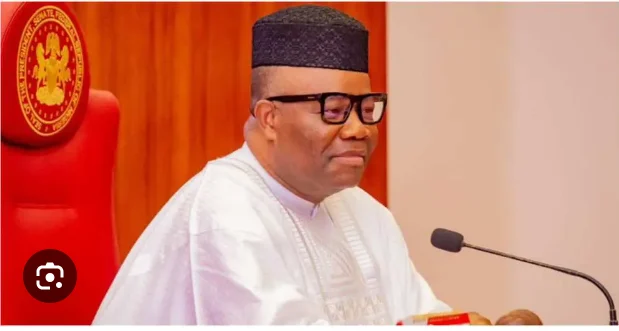
The President of the Senate, Godswill Akpabio, has revealed that the United States is reportedly reducing its embassy staff in Nigeria due to concerns about potential attacks stemming from escalating tensions involving Iran. This significant statement sheds light on the intricate geopolitical factors influencing diplomatic security postures worldwide and raises pertinent questions about Nigeria’s own security landscape. Akpabio made these remarks during the recent inauguration of the new headquarters of the National Assembly Service Commission in Abuja, addressing anxieties surrounding reports of foreign missions scaling down their operations within the country.
Akpabio emphasized that this measure is not an isolated incident specific to Nigeria but rather a component of broader global security precautions being implemented by several nations. "Some people say that even now that some embassies are closing down. Not many embassies are closing down. Many of the embassies are afraid of repercussions from their foes," he stated, indicating a widespread pattern of heightened vigilance among diplomatic outposts.
He further elaborated on the specific concerns cited by the US, stating, "For instance, I can say that America is a bit worried about the bomb blast from Iran, and so across the world, they have to reduce their staff in case Iran decides to attack their embassies." This direct attribution to the Iran-US geopolitical friction marks a significant development, suggesting that regional conflicts are having tangible, immediate impacts on international diplomatic operations.
Akpabio was keen to decouple these security measures from Nigeria’s internal political dynamics, particularly the upcoming general elections. He dismissed suggestions that the reduction in staff was a reflection of Nigeria’s domestic political climate or an anticipation of election-related unrest. Instead, he maintained that diplomatic missions were acting based on overarching international security considerations. "When people are thinking, oh, Nigeria’s embassies are closing because the election is coming. It’s not because the election is coming. The election will come and go, and God will protect you. God will protect Nigeria. Nigeria will outlive this election," he asserted, aiming to reassure the public and project an image of national stability.
Background: Escalating Global Tensions and Diplomatic Security
The Senate President’s remarks arrive at a time of heightened global geopolitical instability, marked by significant tensions between the United States and Iran. This strained relationship has been exacerbated by a series of events, including Iran’s nuclear program, its regional proxy activities, and retaliatory actions following perceived provocations. The US, as a major global power with extensive diplomatic networks, often finds its personnel and facilities abroad vulnerable to threats arising from these complex international disputes.
The reported reduction in US embassy staff in Nigeria is not an unprecedented response to perceived threats. Historically, diplomatic missions have adjusted their staffing levels and security protocols in response to evolving security assessments, ranging from localized conflicts to international state-sponsored actions. The specific mention of Iran suggests a perceived risk of retaliatory attacks targeting US interests, a strategy that Iran has historically employed through various means, including proxy groups and direct actions.
US Department of State Advisories: A Pattern of Concern
This development echoes a previous advisory issued by the US Department of State, which had authorized non-emergency US government employees and their family members to depart the US Embassy in Abuja. The rationale provided at that time cited a deteriorating security situation across Nigeria, encompassing threats such as crime, terrorism, kidnapping, and civil unrest.
The travel advisory, updated in early April 2026, explicitly advised Americans to "reconsider travel" to Nigeria, assigning it a "Level 3: Reconsider Travel" classification. Certain regions within Nigeria were even designated as "Level 4: Do Not Travel," underscoring the severity of the security concerns. This existing advisory already painted a picture of a challenging security environment in Nigeria, independent of any specific international threats.
Chronology of Events and Statements
- Recent Past: The US Department of State issues a travel advisory recommending Americans reconsider travel to Nigeria due to a deteriorating security situation, including crime, terrorism, kidnapping, and civil unrest. Non-emergency personnel and their families are authorized to leave the US Embassy in Abuja.
- April 8, 2026: A revised travel advisory is issued, reiterating the "Level 3: Reconsider Travel" status for Nigeria, with some areas designated "Level 4: Do Not Travel."
- Recent Date (Unspecified in original text): Senate President Godswill Akpabio makes remarks during the inauguration of the new National Assembly Service Commission headquarters in Abuja.
- During the Inauguration Speech: Akpabio attributes the reduction in US embassy staff to fears of potential attacks linked to tensions with Iran, clarifying that this is not related to Nigeria’s upcoming elections.
Broader Context: Nigeria’s Security Landscape
Nigeria has been grappling with a multifaceted security crisis for years. This includes the persistent insurgency by Boko Haram and its splinter groups in the Northeast, widespread banditry and farmer-herder conflicts in the Northwest and North Central regions, and secessionist agitations in the Southeast. These internal challenges have created a complex and often volatile security environment, necessitating robust security responses from the Nigerian government and cooperation with international partners.
The US Department of State’s advisories, while highlighting these internal threats, also reflect a global risk assessment framework. The decision to reduce staff at an embassy is a significant step, indicating a level of concern that transcends typical travel advisories. When coupled with the Senate President’s assertion about Iran, it suggests a dual layer of threats being considered: the ongoing internal security challenges within Nigeria and the potential for external actors to exploit the situation or target diplomatic personnel due to international geopolitical disputes.
Analysis of Implications
1. Geopolitical Ripples: The connection drawn between the US embassy’s staffing decisions and Iran-US tensions highlights the interconnectedness of global security. It suggests that conflicts and rivalries in one region can have direct and immediate repercussions on diplomatic operations in seemingly unrelated parts of the world. This underscores the need for a sophisticated understanding of international relations and threat assessment by all nations.
2. Impact on Diplomatic Relations: A reduction in embassy staff can potentially impact the efficiency and scope of diplomatic operations, including consular services, cultural exchange programs, and bilateral engagements. While temporary, such measures can signal a heightened level of caution and may affect the perception of Nigeria’s security environment internationally.
3. National Security Discourse: Akpabio’s statement has likely injected a new dimension into Nigeria’s national security discourse. While reassuring the public about the elections, it implicitly acknowledges the gravity of international security threats and their potential impact on Nigeria. This could prompt a re-evaluation of Nigeria’s diplomatic security protocols and its engagement with international security intelligence.
4. Economic and Social Impact: While not directly stated, prolonged or escalated security concerns can deter foreign investment, impact tourism, and create anxiety among expatriate communities. The government’s ability to effectively manage both internal and external security threats will be crucial for maintaining stability and fostering economic growth.
5. Reassurance and Confidence Building: The Senate President’s efforts to attribute the US action to external factors rather than domestic instability aim to build confidence in the government’s ability to manage internal affairs. However, the underlying security challenges in Nigeria remain, and continued efforts to address them are paramount for long-term stability and international trust.
Official Responses and Public Perception
The statement from the Senate President is a significant official pronouncement on the matter. It provides a direct insight into the perceived reasons behind the US embassy’s security posture. However, it is important to note that this statement reflects the Senate President’s understanding and interpretation of the situation. Official confirmations or elaborations from the US Department of State on the specific reasons for staff reductions, beyond general security concerns, would provide further clarity.
The Nigerian public’s reaction to such news is likely to be varied. Some may find reassurance in the explanation that the issue is linked to international tensions, believing it reflects Nigeria’s standing on the global stage. Others might view it with apprehension, recognizing that even if the cause is external, the impact on Nigeria’s security and international perception is real. The government’s continued communication and transparent handling of security matters will be critical in shaping public opinion and maintaining trust.
Broader Implications for Nigeria and Beyond
The incident serves as a stark reminder of the complex web of security challenges facing nations in the 21st century. Nigeria, as a major African power, is not immune to global geopolitical shifts. The potential for international conflicts to spill over and impact domestic security, even indirectly, necessitates a proactive and multifaceted approach to national security.
This situation also underscores the importance of robust intelligence gathering and analysis, both domestically and in collaboration with international partners. Understanding the nuances of global threats, such as the Iran-US dynamic, allows for more effective risk mitigation and security planning.
Furthermore, the event highlights the need for strong diplomatic engagement. Nigeria, through its own diplomatic missions abroad, will also be subject to similar security considerations. Maintaining open channels of communication with international partners is crucial for sharing information and coordinating responses to evolving security threats.
In conclusion, the reported reduction in US embassy staff in Nigeria, as articulated by Senate President Godswill Akpabio, points to a complex interplay of international geopolitical tensions, specifically those involving Iran, and Nigeria’s own security environment. While the immediate concern is the safety of diplomatic personnel, the broader implications touch upon Nigeria’s standing in the global arena, the effectiveness of its security apparatus, and the intricate challenges of navigating an increasingly volatile world. The Nigerian government’s continued commitment to addressing both internal security threats and understanding external geopolitical influences will be vital in ensuring national stability and fostering a secure environment for all its citizens and international partners.