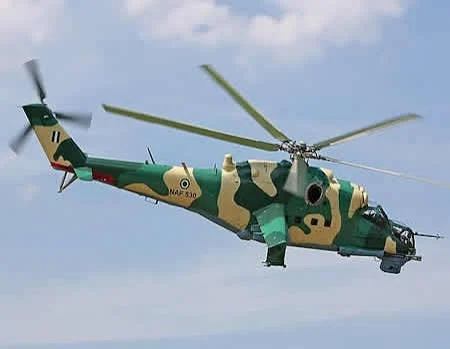
The Nigerian Air Force (NAF) has unveiled a comprehensive operational report detailing its contributions to national security between November 2025 and September 2026. The data, released by the Director of Public Relations and Information, Air Commodore Ehimen Ejodame, serves as a cornerstone of the service’s performance appraisal as it marks the first anniversary of Air Marshal Sunday Aneke’s tenure as Chief of the Air Staff (CAS). The figures highlight a period of intense aerial activity, significant logistical investment, and a major push toward technological self-reliance and fleet modernization.
According to the official communique, the NAF logged more than 6,100 flying hours across 2,900 distinct sorties. These operations were sustained by a massive consumption of 10 million litres of Jet A-1 aviation fuel, underscoring the scale of the service’s commitment to neutralizing threats across Nigeria’s volatile security landscape. The operations were not merely exercises in presence; they were precision-targeted missions designed to degrade the capabilities of non-state actors, dismantle insurgent supply lines, and provide critical support to ground forces engaged in counter-insurgency and counter-terrorism campaigns.
Operational Strategy and Intelligence-Led Warfare
The NAF’s methodology over the past eleven months has been defined by a pivot toward "intelligence-led mission planning." Moving away from conventional patrols, the service has prioritized actionable intelligence to ensure that every litre of fuel burned and every hour flown contributes directly to a measurable strategic outcome.
Air Commodore Ejodame emphasized that the missions comprised a blend of precision air strikes, armed reconnaissance, surveillance, and close air support. By leveraging advanced intelligence, the NAF has been able to disrupt the freedom of movement of hostile elements, thereby enhancing the operational effectiveness of surface forces. This synergy between air power and ground maneuvers has been a hallmark of Air Marshal Aneke’s leadership, aimed at minimizing collateral damage while maximizing the impact on enemy combatants.
Fleet Modernization: Enhancing Combat Capability
A critical component of the NAF’s recent success is its aggressive fleet modernization agenda. Recognizing that aging platforms require excessive maintenance and offer limited combat utility, the service has embarked on a multi-pronged acquisition and reactivation strategy.
In September 2026, the NAF welcomed five new helicopters into its inventory: three AW-109 Trekker Type B helicopters and two H125 helicopters. These assets are specifically tailored for surveillance, rapid deployment, and utility roles, filling gaps in the NAF’s regional response capacity. Looking ahead, the service is currently pursuing the procurement of 12 AH-1Z attack helicopters—a move widely seen by defense analysts as a game-changer for the NAF’s offensive capabilities. These platforms are renowned for their agility, advanced sensor suites, and heavy ordnance capacity, which will significantly bolster the service’s ability to conduct long-range interdiction missions.
The commitment to maintenance is equally evident in the international efforts to revive existing platforms. Six L-39ZA aircraft are currently undergoing deep-level reactivation and technical upgrades in Slovakia and Nigeria. Furthermore, a C-130 Hercules transport aircraft is undergoing periodic depot maintenance in Portugal, ensuring that the NAF’s airlift capacity remains robust enough to support troops deployed in frontline theaters.
Welfare for Enhanced Warfare: Human Capital Development
Air Marshal Aneke has anchored his command philosophy on the principle of "Welfare for Enhanced Warfare." The underlying premise is that technical superiority is redundant if the personnel operating the hardware are not adequately supported. To this end, the NAF has implemented a series of welfare reforms ranging from salary and allowance adjustments to significant improvements in medical support and on-base infrastructure.
The service has prioritized the revitalization of welfare airlift services, ensuring that personnel deployed in the most challenging operational zones are not disconnected from their families or the logistical support necessary to maintain morale. This human-centric approach is complemented by an aggressive promotion cycle. During the reporting period, 57 senior officers were elevated to the ranks of Air Vice Marshal and Air Commodore, while 3,470 senior non-commissioned and non-commissioned officers were promoted.
Education and professional development have also seen record investment. More than 550 personnel have been sent on international training programs to gain specialized competencies, while over 6,000 personnel have undergone local training. These programs are designed to transition the NAF into a more technically proficient, data-driven, and disciplined force.
Infrastructure and Indigenous Innovation
The physical footprint of the NAF is undergoing a massive transformation. With 284 projects approved, 145 completed, and 139 currently in progress, the service is systematically upgrading its residential, academic, and administrative facilities. These projects are not restricted to barracks alone; they include electricity, water supply, and recreational facilities, which contribute to the holistic well-being of the NAF community.
Perhaps most significantly, the NAF is pushing for "indigenous capacity." The service has successfully moved into local production for essential operational components, such as Aircraft Release Device 863 impulse release cartridges and a 250-kilogramme bomb-loading trolley. Furthermore, the development and ground testing of locally produced 57-millimetre rockets signify a major step toward reducing dependence on foreign military imports, which are often subject to supply chain delays and geopolitical constraints.
Strengthening Accountability and Safety
In a move to modernize its institutional governance, the NAF has established an Operational and Safety Audit Committee. This committee is tasked with reviewing every aspect of flight safety and operational conduct. Parallel to this, the NAF is developing standardized structures to mitigate and respond to civilian harm. By training personnel on the nuances of civilian protection and enhancing its investigation capabilities, the NAF is signaling a shift toward greater accountability—an essential factor in maintaining the "hearts and minds" of the civilian population in conflict-affected areas.
Furthermore, the announcement of plans to establish an Open-Source Intelligence (OSINT) Centre represents a forward-thinking move to integrate modern digital tools into military decision-making. By analyzing publicly available data and utilizing emerging technologies, the NAF intends to improve its situational awareness, thereby reducing the "fog of war" that often complicates counter-insurgency operations.
Analysis: Implications for National Security
The data provided by the NAF suggests a shift from reactive military engagement to a more proactive, sustainable, and technologically integrated operational model. The focus on intelligence-led sorties and local manufacturing reflects an understanding that Nigeria’s security challenges—ranging from banditry in the North-West to insurgency in the North-East—cannot be solved through brute force alone.
The 10 million litres of fuel consumed are a testament to the intensity of the air campaign, but the true metric of success for the NAF remains the "effectiveness of surface forces." By disrupting hostile freedom of action, the NAF provides the necessary air cover for ground troops to clear, hold, and rebuild territories. The emphasis on civil-military relations, through healthcare and educational initiatives, also suggests that the military leadership is acutely aware of the necessity of community cooperation in intelligence gathering.
As the NAF enters the second year of Air Marshal Aneke’s leadership, the challenge will be to sustain this momentum. The transition to the AH-1Z attack helicopters and the expansion of the OSINT capabilities will require continuous investment and high-level technical training. However, the current trajectory—defined by a balanced focus on hardware modernization, personnel welfare, and indigenous industrialization—positions the NAF as a central pillar of Nigeria’s national defense architecture.
The service remains committed to the principle that airpower is a strategic asset. By refining its maintenance schedules, deepening its strategic partnerships, and fostering professional growth within its ranks, the Nigerian Air Force is positioning itself to be more than just a combatant; it is evolving into a professional institution capable of navigating the complex, multi-dimensional security environment of the mid-2020s. The results of the past eleven months offer a clear indicator that the "Welfare for Enhanced Warfare" agenda is not just a slogan, but a tactical and organizational framework designed to secure Nigeria’s future.