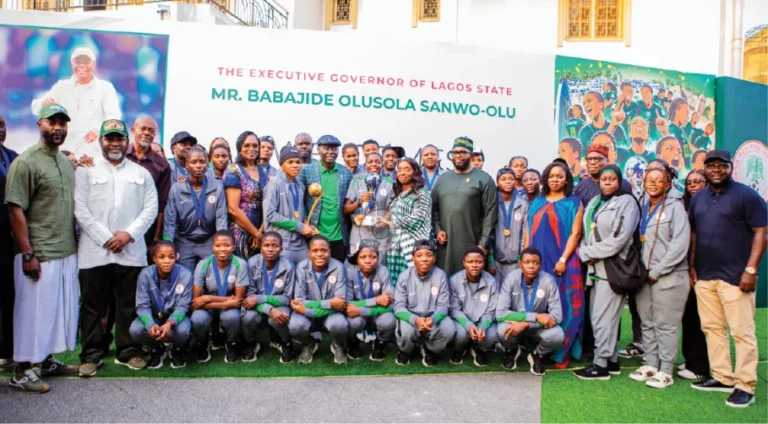
The Lagos State Government recently played host to the triumphant Nigeria U-17 women’s national team, the Flamingos, at a celebratory dinner held at the Lagos House in Marina. While the event featured tangible rewards—including cash gifts and high-end communication devices—the discourse led by Governor Babajide Sanwo-Olu transcended material incentives. Instead, the occasion served as a platform for a profound dialogue on the rigors of professional athleticism, the necessity of long-term discipline, and the strategic path required for these young athletes to transition into the senior national team, the Super Falcons.
A Historic Achievement on the Global Stage
The Flamingos’ victory at the FIFA U-17 Women’s World Cup in Morocco represents a watershed moment for Nigerian football. For years, the nation has sought to bridge the gap between regional dominance and global competitiveness. By securing the trophy, the team did more than just add a new line to the record books; they fundamentally shifted the perception of Nigerian youth football on the international stage.
The tournament in Morocco was a test of resilience. Competing against established footballing powerhouses—nations with decades of investment in youth development and structured grassroots systems—the Flamingos demonstrated tactical maturity and mental fortitude. The campaign was characterized by high-scoring matches, a disciplined defensive structure, and a collective spirit that analysts have described as the "gold standard" for future youth squads.
Chronology of a Championship Run
The journey to the title was not without its hurdles. Following the initial announcement of the squad, the team faced scrutiny from a domestic fan base that had grown weary of underwhelming performances by Nigeria’s senior national teams in previous cycles.
- Qualification Phase: The Flamingos navigated a grueling qualifying campaign, overcoming sub-regional rivals to secure their ticket to Morocco.
- Group Stage Dominance: Upon arrival in Morocco, the team established a rhythm early, winning their opening fixtures and signaling their intent to challenge for the title.
- The Quarter-Final Shift: It was during the knockout stages that the public interest in Nigeria peaked. As the team dismantled tactical setups from traditional giants like Brazil and Japan, the domestic narrative shifted from skepticism to overwhelming support.
- The Final Triumph: The ultimate victory served as a validation of the technical crew’s approach, cementing the players’ status as national heroes and bringing a sense of pride to a country often divided by its sporting narratives.
Sanwo-Olu’s Call for Sustained Excellence
During the reception, Governor Sanwo-Olu emphasized that the U-17 title should be viewed as a foundational milestone rather than a career zenith. Drawing parallels to the careers of established stars like Asisat Oshoala and Rasheedat Ajibade, the Governor highlighted that the transition from youth football to professional prominence is fraught with challenges.
"At this stage, you have not yet reached the height of your careers," Sanwo-Olu noted. "This is the first stage. You have to work even harder because the competitive landscape is constantly evolving. When you move to the U-20 level, the competition intensifies. Players who missed out on this squad will be training with even greater intensity, and you must stay ahead of the curve."
His message was clear: success in youth sports is a fleeting metric if not backed by a commitment to physical and cognitive development. He urged the players to remain disciplined, avoid the pitfalls of early fame, and focus on their academic and professional growth at their respective clubs.
The Role of Technical Leadership
A significant portion of the Governor’s address was dedicated to head coach Akeem Busari and his technical staff. In modern football, the relationship between a coach and a youth squad is as much about mentorship as it is about tactics. The Governor credited the coaching staff for maintaining the team’s focus during moments of extreme pressure.
"If we win a World Cup, it is not by chance," Sanwo-Olu remarked. "You saw the Brazilians and the Japanese; they were visibly devastated by the loss. That intensity is what you faced. The credit goes to the coaches for pushing these young women beyond their perceived limits and for ensuring that they maintained the mental discipline required to perform under global spotlights."
Socio-Economic and Cognitive Implications of Sports
Beyond the accolades, the Governor reflected on the broader societal utility of sports. He posited that the benefits of athletic competition extend far beyond financial remuneration. According to the Governor, sports act as a "strong social enabler" that triggers cognitive growth, stimulates strategic thinking, and fosters psychological resilience.
For young women in Nigeria, the success of the Flamingos carries extra weight. By breaking barriers and achieving success on the world stage, these players have provided a roadmap for gender equity in sports. The Lagos State Government’s commitment to monitoring their progress indicates a move toward a more structured "athlete-care" model, where the state maintains an interest in the player’s development even after the initial celebration.
The Path Forward: Challenges and Opportunities
While the celebration in Lagos was a moment of unity, it also highlighted the systemic challenges facing Nigerian football. The need for consistent investment in grassroots infrastructure remains paramount. The transition from the U-17 level to the senior level is often where promising careers stall due to a lack of professional opportunities or mentorship.
Analysts suggest that for this generation of Flamingos to succeed, several conditions must be met:
- Structured Mentorship: Connecting these young players with established professionals to navigate the complexities of international club football.
- Academic Integration: Ensuring that the pursuit of professional football does not come at the expense of education, a point strongly advocated by the Governor.
- Institutional Support: The Nigeria Football Federation (NFF) and the National Sports Commission must collaborate to ensure that these players have a clear path to the U-20 and, eventually, the Super Falcons.
Governor Sanwo-Olu’s promise to personally monitor the progress of the team signals a proactive approach to state-level sports management. By keeping the lines of communication open, the Lagos State Government hopes to avoid the "lost generation" phenomenon, where youth champions fail to make a mark on the senior circuit.
Conclusion: A Legacy in the Making
The reception of the Flamingos at the Lagos House was more than a ceremonial gesture; it was a rallying cry for the next generation of Nigerian female athletes. The Governor’s message served to ground the players, reminding them that the trophy in their possession is a result of past labor, but their future is entirely dependent on their present choices.
As the team disperses to their various clubs and academic institutions, the challenge will be to maintain the "Flamingo spirit"—a combination of technical skill, tactical discipline, and, most importantly, the hunger to improve. For Nigeria, the hope is that this victory is not an isolated incident but the beginning of a sustained era of dominance in women’s football. With the right support, continued investment, and the internal drive emphasized by the state leadership, these young women are well-positioned to become the next generation of global icons, carrying the flag of the nation to even greater heights on the international stage.