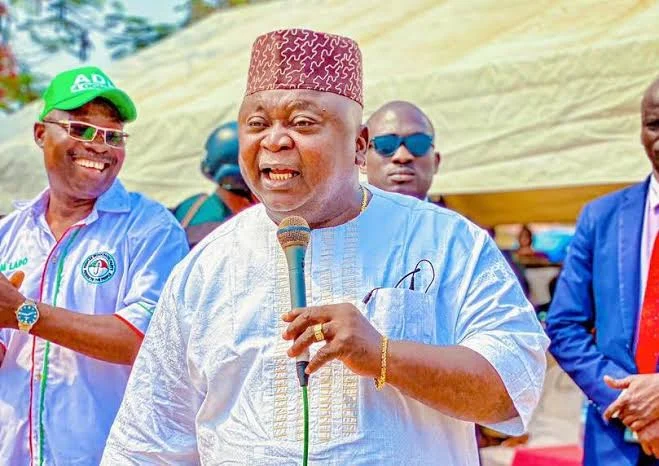
Oladipupo Adebutu, the Peoples Democratic Party (PDP) governorship aspirant for Ogun State, has ignited a fresh debate on fiscal federalism and grassroots governance, pledging to restore full financial autonomy to local government councils if elected in 2027. His bold declaration, made during a pivotal meeting with the revered Egba Traditional Council, came alongside a scathing accusation that governors across Nigeria, irrespective of party affiliation, are systematically diverting statutory allocations meant for local governments. This assertion immediately positions local government autonomy as a central tenet of his nascent campaign, aiming to resonate with citizens yearning for development at the closest tier of government.
The pronouncements unfolded on a Sunday at the historic Ake Palace in Abeokuta, the ancestral seat of the Egba people. Adebutu’s visit was not merely a courtesy call but a strategic political overture, seeking the blessings, counsel, and unwavering support of traditional rulers for his gubernatorial ambition. The optics of such a meeting underscore the enduring influence of traditional institutions in shaping political narratives and garnering grassroots legitimacy in Nigeria. Accompanied by a formidable retinue of party stalwarts, including his running mate, Lateefat Sowunmi-Kolapo; the PDP candidate for Ogun Central Senatorial District, Iyabo Obasanjo; and the Ogun State PDP Chairman, Abayomi Tella, Adebutu articulated a vision centered on empowering local communities through direct access to their constitutionally mandated funds.
The Core Allegation: A Systemic Breach of Fiscal Trust
Adebutu’s central accusation—that governors are siphoning local government allocations—is not new in Nigeria’s political discourse but gains significant weight when voiced by a prominent political figure seeking high office. He explicitly stated, "It’s not a party thing. Both APC and PDP, all the governors are embezzling local government allocations. It’s not a secret." This assertion implies a bipartisan failure in upholding the principles of fiscal decentralization and casts a shadow over the integrity of governance at the state level. The alleged diversion of funds is widely believed to be a primary inhibitor of grassroots development, contributing to the decay of local infrastructure, inadequate social services, and the general disenfranchisement of rural and semi-urban populations.
His pledge to rectify this perceived systemic abuse forms the bedrock of his policy agenda. "I will do something that will stun this nation and put us in the right direction. Local governments shall get their own money," Adebutu declared before the monarchs. This promise transcends mere rhetoric, touching upon a deep-seated grievance among many Nigerians who observe their local councils struggling to deliver basic services despite constitutional provisions for their funding. The implications of such a policy, if implemented, would be profound, potentially reshaping the dynamics of power and resource distribution within the Nigerian federation.
Strategic Engagement with Traditional Authorities and Political Allies
The choice of the Egba Traditional Council as the platform for this significant declaration highlights the strategic importance of traditional rulers in Nigeria’s political landscape. These custodians of culture and tradition command immense respect and influence within their domains, often serving as critical intermediaries between the government and the populace. Their endorsement, or even their mere reception of a candidate, can significantly boost a politician’s credibility and electoral prospects. For Adebutu, securing the blessings of Oba Adedotun Aremu Gbadebo, the Alake and Paramount Ruler of Egbaland, and other esteemed monarchs, is a crucial step in building a broad-based coalition of support ahead of the 2027 elections.
The presence of other key PDP figures further solidified the collective resolve of the party. Lateefat Sowunmi-Kolapo, as the aspiring deputy governor, appealed directly to the people of Egbaland, emphasizing her commitment to regional development. Iyabo Obasanjo, a prominent political figure and daughter of former President Olusegun Obasanjo, lent significant weight to Adebutu’s campaign. Her presence and endorsement, particularly after her past political affiliations, signal a strategic alignment and a belief in Adebutu’s vision. She asserted that Adebutu possessed the "vision and political will to actualize the aspirations" she held for the people, maintaining that the PDP currently boasts the strongest political team in Egbaland. These endorsements are designed to project a unified front and demonstrate widespread confidence in Adebutu’s leadership capabilities.
The Enduring Quest for Grassroots Empowerment: A Historical Context
The debate surrounding local government autonomy is deeply entrenched in Nigeria’s political history, dating back to the pre-colonial and colonial eras, and intensified post-independence. The 1976 local government reforms, often considered a landmark, aimed to bring government closer to the people by granting local councils greater administrative and fiscal responsibilities. However, subsequent military regimes and even democratic dispensations have often eroded these gains.
Constitutionally, local governments are recognized as the third tier of government. Section 7 of the 1999 Constitution (as amended) guarantees the system of democratically elected local government councils. More critically, Section 162 outlines the Federation Account and specifies the distribution of revenue. It mandates that a portion of the Federation Account be allocated to local governments. However, it also establishes the controversial State-Local Government Joint Account (JAC), managed by state governments. This joint account mechanism is widely identified as the primary conduit through which state governors allegedly divert or control local government funds, thereby stifling their financial independence.
Over the years, numerous attempts have been made, particularly through constitutional review processes, to amend these provisions and grant full financial and administrative autonomy to local governments. Bills aimed at delinking local governments from state control and ensuring direct remittances of their allocations from the Federation Account have repeatedly passed through the National Assembly but have often failed to secure the requisite concurrence from two-thirds of state Houses of Assembly. This consistent failure underscores the vested interests of state governors in maintaining control over local government finances, viewing it as a critical source of political patronage and influence. The timeline of these legislative efforts, spanning multiple National Assembly sessions, highlights the formidable political resistance to genuine local government fiscal independence.
Unpacking Local Government Finances and Development Deficits
Local governments in Nigeria are primarily funded through two main sources: statutory allocations from the Federation Account and internally generated revenue (IGR). The Federation Account Allocation Committee (FAAC) distributes revenue among the federal, state, and local governments. Historically, local governments are constitutionally entitled to about 20.6% of the Federation Account, alongside a share of the Value Added Tax (VAT) and other specific revenue streams. However, the operational reality often deviates significantly from this constitutional provision due to the existence and operation of the Joint Account.
When funds are channeled through the state-local government joint account, governors often exercise considerable discretion over their disbursement. This control can manifest in several ways:
- Direct Diversion: Funds meant for local governments are allegedly re-routed to state projects or personal coffers, often without clear accounting.
- Unilateral Deductions: States frequently make arbitrary deductions for various "joint projects," "state services," or even staff salaries and pensions without adequate consultation or transparency with the local councils.
- Ghost Projects: Funds are sometimes allocated to non-existent projects or to contractors linked to state officials, leading to significant financial leakages.
- Wage Bill Control: States sometimes assume control over the payment of local government salaries, using it as a centralizing mechanism and often leading to delayed payments or underpayment, further debilitating local councils.
The consequence of this alleged financial strangulation is devastating for grassroots development. Local governments, envisioned as engines of progress and the closest tier of governance to the people, are rendered largely impotent. Essential services like primary healthcare, basic education, rural road maintenance, waste management, and local market development suffer immensely. This deficit in service delivery contributes significantly to rural-urban migration, exacerbates poverty, and erodes public trust in democratic governance. The inability of local councils to execute meaningful projects due to lack of funds leads to a perception of their irrelevance, further weakening their institutional capacity and accountability to the people they are meant to serve. Data from various civil society organizations consistently points to a direct correlation between the lack of local government autonomy and the prevalence of underdevelopment in rural areas across Nigeria.
A Blueprint for Development and Fiscal Prudence
Beyond his commitment to local government autonomy, Adebutu also outlined a broader vision for Ogun State’s development, emphasizing fiscal responsibility. He advocated for a paradigm shift away from what he termed "dependence on borrowing for infrastructure." "You don’t borrow money for infrastructure anymore," he stated, signaling a potential move towards more innovative and sustainable funding models, possibly through public-private partnerships, improved internally generated revenue (IGR) strategies, or prudent management of existing resources. This approach, if successfully implemented, could free the state from the burden of escalating debt, allowing for more substantial and impactful development projects that are less susceptible to external economic shocks.
A significant focus of his infrastructure plan is to strengthen connectivity between Ogun State and Lagos. Given Ogun State’s strategic location as a gateway to Nigeria’s economic capital, improved road networks and transportation infrastructure would unlock immense economic potential, facilitate trade, ease movement of goods and people, and attract investment. Such projects would not only enhance regional integration but also create jobs and stimulate local economies. This vision aligns with the broader economic imperative of fostering regional hubs and leveraging geographical advantages for sustainable growth.
Adebutu also leveraged his past public service record in the National Assembly to buttress his claims of integrity. "I have been reiterating to you that I, Oladipupo Olatunde, son of Adebutu, was at the National Assembly twice, and I can boast that I didn’t embezzle public funds. How many politicians can say this?" he challenged. This direct appeal to his personal integrity is a calculated move to differentiate himself from the pervasive perception of corruption in Nigerian politics and to build trust among the electorate. In a political climate often characterized by allegations of malfeasance, a politician who can credibly claim a clean financial record holds a significant advantage and can inspire confidence among a jaded populace. His two terms in the National Assembly provide a timeline of his legislative experience and offer a basis for voters to assess his claims of financial probity.
Political Allies and Traditional Affirmations
The gathering at Ake Palace served as a powerful platform for Adebutu’s allies to articulate their support and reinforce the PDP’s agenda. Abayomi Tella, the Ogun State PDP Chairman, passionately lamented the "collapse of the local government system" in the state, directly attributing it to the absence of financial autonomy. He drew on his personal experience as a former local government chairman, recalling a period when he received a substantial allocation of N200 million, which he successfully utilized to construct four roads within his council area. This anecdote served as a poignant contrast to the current predicament, where many incumbent chairmen struggle to execute even minor projects due to financial constraints. Tella’s testimony added practical credence to Adebutu’s pledge, vouching for his commitment and preparedness to steer Ogun State towards development.
Lateefat Sowunmi-Kolapo, Adebutu’s running mate, appealed to the Egbaland community for support, emphasizing her long-standing commitment to the development of the area. Her presence as a female political leader from the region is designed to broaden the appeal of the ticket and tap into local sentiments.
Iyabo Obasanjo’s endorsement was particularly noteworthy. Having previously been associated with other political leanings and experienced an unsuccessful governorship bid, her decision to back Adebutu signifies a strategic shift and a belief in his capacity to deliver. She asserted that Adebutu possessed the "vision and political will to actualize the aspirations" she held for the people. Her declaration that the PDP has the "strongest political team in Egbaland" was a clear call to action for the traditional rulers and the electorate to support the party in the upcoming 2027 elections.
Perhaps the most significant endorsement came from the Alake and Paramount Ruler of Egbaland, Oba Adedotun Aremu Gbadebo. Describing Adebutu as a "trustworthy and dependable leader," the monarch expressed confidence in his character and leadership. His proverb, "The son of a lion must resemble the lion. In fact, he is an even better version of his father," served as a powerful traditional affirmation, linking Adebutu’s leadership qualities to the esteemed legacy of his father, Chief Kessington Adebutu, a renowned philanthropist and businessman. Such a blessing from a revered monarch carries significant weight and can sway public opinion within the traditional domain, particularly in rural and semi-urban areas where traditional authority remains strong.
The Path Forward: Implications and Hurdles for Grassroots Governance
Adebutu’s pledge, if pursued vigorously and successfully implemented, carries far-reaching implications for governance in Nigeria. Granting full financial autonomy to local governments would fundamentally alter the federal-state-local government power dynamics. It would empower local councils to directly receive and manage their allocations, enabling them to respond more effectively to the immediate needs of their communities. This could lead to a resurgence of grassroots development, improved service delivery, and enhanced accountability as local leaders become directly answerable to their constituents for resource management.
However, the path to full autonomy is fraught with challenges. Beyond overcoming the entrenched resistance from state governors, who benefit immensely from the current joint account system, there are significant administrative and capacity-building hurdles. Many local governments currently lack the robust institutional frameworks, skilled personnel, and transparent accountability mechanisms required to effectively manage substantial funds. Without proper oversight, there is a risk that autonomy could lead to increased corruption or mismanagement at the local level. Therefore, any move towards autonomy must be accompanied by comprehensive reforms in local government administration, including capacity building, stringent auditing processes, and community participation frameworks to ensure prudent and transparent use of funds. The lack of regularly conducted local government elections in many states, leading to the appointment of caretaker committees, further complicates the accountability structure.
The political implications for the 2027 elections in Ogun State are also significant. Adebutu’s strong stance on local government autonomy could emerge as a defining campaign issue, potentially mobilizing a substantial segment of the electorate that feels neglected by the current system. It could force other gubernatorial aspirants to articulate their own positions on this critical matter, thereby enriching the electoral discourse. Nationally, if a state successfully implements full LG autonomy, it could set a precedent and exert pressure on other states to follow suit, potentially catalyzing a long-overdue reform of Nigeria’s federal structure and deepening democratic principles.
Divergent Views and the Call for Accountability
While Adebutu’s allegations resonate with a widespread perception, incumbent state governments and other political parties would likely offer counter-arguments. They might defend the joint account system as a necessary mechanism for coordinated development planning, ensuring fiscal discipline, or addressing disparities among local councils. Some might argue that local governments lack the capacity for independent financial management or that the state government acts as a benevolent overseer. However, these defenses often fail to address the core concern of transparency and accountability regarding the specific allegations of diversion and the observable lack of grassroots development.
Civil society organizations and good governance advocates have consistently championed local government autonomy, viewing it as essential for democratic deepening and sustainable development. Their perspectives often highlight the need for constitutional amendments that remove the joint account, ensure direct funding, and establish independent oversight bodies for local government finances. Their advocacy provides a crucial non-partisan voice in this ongoing debate, pushing for reforms that prioritize the welfare of citizens at the grassroots. Economists generally agree that fiscal decentralization, when properly managed with robust accountability, leads to more efficient resource allocation and better service delivery, but caution against implementing it without adequate local capacity.
In conclusion, Oladipupo Adebutu’s impassioned pledge for full local government financial autonomy, coupled with his stark allegations against state governors, injects a critical and timely issue into the political discourse ahead of the 2027 Ogun State gubernatorial elections. His vision, supported by key party figures and blessed by influential traditional rulers, aims to tackle a fundamental flaw in Nigeria’s federal system that has long hampered grassroots development. While the implementation of such a policy presents considerable challenges, the debate it sparks is vital for re-evaluating the efficacy of governance at all tiers and for charting a course towards a more equitable and responsive democratic future for Nigeria. The coming political season will undoubtedly see this crucial issue take center stage, as citizens demand tangible solutions to the perennial problem of local government incapacitation.