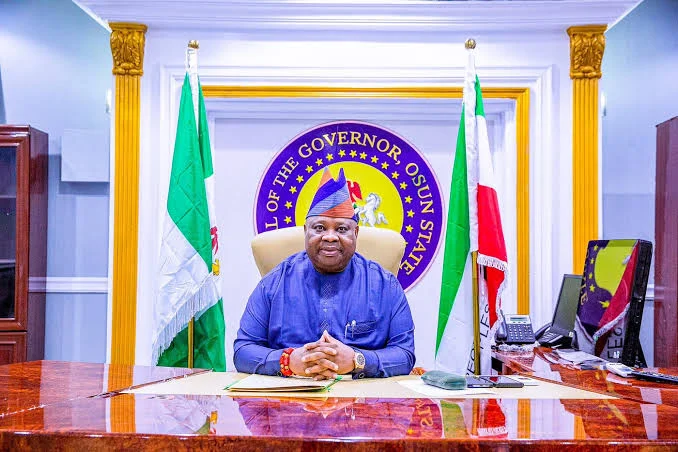
Osun State Governor, Ademola Adeleke, has vehemently condemned what he described as the deliberate sabotage of a section of the newly commissioned Lameco Bridge in Osogbo, directly accusing unnamed political adversaries of orchestrating the vandalism of public infrastructure for political expediency. The governor’s strong denunciation came on Friday following an on-site inspection of the damaged portion of the bridge. In response to the incident and a similarly reported issue at the Lagere Flyover, Governor Adeleke issued a directive for immediate and enhanced security surveillance of all major public infrastructure projects across the state.
Background and Chronology of Events
The controversy surrounding the Lameco Bridge began to unfold recently, casting a shadow over a project intended to enhance connectivity and economic activity within Osogbo, the state capital. The bridge, a significant infrastructure development, was officially commissioned on July 1st, marking a milestone for the administration and the residents of Osun State. However, less than a month after its inauguration, a structural defect was reportedly discovered, leading to its temporary closure to traffic. This discovery immediately triggered concern and suspicion regarding the integrity of the construction and the circumstances leading to the alleged defect.
The initial reports of a structural issue quickly escalated into allegations of deliberate sabotage. The Osun State chapter of the Accord Party was among the first to publicly point fingers, suggesting that elements within the opposition All Progressives Congress (APC) were responsible for the damage, aiming to discredit the current administration’s developmental efforts. This accusation immediately ignited a political firestorm, with the APC vehemently denying any involvement. The opposition party countered by suggesting that the reported defects might stem from inherent structural deficiencies in the project itself, questioning the quality of work rather than attributing it to malicious intent. In response to these conflicting claims, the APC has called for an independent structural integrity assessment of the bridge, a move that underscores the deep-seated political divisions surrounding the incident. The state government, however, remains firm in its assertion that the damage was a result of intentional vandalism.
Governor Adeleke’s Accusations and Official Response
Governor Adeleke, in his address following the inspection, did not mince words. He expressed profound concern over the incident, relaying information received from engineers within the Ministry of Works and Infrastructure. The governor characterized the alleged acts as fundamentally anti-developmental, asserting that politicians should instead focus on engaging with the electorate through the presentation of their policy proposals and track records.
"This is no longer politics," Governor Adeleke stated emphatically, as quoted in a statement released by his spokesperson, Olawale Rasheed. "Election is about the people voting for the leaders of their choice. Our job as politicians is to market our plans and records. Why would any genuine politician arrange to destroy a beautiful edifice like the Lameco Bridge because of an election? That conduct is a hate crime against the people of Osun State."
He further elaborated on the moral implications of such actions, directly implicating the Osun APC. "It is so immoral that Osun APC is not even ashamed of its masterminding such sabotage. I call on politicians to play the politics of development. These infrastructures were built with public funds. Why should we endanger the lives of our people and waste public resources simply because of elections?"
The governor lauded the swift response of the engineers from the Ministry of Works and Infrastructure. His directive for enhanced surveillance of public assets reflects a broader strategy to safeguard the state’s developmental gains. "I hereby direct immediate surveillance and monitoring of key infrastructures. We must secure public assets in the best interest of the state and her residents," he declared. This measure aims to deter future acts of vandalism and ensure the longevity of public projects.
Supporting Data and Broader Implications
The Lameco Bridge project, like many public infrastructure initiatives, represents a significant investment of public funds. While specific financial details of the Lameco Bridge construction were not immediately available in the initial report, infrastructure projects of this magnitude typically involve substantial budgetary allocations. For instance, similar bridge construction projects in Nigeria have seen costs ranging from hundreds of millions to billions of Naira, depending on their scale, complexity, and location. The financial implications of vandalism are therefore considerable, not only in terms of the direct cost of repairs but also the disruption to economic activities and the potential loss of public trust.
The commissioning of the Lameco Bridge was intended to alleviate traffic congestion, improve commuter experience, and potentially boost local commerce by enhancing accessibility. Its closure, even temporarily, negates these intended benefits and can lead to increased travel times, higher transportation costs for businesses, and general inconvenience for residents. The alleged sabotage, if proven, represents not just an attack on physical infrastructure but also an attack on the progress and well-being of the citizens of Osun State.
Analysis of Political Motivations and Consequences
The accusations of political sabotage, particularly directed at the APC, highlight the often-intense political rivalries that characterize Nigerian governance. In a political landscape where electoral outcomes are fiercely contested, opposition parties may resort to various strategies to undermine the incumbent administration. Sabotaging public projects, especially those recently commissioned and symbolic of development, can be seen as a tactic to create negative perceptions and sow doubt about the government’s competence and ability to deliver.
However, such actions carry significant risks. Public condemnation of vandalism is generally high, and being associated with such acts can be politically damaging. The APC’s denial and counter-accusations suggest a strategy of deflection and an attempt to shift the narrative towards questioning the project’s quality. The call for an independent assessment could be a genuine request for transparency or a maneuver to further delay any conclusive findings that might implicate them.
The long-term implications of such alleged sabotage extend beyond the immediate repair costs. It can erode public confidence in governance and democratic processes. When public resources are deliberately damaged, it fosters cynicism and a sense of futility regarding developmental efforts. Moreover, it can create a climate of distrust between political actors and the public, hindering constructive political discourse and cooperation.
Governor Adeleke’s directive for enhanced surveillance is a proactive measure to protect state assets. However, the underlying issue of political intolerance and the tendency towards destructive tactics require a deeper societal and political engagement. Promoting a culture of respect for public property and encouraging issue-based politics, where leaders compete on the merit of their ideas and performance, are crucial steps towards mitigating such occurrences in the future.
The incident at the Lameco Bridge serves as a stark reminder of the challenges faced by governments in Nigeria in delivering and maintaining public infrastructure amidst a highly politicized environment. The coming days will likely see further developments as investigations proceed and political actors continue to engage in the ensuing debate, with the integrity and security of Osun State’s public assets at the forefront. The government’s commitment to transparency and swift action in addressing the damage and holding perpetrators accountable will be critical in restoring public confidence.