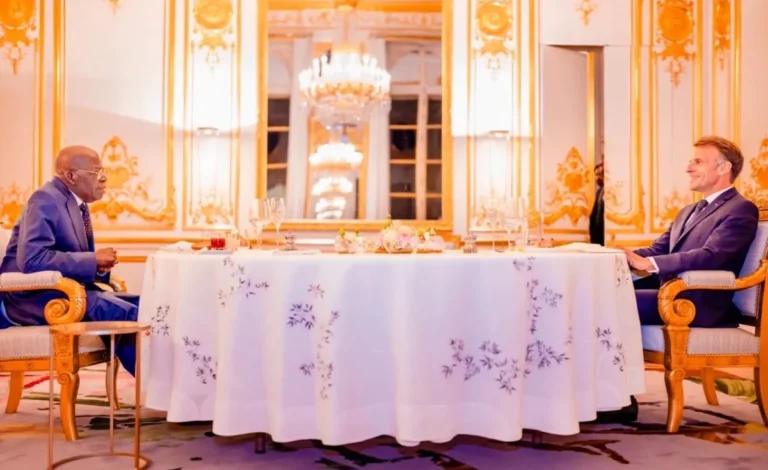
In a significant diplomatic engagement underscoring the deepening ties between West Africa’s largest economy and the European Union’s leading power, President Bola Ahmed Tinubu of Nigeria met with President Emmanuel Macron of France for a private dinner at the historic Élysée Palace in Paris on Thursday evening. The meeting, which occurred during President Tinubu’s ongoing three-week annual leave in Europe, represents the latest in a series of high-level diplomatic exchanges between the two administrations since President Tinubu assumed office in May 2023.
The interaction was confirmed by the President’s Special Adviser on Information and Strategy, Bayo Onanuga, who shared details and official photographs of the event on the social media platform X. While the meeting was private and informal in nature, analysts suggest that such engagements serve as critical conduits for high-level policy alignment, particularly as Nigeria navigates significant macroeconomic reforms and regional security challenges in the Sahel.
A Chronology of Diplomatic Engagement
The relationship between Nigeria and France has seen an accelerated trajectory since the inauguration of the Tinubu administration. President Tinubu has consistently utilized international platforms to signal his commitment to attracting foreign direct investment (FDI) and strengthening traditional alliances.
The current visit to Paris follows a well-defined itinerary. President Tinubu began his three-week annual leave in London, where he conducted a series of private engagements, before traveling to France on Monday. This visit to the French capital is not merely a social call but a continuation of the rapport established between the two leaders over the past eighteen months.
Key milestones in this diplomatic timeline include:
- May 2023: Inauguration of President Tinubu, followed by an immediate invitation for closer economic cooperation with EU member states.
- June 2023: President Tinubu’s participation in the New Global Financing Pact summit in Paris, where he engaged with President Macron to discuss debt sustainability and climate financing for developing nations.
- Late 2023–2024: Multiple ministerial-level meetings focusing on energy transition, agricultural technology, and defense cooperation.
- October 2024: The current private dinner at the Élysée Palace, marking the latest iteration of their sustained dialogue.
Economic and Bilateral Context
Nigeria remains one of France’s most significant trading partners in sub-Saharan Africa. The economic relationship is anchored in the energy sector, but has increasingly expanded into infrastructure, retail, and technology. According to data from the French Ministry of Economy and Finance, bilateral trade between the two nations has historically fluctuated based on crude oil prices, yet there has been a concerted effort to diversify this portfolio.
French companies, including TotalEnergies, have maintained a massive presence in Nigeria’s oil and gas industry for decades. More recently, French firms such as Schneider Electric and various construction conglomerates have looked to capitalize on Nigeria’s infrastructure development needs. The current administration in Abuja, which is aggressively pursuing a fiscal reform agenda—including the removal of fuel subsidies and the floating of the naira—is actively seeking foreign capital to stabilize the economy and stimulate job creation.
While official statements from the Élysée did not disclose specific agreements, the optics of the meeting suggest a focus on "mutual interest." For President Tinubu, whose administration is battling high inflation and a cost-of-living crisis, maintaining a steady, productive relationship with a major G7 leader provides both economic reassurance and political capital.
Official Statements and Diplomatic Messaging
The messaging from both camps emphasized the warmth and strategic importance of the encounter. Bayo Onanuga’s statement highlighted that the dinner served as a reflection of the "enduring relationship" between the two nations and a "shared commitment to strengthening bilateral cooperation."
In a personal statement issued following the event, President Tinubu echoed these sentiments, noting, "Our conversation reaffirmed the strong friendship between Nigeria and France, as well as our shared commitment to deepening cooperation and building a mutually beneficial partnership between our two nations."
The inclusion of the First Lady of France, Brigitte Macron, in the meeting further emphasized the personal nature of the diplomatic rapport between the two leaders, a common feature in high-level statecraft intended to foster trust at the highest level of government.
Strategic Implications for West Africa
The meeting occurs at a delicate time for West African geopolitics. France has seen a recalibration of its influence in the Sahel, particularly following political shifts in Niger, Mali, and Burkina Faso. As a regional hegemon and a leader within the Economic Community of West African States (ECOWAS), Nigeria plays a pivotal role in the stability of the sub-region.
Analysts observe that Paris views Abuja as a essential partner in maintaining regional security and democratic norms. Consequently, the relationship is evolving from a traditional post-colonial commercial partnership into a more complex security and political alliance. By engaging with President Macron, President Tinubu is positioning Nigeria as the primary interlocutor for European interests in West Africa.
Furthermore, the focus on "mutually beneficial partnership" suggests that Nigeria is keen to move beyond being a supplier of raw materials. The Nigerian government’s "Renewed Hope" agenda emphasizes local value addition, particularly in the agricultural and manufacturing sectors. Negotiations regarding French investment in these sectors are likely to be a recurring theme in the background of such high-level dinners.
Analysis: What the Silence Indicates
In professional journalism, the absence of specific details regarding "potential agreements" is often as telling as the meeting itself. When two heads of state meet for a private dinner, the absence of a formal press release containing a list of signed MoUs (Memorandums of Understanding) often suggests that the objective of the meeting was relationship management rather than immediate transactional outcomes.
For a leader in the middle of a complex domestic reform program, the ability to engage with Western leaders on a first-name basis is a significant indicator of international legitimacy. The meeting serves to reassure international markets and multilateral institutions that Nigeria remains a stable, accessible, and friendly destination for foreign investment, despite the temporary volatility associated with its current structural reforms.
Moreover, the timing of this meeting, occurring during a period of annual leave, suggests that the relationship has reached a level of maturity where high-level policy coordination can occur outside of the rigidity of state visits. This fluidity allows for more candid, informal discussions on sensitive regional security concerns, energy transition timelines, and global climate goals.
Future Outlook
As President Tinubu concludes his European trip and prepares to return to the challenges of governance in Abuja, the takeaway from the Paris dinner is clear: the Nigeria-France relationship remains a cornerstone of Nigeria’s foreign policy.
Moving forward, stakeholders in the business community will be watching for tangible outcomes from this meeting. Areas of expected progress include:
- Energy Transition Funding: Potential French support for Nigeria’s gas-to-power initiatives.
- Trade Facilitation: Efforts to simplify bureaucratic processes for French businesses operating in Nigeria.
- Security Collaboration: Enhanced intelligence sharing and technical support regarding regional threats.
In conclusion, while the dinner at the Élysée Palace was characterized by its private and social nature, it underscores a deliberate and sustained effort by the Tinubu administration to solidify its diplomatic standing. By fostering deep personal and strategic ties with leaders like Emmanuel Macron, Nigeria is seeking to ensure that its national interests are protected and advanced within the broader global framework. As the global economic landscape shifts, the strength of these bilateral relationships will continue to serve as a vital buffer and a catalyst for the development goals of the Nigerian state.