
The United States is currently navigating a profound and unprecedented transformation of its public health landscape. Since January 2025, sweeping policy changes driven by the Trump administration—most notably aggressive rollbacks of Medicaid, the systematic dismantling of federal vaccine guidance, and the political purging of career scientific leadership—have sent shockwaves through the nation’s medical infrastructure. While the full cumulative toll of these decisions will take decades to calculate, the immediate fallout is already starkly visible. Communities across the country are grappling with surging rates of vaccine-preventable diseases, worsening maternal health outcomes, and a destabilized healthcare safety net that disproportionately harms low-income families and marginalized populations.
These domestic disruptions unfold against a backdrop of historic healthcare fragility. The United States remains a distinct outlier among developed nations, lacking universal healthcare coverage. Approximately two-thirds of Americans rely on private insurance, while millions remain uninsured or heavily dependent on public assistance programs like Medicaid. It is within this fragile ecosystem that the current administration’s fiscal and ideological interventions are taking root, reshaping everything from childhood immunization schedules to the foundational integrity of federal health agencies.
Fiscal Retrenchment and the Shrinking Safety Net
At the core of the administration’s domestic policy is a dramatic contraction of public health financing. Central to this strategy is a projected $900 billion reduction in federal Medicaid spending between 2025 and 2034. By tightening eligibility requirements and introducing administrative hurdles, the Congressional Budget Office estimates that 10.5 million low-income Americans will lose or face severely reduced health benefits.

Administration officials have framed these measures as necessary fiscal discipline. However, nonpartisan policy analysts note that the savings are largely engineered to offset sweeping tax cuts that preferentially benefit wealthier Americans. The impact of these cuts is not distributed evenly. Rural healthcare facilities, already operating on razor-thin margins, face mounting closure risks. Furthermore, maternal care services and healthcare access for Black and Hispanic communities—populations already experiencing historical health disparities—are projected to bear the heaviest burden.
Compounding these Medicaid reductions, the broader Department of Health and Human Services (HHS) operating budget was slashed by 12.5% for the fiscal year beginning in October 2025. This financial contraction has triggered widespread hiring freezes, delayed research grants, and crippled community health centers. Food support programs for low-income families have similarly experienced budgetary contractions, creating a multi-front retreat from federal social safety nets.
Chronology of a Paradigm Shift: Reshaping Federal Vaccine Policy
The most visible and ideologically charged arena of the administration’s health agenda has been federal vaccine policy. Upon assuming office in late February 2025, HHS Secretary Robert F. Kennedy Jr.—a prominent and long-standing critic of standard immunization protocols—moved swiftly to alter the nation’s approach to infectious disease prevention.
The foundation for this shift was laid during the COVID-19 pandemic, which forged an unlikely political alliance between vaccine skeptics suspicious of mRNA technology and libertarian factions opposed to public health mandates. By May 2025, the Food and Drug Administration (FDA) dramatically narrowed its recommendations for COVID-19 boosters, restricting them primarily to individuals over 65 and those aged 12 and older with specific underlying health conditions.

The overhaul accelerated significantly in June 2025. In an unprecedented move, Secretary Kennedy dismissed all members of the Centers for Disease Control and Prevention’s (CDC) Advisory Committee on Immunization Practices (ACIP), replacing them with individuals known for expressing skepticism toward conventional vaccine safety and efficacy. The newly constituted committee promptly upended decades-old immunization norms, declaring that routine childhood vaccinations for hepatitis A, hepatitis B, meningitis, rotavirus, influenza, and COVID-19 were no longer mandatory standards. Instead, the committee recommended "shared clinical decision-making" between patients, parents, and physicians.
These administrative actions triggered immediate legal pushback. Professional medical associations and a coalition of 14 state attorneys general filed federal lawsuits challenging both the dismissal of the advisory committee and the alteration of the childhood immunization schedule. Although initial judicial rulings found federal overreach in the termination of the ACIP panel, the administration doubled down with executive authority.
In August 2026, President Donald Trump issued a sweeping executive order on childhood immunizations. The decree reduced the recommended slate of childhood vaccines from 18 to 11 and mandated the unbundling of the traditionally combined measles, mumps, and rubella (MMR) vaccine into separate inoculations. Shortly thereafter, HHS canceled $500 million in mRNA vaccine research funding previously allocated through the Biomedical Advanced Research and Development Authority (BARDA), with Secretary Kennedy asserting that the technology posed unwarranted risks.
The Resurgence of Preventable Epidemics
Public health experts and epidemiologists have warned that dismantling long-standing immunization frameworks carries immediate epidemiological consequences. These warnings are now materializing in public health data across the nation.

The United States, which proudly declared the elimination of measles in the year 2000, is currently confronting its most severe measles outbreak in over three decades. According to CDC surveillance data, more than 4,850 cases across 43 distinct outbreaks were recorded by late October 2026—more than double the total caseload of the previous year. The Center for Infectious Disease Research and Policy (CIDRAP) at the University of Minnesota reported consecutive weeks of triple-digit case increases nationwide, warning that the United States is on the precipice of losing its official measles elimination status.
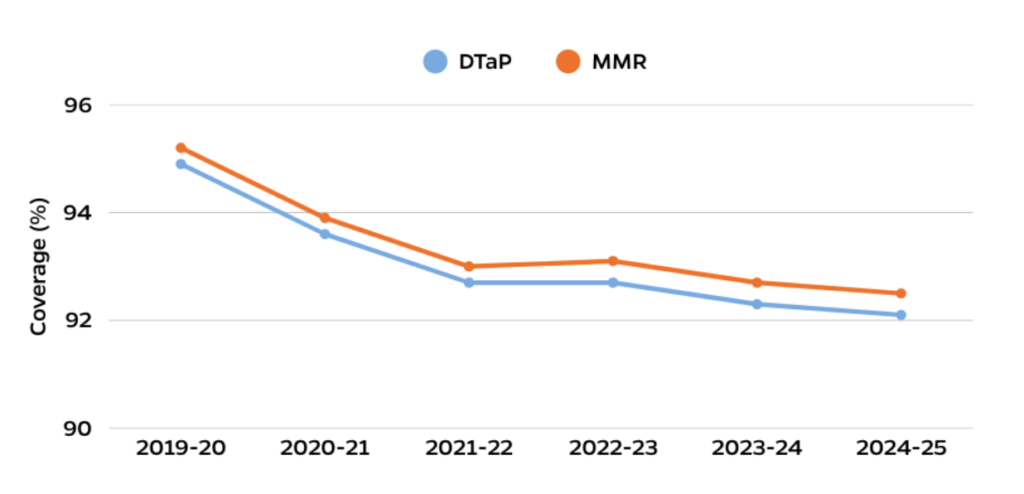
Epidemiological investigations confirm that the outbreaks are directly linked to declining vaccination coverage. Data compiled by Johns Hopkins University indicates that kindergarten vaccination rates for MMR dropped to 92.5% during the 2024–2025 school year, falling well below the 95% threshold required to maintain herd immunity. Similar declines were documented for diphtheria, tetanus, and pertussis (DTaP) and polio immunizations.
Despite mounting infection rates, federal leadership has continued to question standard immunization paradigms. In late 2026, HHS announced the establishment of a dedicated vaccine injury research center within the National Institutes of Health (NIH) and introduced financial incentive programs for physicians reporting adverse vaccine events—moves that critics argue serve to institutionalize unfounded skepticism and further depress uptake rates.
The Exodus of Scientific Leadership
The transformation of federal health policy has been accompanied by a massive turnover of career scientists and institutional leaders. Across the CDC, the NIH, the FDA, and other scientific bodies, at least 25 senior health leaders have been fired, forced to resign, or reassigned, alongside an estimated 10,000 agency staff reductions framed as cost-saving measures.
The CDC has experienced the most severe institutional disruption. In August 2025, Senate-confirmed CDC Director Dr. Susan Monarez was dismissed after refusing to comply with directives from political appointees. In subsequent testimony before a Senate subcommittee, Dr. Monarez stated that she had been instructed to pre-approve all recommendations from the newly reconstituted ACIP regardless of underlying scientific evidence and to purge career officials managing vaccine policy without cause.
Following her dismissal, Dr. Demetre Daskalakis, director of the CDC’s National Center for Immunization and Respiratory Diseases, resigned in protest alongside three other top agency officials. Dr. Daskalakis subsequently wrote that current policies risk echoing historical precedents by promoting natural infection over proven scientific prevention and undermining community health standards for political ends.
Similar purges occurred across the NIH, where nine top officials—including the directors of five constituent research institutes—were forced out. At the FDA, Commissioner Marty Makary was dismissed in May 2025, and subsequent acting leadership was cycled through the agency within weeks. Outside the direct health agencies, the White House abruptly dismissed all 24 members of the National Science Board, drawing sharp rebukes from congressional lawmakers who questioned whether federal scientific advisory bodies were being systematically populated by political loyalists.
Collateral Damage: Maternal Health and Reproductive Care
Beyond immunization policy and institutional restructuring, the intersection of federal health budget cuts and state-level restrictions on reproductive healthcare has severely impacted maternal and infant outcomes.

The United States already maintains the highest maternal mortality rate among high-income nations. Following the overturning of federal abortion protections, restrictive state laws have created an environment of legal uncertainty for obstetricians and gynecologists, complicating emergency interventions during complicated pregnancies and miscarriages.
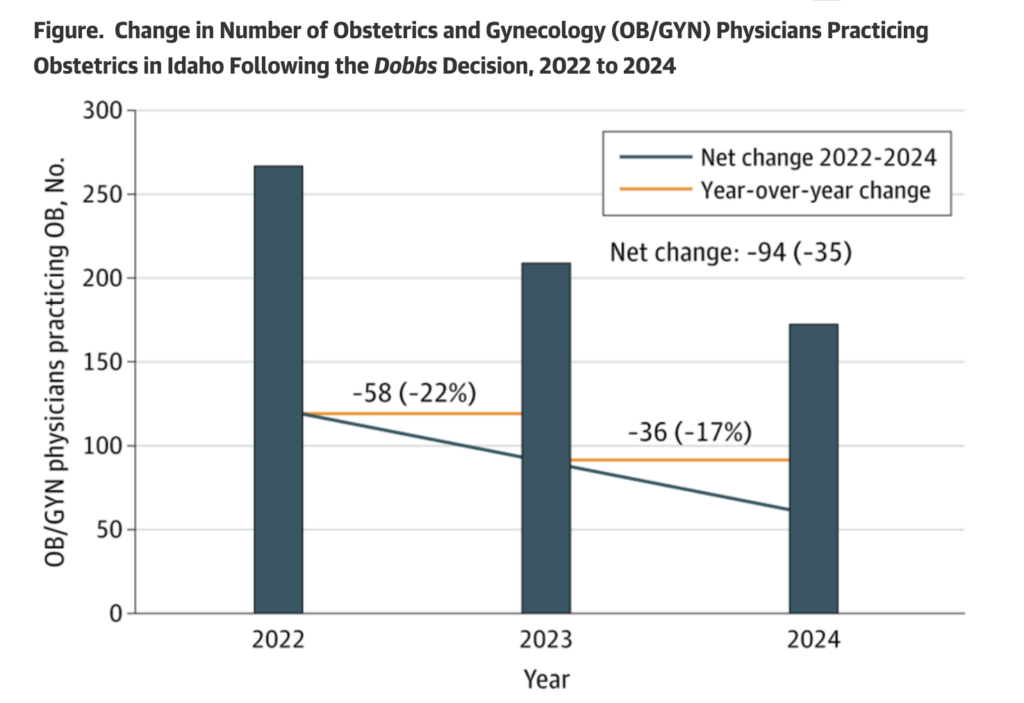
This chilling effect has translated into a measurable flight of medical professionals from restrictive jurisdictions. While 12 states with the most stringent abortion bans have experienced generalized declines in their obstetrician-gynecologist workforces, certain states have faced acute crises. In Idaho, for example, approximately 35% of practicing OB-GYNs have left the state or ceased practicing since the implementation of near-total abortion bans. Consequently, half of Idaho’s counties no longer possess a single practicing obstetrician, forcing rural patients to travel hundreds of miles for routine prenatal care.
Data published in JAMA Open Network further highlights disparities in infant mortality, noting higher death rates in states with restrictive reproductive healthcare laws compared to more permissive jurisdictions. A comprehensive report by the non-profit maternal advocacy group March of Dimes described the nation’s maternal health system as "dangerously stalled," pointing to rising rates of preterm births among women of color and a national decline in early-trimester prenatal care utilization.
Broader Implications and Public Sentiment
The long-term implications of these combined policy shifts—ranging from narrowed Medicaid access and slashed research budgets to the institutionalization of vaccine skepticism and the demoralization of the federal scientific workforce—point toward a systemic deterioration of American public health. Public health economists note that while preventive measures save billions of dollars and countless lives over time, their dismantling creates delayed, cumulative deficits that will be exceedingly difficult to reverse.
Ironically, the political momentum behind these changes was initially fueled by public anxiety over chronic illness and a general distrust of institutional health management. Millions of Americans resonated with the core premise of the "Make America Healthy Again" movement, hoping to address the underlying drivers of chronic disease, such as the pervasive influence of the ultra-processed food industry and rising obesity rates.
However, public health analysts argue that the administration’s actual policy interventions have done little to confront corporate food drivers or metabolic disease. Instead, they have systematically dismantled proven infectious disease controls, weakened the healthcare safety net for low-income populations, and politicized the scientific institutions charged with protecting the nation’s well-being. As preventable outbreaks spread and foundational health infrastructure contracts, the United States faces a defining test of its public health resilience in the decades ahead.