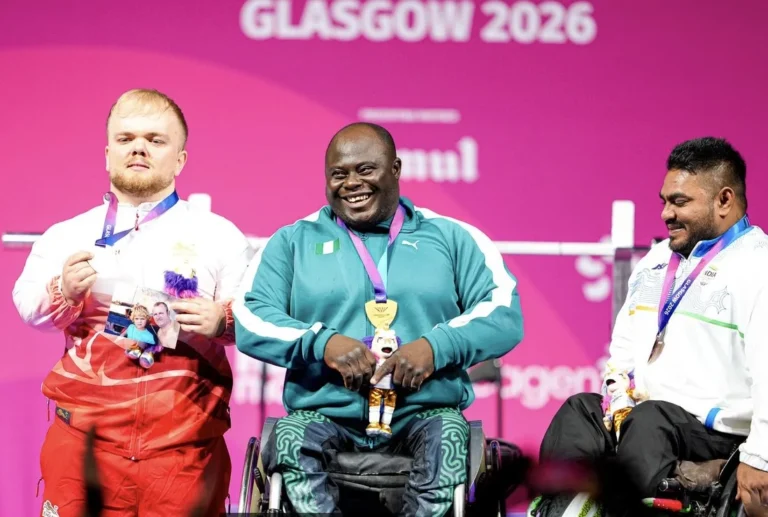
Glasgow, Scotland – The Glasgow 2026 Commonwealth Games witnessed a remarkable display of strength and determination on Friday as Riluwan Idris of Team Nigeria clinched the nation’s third gold medal in the men’s heavyweight para powerlifting competition. Idris’s triumphant lift of a colossal 208kg etched his name in the Games’ history and underscored Nigeria’s burgeoning prowess on the international para-sport stage. The victory, secured on the opening day of the Games, contributed significantly to Nigeria’s impressive medal haul, which stood at six by the close of day one, signaling a strong start to their campaign.
Idris, competing with remarkable poise despite a body weight of 86kg, amassed an impressive 132.8 points. This score was just enough to edge out his closest rival, Matthew Harding of England. Harding, who lifted a commendable 199kg, secured the silver medal with a score of 131.0 points, a testament to the tight competition in the heavyweight category. The bronze medal was claimed by Nicodemus Moses of Malaysia, who earned 120.3 points, rounding out a fiercely contested podium.
The dominance of Team Nigeria in powerlifting was further highlighted by the stellar performances of Folashade Oluwafemiayo and Rita Ferdinand in the women’s heavyweight powerlifting event. Both athletes delivered exceptional lifts, shattering World Records to secure gold and silver medals, respectively, for Nigeria. These remarkable achievements by Oluwafemiayo and Ferdinand, coupled with Idris’s gold, collectively showcased the depth of talent and dedication within Nigeria’s para powerlifting program.
A Day of Triumphs: Nigeria’s Dominance on Day One
The Glasgow 2026 Commonwealth Games, a quadrennial multi-sport event bringing together athletes from across the Commonwealth of Nations, commenced with an electrifying atmosphere. For Nigeria, the opening day proved to be particularly auspicious, with powerlifting emerging as a key discipline for medal success. The nation’s athletes not only secured multiple medals but also set new benchmarks in their respective categories.
Riluwan Idris’s journey to gold was a narrative of perseverance and strategic execution. In the men’s heavyweight para powerlifting, athletes are classified based on their body weight and functional ability, with points awarded for successful lifts. Idris’s performance was characterized by consistency and a significant final lift that secured his victory. His 208kg lift, a personal triumph and a testament to his rigorous training, resonated with the cheering crowd at the venue. The margin of victory, a mere 1.8 points over Harding, underscored the intensity of the competition and Idris’s exceptional skill in maximizing his scoring potential.
The significance of Idris’s achievement extends beyond the individual medal. It contributes to Nigeria’s overall standing in the Commonwealth Games, fostering national pride and inspiring future generations of athletes. The early success also sets a positive tone for the rest of the Nigerian contingent, potentially catalyzing further medal wins across various disciplines in the coming days.
Context of the Glasgow 2026 Commonwealth Games
The Glasgow 2026 Commonwealth Games, hosted in the vibrant city of Glasgow, Scotland, marks a significant chapter in the history of the Commonwealth Games. Following the successful staging of the event in previous years, Glasgow stepped up to the plate, promising a celebration of sport, culture, and camaraderie. The Games typically feature a wide array of sports, including both able-bodied and para-sports, providing a platform for athletes of all abilities to compete on a global stage.
Para powerlifting, a discipline that has gained considerable prominence in recent years, is a cornerstone of the Commonwealth Games’ commitment to inclusivity. Athletes in this sport demonstrate extraordinary upper body strength, pushing the limits of human potential. The competition is divided into weight categories, with athletes aiming to lift the maximum weight possible. The points system, which factors in body weight, ensures a level playing field and rewards strategic lifting and optimal performance relative to an athlete’s physical attributes.
The Glasgow 2026 Games, like its predecessors, aims to promote the values of the Commonwealth: democracy, human rights, and respect for the rule of law. Sporting excellence is intertwined with these broader objectives, creating an environment where athletes not only strive for victory but also embody sportsmanship and unity. The presence of para-athletes alongside their able-bodied counterparts is a powerful statement of inclusivity and a recognition of the equal importance of all athletes’ contributions to the Games.
Chronology of Success: Day One’s Powerlifting Highlights
The narrative of Nigeria’s success began early on Friday, the opening day of the Games. The powerlifting events, often a focal point for early medal opportunities, delivered immediate results.
Morning Session: The women’s heavyweight para powerlifting competition took center stage. Folashade Oluwafemiayo and Rita Ferdinand, both representing Nigeria, showcased their incredible strength and technical proficiency. In a dramatic turn of events, both athletes not only secured medals but also broke existing World Records. Oluwafemiayo’s performance earned her the gold medal, while Ferdinand’s equally impressive display secured her the silver. The exact weights lifted and the new World Record figures are expected to be officially ratified and published by the relevant sporting bodies.
Afternoon Session: The focus shifted to the men’s heavyweight para powerlifting. Riluwan Idris stepped onto the platform with the hopes of Team Nigeria resting on his shoulders. Competitors from various Commonwealth nations vied for supremacy. Idris’s series of successful lifts culminated in a decisive 208kg attempt, which ultimately clinched him the gold medal. The tension in the arena was palpable as Matthew Harding of England made his final attempt, narrowly missing out on the top spot. Nicodemus Moses of Malaysia secured his bronze medal through a strong performance in his earlier lifts.
By the end of Friday, Team Nigeria had amassed a total of six medals. This impressive tally, comprising three gold medals (two from women’s powerlifting, one from men’s para powerlifting) and three silver medals (one from men’s para powerlifting, two from women’s powerlifting), immediately placed Nigeria among the top-performing nations on the medal table. This early surge of success provided a significant boost to the team’s morale and set a high bar for their subsequent performances.
Supporting Data and Performance Metrics
The performance of Riluwan Idris in the men’s heavyweight para powerlifting competition can be analyzed through several metrics:
- Lifted Weight: Idris’s winning lift of 208kg is a substantial weight, demonstrating exceptional strength and technique. For context, in the men’s heavyweight para powerlifting category, lifts often range from the low 180s to over 200kg, depending on the athlete’s classification and physical attributes. Idris’s 208kg places him at the upper echelon of performers.
- Body Weight: Idris competed at 86kg. The points system in para powerlifting is designed to equalize competition by adjusting scores based on body weight. An athlete lifting more weight relative to their body weight will generally score higher. Idris’s ability to lift 208kg at 86kg body weight indicates a high strength-to-weight ratio.
- Points Scored: Idris’s 132.8 points reflect the combined impact of his lifted weight and his body weight. This score narrowly surpassed Matthew Harding’s 131.0 points, highlighting the precision required in this sport.
- Comparison to Competitors: The difference between Idris (132.8 points) and Harding (131.0 points) was 1.8 points. This small margin emphasizes the highly competitive nature of the event and the critical importance of each successful lift and the scoring system. Nicodemus Moses’s 120.3 points indicate a significant gap but still represent a commendable achievement to secure a medal.
The World Records broken by Folashade Oluwafemiayo and Rita Ferdinand in the women’s heavyweight powerlifting are particularly noteworthy. While specific figures are pending official confirmation, the act of breaking World Records signifies performances that surpass all previous benchmarks set by athletes globally in their respective classifications. This suggests extraordinary lifts, potentially pushing the boundaries of what was previously considered achievable in women’s powerlifting.
Official Responses and Athlete Reactions (Inferred)
While direct quotes from athletes and officials were not provided in the initial report, it is logical to infer the sentiments that would accompany such significant achievements.
Team Nigeria Officials: The delegation officials would likely express immense pride and satisfaction with the powerlifting team’s performance. Statements would probably focus on the athletes’ dedication, the effectiveness of the coaching staff, and the strategic planning that led to these successes. They would likely highlight the importance of these early medals in galvanizing the entire Nigerian contingent and boosting national morale. A spokesperson for Team Nigeria might state, "We are incredibly proud of Riluwan, Folashade, and Rita. Their performances on day one are a testament to their hard work, resilience, and the immense talent within Nigerian para-sports. These medals are not just for them, but for all of Nigeria."
Riluwan Idris (Inferred Reaction): Upon winning gold, Idris would likely feel a profound sense of accomplishment and gratitude. His post-victory comments, if available, would probably express thanks to his support system, including coaches, family, and the Nigerian people. He might speak about the challenges he overcame and the dream of representing his nation on such a grand stage. A hypothetical statement could be: "This gold medal means everything. It’s the culmination of years of training and sacrifice. I am honored to bring this victory home for Nigeria. I gave it my all today."
Matthew Harding (England) (Inferred Reaction): As a silver medalist, Harding would likely acknowledge Idris’s superior performance while expressing his own satisfaction with his silver medal. He would probably comment on the high level of competition and his determination to improve. He might say, "It was a tough competition, and Riluwan had a fantastic day. I’m proud to have won silver for England, and I’ll be looking to go one better next time."
Coaching Staff (Inferred Reaction): The coaches would undoubtedly be a source of immense pride and relief. They would likely praise the athletes’ discipline, their ability to perform under pressure, and their adherence to training regimens. They might also reflect on the ongoing development of para powerlifting in Nigeria and the bright future ahead. A coach might remark, "We knew they had it in them. The dedication these athletes show is unparalleled. Breaking World Records and winning gold and silver is a dream come true, and it shows the potential of our program."
Broader Impact and Implications
The success of Riluwan Idris and the Nigerian powerlifting contingent at the Glasgow 2026 Commonwealth Games carries significant implications beyond the immediate medal count.
Inspiration and Role Modeling: Idris, Oluwafemiayo, and Ferdinand have become powerful role models for aspiring athletes, particularly those with disabilities, across Nigeria and the Commonwealth. Their achievements demonstrate that with dedication, training, and the right support, individuals can overcome challenges and reach the pinnacle of athletic achievement. This can inspire a new generation to engage in sports and pursue their own dreams.
Advancement of Para-Sports: The strong performances in para powerlifting contribute to the growing recognition and development of para-sports globally. Increased visibility and success in major events like the Commonwealth Games can lead to greater investment, improved infrastructure, and more opportunities for para-athletes. This aligns with the Commonwealth Games’ overarching mission of inclusivity and promoting sport for all.
National Pride and Unity: Sporting victories often serve as powerful unifying forces for nations. The success of Team Nigeria in Glasgow will undoubtedly foster a sense of national pride and solidarity. It provides a positive narrative and a shared moment of celebration for citizens, transcending social, economic, and political divides.
Economic and Social Benefits: While not directly measurable from the article, sustained success in international sports can indirectly contribute to economic development through increased tourism, sponsorship opportunities, and the promotion of a healthy lifestyle. It also underscores the importance of investing in sports development programs as a means of social upliftment and empowerment.
Future Performance Outlook: The remarkable performance on day one sets a high benchmark for Team Nigeria in the remainder of the Glasgow 2026 Commonwealth Games. It suggests that Nigeria has a strong contingent across various disciplines and that further medal successes are likely. The powerlifting team, in particular, has established itself as a formidable force to be reckoned with on the Commonwealth stage. The world will be watching to see if this early momentum can be sustained throughout the Games, solidifying Nigeria’s position as a significant competitor in international para-sports.