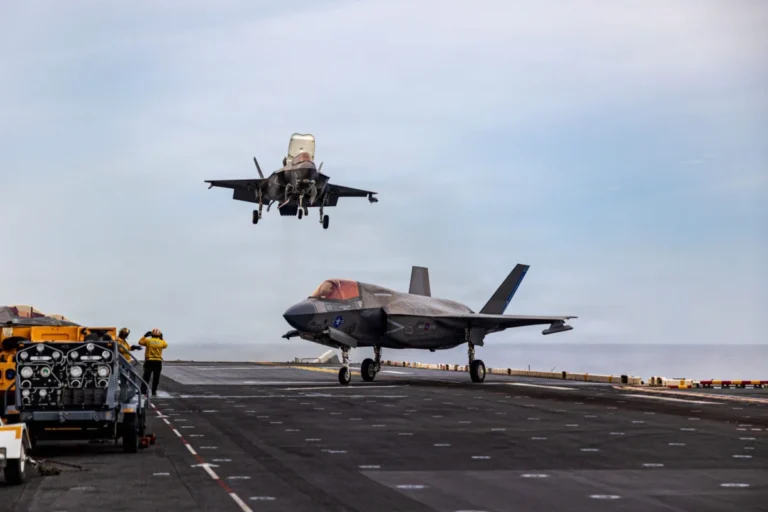
Saudi Arabia has secured potential United States approval for a landmark $24.3 billion acquisition of 48 F-35 Lightning II stealth fighter jets, marking a historic and long-awaited breakthrough in the kingdom’s multi-year strategic pursuit of America’s most advanced combat aircraft. The prospective foreign military sale, which includes 49 Pratt & Whitney engines, advanced communications suites, and comprehensive logistical and maintenance support, is designed to furnish Riyadh with two fully operational F-35 squadrons. This major defense development unfolds concurrently with diplomatic and military maneuvers by Morocco, which is deepening its strategic alignment with Washington and Israel while simultaneously pressing its own longstanding case for the procurement of the fifth-generation stealth fighter to counter regional imbalances.
Geopolitical Realignment and Strategic Defense Modernization
The prospective procurement of the F-35 Lightning II represents a dramatic escalation in Saudi Arabia’s defense capabilities, seamlessly integrating into a broader, multi-billion-dollar modernization of the Royal Saudi Air Force (RSAF). Currently operating a mixed fleet comprised of US-made F-15 S/SA/SA advanced strike eagles, European-built Panavia Tornados, and Eurofighter Typhoons, the introduction of the stealth aircraft will elevate Riyadh into an elite tier of air power operators.
For years, the oil-rich kingdom has aggressively pursued the F-35 to bolster its national defense infrastructure against mounting asymmetric and conventional regional threats. Chief among these concerns are the ballistic missile and drone capabilities fielded by Iran, as well as persistent hostilities orchestrated by Iran-backed Houthi movements across the southern border in Yemen.
The US State Department formally underscored the strategic utility of the transaction, noting that the proposed acquisition directly underpins the foreign policy objectives and national security interests of the United States. By upgrading the capabilities of a designated Major Non-NATO Ally, Washington aims to reinforce a vital anchor of political stability and economic progress within the volatile Gulf region.
The Qualitative Military Edge and Israeli Calculations
Despite the strategic benefits cited by Washington, the F-35 deal carries immense geopolitical sensitivity due to legal frameworks governing regional arms exports. Under United States law, the executive branch is legally mandated to preserve Israel’s Qualitative Military Edge (QME) when evaluating major foreign military sales in the Middle East. This statutory requirement ensures that Israel maintains the technological superiority and military capability necessary to deter and defend itself against potential coalitions of hostile adversaries.
Historically, Israel has stood as the exclusive operator of the F-35 in the Middle East, leveraging the platform to project air superiority across the theater. The introduction of Saudi Arabia as the region’s second operator has naturally ignited intense policy debates concerning the preservation of the QME.
These sensitivities were publicly brought to the forefront during Crown Prince Mohammed bin Salman’s high-profile visit to Washington in November 2025. Addressing the complex balance between allied security requirements and Israeli technological primacy, President Donald Trump remarked during discussions, "I know they’d like you to get planes of reduced caliber. I don’t think that makes you too happy," before emphasizing that both strategic partners should ultimately receive "top of the line" military hardware.
Concurrently, the US State Department maintained that the proposed package would not fundamentally alter the established military balance of the region. Officials argued that equipping a key non-NATO ally with advanced intercept and strike capabilities acts as a stabilizing deterrent rather than an escalatory measure.
The Interplay Between Advanced Arms and Regional Normalization
The trajectory of the Saudi F-35 acquisition has long been tethered to broader diplomatic initiatives aimed at reshaping the Middle East’s security and political architecture. Specifically, the fighter jet has repeatedly served as a critical diplomatic lever in Washington-led efforts to foster formal normalization between Saudi Arabia and Israel.
During the Biden administration, exploratory talks regarding the supply of the F-35 were closely coupled with negotiations for a comprehensive regional pact that included Saudi-Israel normalization. Although those diplomatic tracks ultimately stalled over core regional disputes, the linkage re-emerged under the subsequent administration.
In late 2025, President Trump explicitly linked the advancement of defense sales to regional diplomacy, stating that the historic Abraham Accords would serve as an integral framework for future integration. "We’re going to be discussing. I hope that Saudi Arabia will be going into the Abraham Accords fairly shortly," Trump noted.
In response, Crown Prince Mohammed bin Salman signaled a pragmatic openness toward formal normalization, while steadfastly reiterating the kingdom’s foundational diplomatic conditions. "We want to be part of the Abraham Accords but we want also to be sure that we secure a clear path of two-state solution," the Crown Prince affirmed, highlighting the enduring centrality of the Palestinian statehood issue in Riyadh’s foreign policy calculations.
Morocco’s Strategic Imperatives and the North African Balance
As Saudi Arabia secures its American green light, parallel dynamics are unfolding in North Africa, where Morocco—another vital US Major Non-NATO Ally—is intensifying its own campaign to acquire the F-35. Rabat’s defense procurement strategy is heavily influenced by a shifting regional security paradigm and an escalating arms race with its primary strategic rival, Algeria.
The urgency within Moroccan military planning escalated significantly following reports regarding Algeria’s defense posture. According to assessments by the International Institute for Strategic Studies (IISS), Algeria’s prospective and operational integration of advanced Russian-supplied military hardware—including the Su-57 fifth-generation stealth fighter, making Algiers a notable foreign operator of advanced Russian platforms—prompted Rabat to initiate exploratory talks with Washington regarding the F-35 as early as 2021.
This military competition is further complicated by longstanding territorial disputes, most notably over Western Sahara, where Morocco claims sovereign administration while Algeria provides diplomatic, logistical, and political backing to the Polisario Front independence movement.
Deepening Ties with Washington and Tel Aviv
To strengthen its hand in securing advanced American military technology, Rabat has systematically deepened its strategic and diplomatic partnerships with both the United States and Israel.
The cornerstone of this modern alignment was laid in 2020, when Morocco normalized diplomatic relations with Israel under the US-brokered Abraham Accords. In exchange, the United States formally recognized Moroccan sovereignty over the disputed Western Sahara territory. This diplomatic breakthrough fundamentally transformed bilateral ties, cementing a security architecture in which the United States and Israel supplied an overwhelming 84% of Morocco’s major conventional arms imports between 2021 and 2025.
The momentum of this partnership was further accelerated during a high-level diplomatic summit in New York. Hosted by US Ambassador to the United Nations Mike Waltz, Moroccan Foreign Minister Nasser Bourita and Israeli Foreign Minister Gideon Saar formally agreed to upgrade their respective liaison offices to full embassies, exchange resident ambassadors, and significantly expand bilateral cooperation in trade, technology, and intelligence-sharing.
Fact-Based Analysis of Regional Implications
The convergence of Saudi Arabia’s prospective F-35 procurement and Morocco’s persistent diplomatic and military campaigns illustrates a broader structural shift in US foreign military sales policy. Washington is increasingly leveraging high-end defense technology not merely as an instrument of traditional security assistance, but as a primary anchor for regional integration and strategic alignment.
By approving the Saudi transaction, the United States is signaling its commitment to maintaining robust deterrence umbrellas across multiple theaters, reassuring Gulf monarchies against persistent Iranian maritime and aerial threats. Simultaneously, by encouraging North African integration through the expansion of the Abraham Accords, Washington seeks to counter the proliferation of non-Western military technology—particularly advanced Russian and Chinese defense platforms—within critical strategic corridors.
Ultimately, while the integration of the F-35 into the inventories of Riyadh and Rabat introduces complex operational and diplomatic challenges regarding regional military balances and non-proliferation norms, it underscores a decisive pivot toward a defense ecosystem deeply intertwined with Western technological dominance. As both nations navigate their respective regional conflicts and diplomatic milestones, the path of the stealth fighter will remain a central barometer of shifting global power dynamics in the Middle East and North Africa.