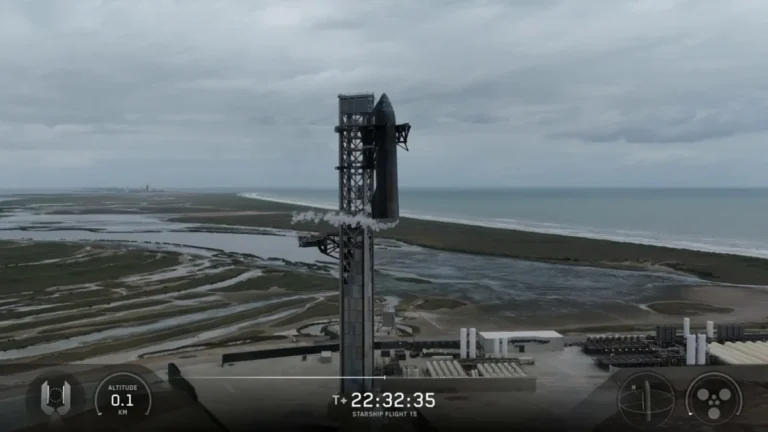
On Saturday, November 14, 2026, the landscape of aerospace engineering underwent a fundamental shift as a massive spacecraft returned from nearly a full day in orbit, plummeted through the atmosphere in a horizontal orientation, executed a precise flip-maneuver to a vertical position, and was intercepted in midair by the mechanical arms of the launch tower. This achievement, marking the conclusion of SpaceX’s Starship Flight 15, represents a significant milestone in the company’s efforts to establish a fully and rapidly reusable launch system. Utilizing Ship 42 and the "Mechazilla" tower at Starbase, Texas, the operation validated a long-sought design philosophy that eliminates the need for landing legs, thereby optimizing the vehicle’s mass-to-payload ratio.
The Anatomy of the Launch System
Starship stands as the most formidable launch vehicle in the history of human spaceflight, comprised of two primary, vertically stacked stages. The primary booster, known as Super Heavy, measures 72 meters (236 feet) in height and generates massive thrust through a cluster of 33 Raptor engines. Its role is to provide the initial velocity necessary to breach the dense lower atmosphere. Perched atop the booster is the Ship—the Starship itself—standing at 52 meters (171 feet) and powered by six engines, three optimized for atmospheric flight and three for the vacuum of space. When fully integrated, the vehicle reaches an imposing height of 124 meters (407 feet).
The absence of landing legs on either component is a strategic design choice. By offloading the mechanical infrastructure required for landing to the ground-based launch tower, SpaceX engineers have significantly reduced the dry mass of the vehicle. This reduction directly translates into higher cargo capacity and increased efficiency, as every kilogram saved from the vehicle’s structure is an additional kilogram available for scientific instruments, satellites, or, in future iterations, human crew and life support systems.
Chronology of Flight 15
The mission commenced on Friday, November 13, 2026, with a flawless ignition and ascent from Starbase. Approximately 140 seconds into the flight, the mission reached its first major milestone: hot staging. In this maneuver, the Ship ignited its own engines while still physically attached to the Super Heavy booster, effectively pushing itself away through a force-separated coupling. This technique allows for continuous thrust during the transition, preventing the deceleration associated with traditional stage separation.

Following the separation, the trajectories of the two vehicles diverged. The Ship continued its ascent toward orbital velocity, while the Super Heavy booster initiated its return sequence. However, the booster’s journey home was interrupted. During the critical boostback burn—a sequence designed to reverse the booster’s direction toward the launch site—the system experienced an anomaly. The relighting of 32 of the 33 engines was achieved, but the burn terminated prematurely due to a fuel depletion issue.
Unable to reach the launch site safely, the booster’s autonomous flight software correctly determined that a catch attempt would be hazardous. It diverted toward the Gulf of Mexico, maintaining a hover before triggering the flight termination system (FTS). This safety protocol ensures that in the event of a failure, the vehicle is neutralized over uninhabited water rather than posing a risk to the launch infrastructure or the surrounding region.
Meanwhile, the Ship proceeded to orbit, where it successfully deployed 26 Starlink internet satellites. Following deployment, the vehicle entered a prolonged orbital phase lasting over 20 hours. During this period, flight controllers conducted three health check-ups, monitoring system integrity as the vessel traversed the skies over Hawaii and Chile.
Atmospheric Reentry and the Thermal Challenge
The return to Earth began roughly 21.5 hours after liftoff, initiated by a brief ten-second deorbit burn. As the ship re-entered the atmosphere at velocities approaching 26,000 kilometers per hour (16,000 mph), it encountered extreme thermal conditions. The kinetic energy of the ship compressed the atmosphere ahead of it, creating a plasma-filled shockwave.
To survive these temperatures, which can exceed 1,400 degrees Celsius, the Ship is protected by thousands of hexagonal ceramic tiles. The decision to use a hexagonal geometry rather than traditional squares is a critical engineering refinement; the zigzagging gaps between the tiles prevent hot gases from establishing a straight, high-pressure path that could lead to structural failure beneath the shield. This heat shield has been the subject of extensive iterative testing, as maintaining the integrity of these tiles is essential for a vehicle intended for rapid, multi-flight turnaround.

The Belly Flop and the Final Catch
Upon re-entering the denser atmosphere, the Ship performed the "belly flop"—a controlled, horizontal descent that utilizes the vehicle’s massive surface area as an aerodynamic brake. Throughout this phase, four independent flaps—two near the nose and two near the tail—modulated the ship’s descent, mimicking the control mechanisms used by human skydivers to stabilize their fall.
As it neared the Texas coastline, the ship transitioned into its terminal descent. The final 18 seconds of the mission were a masterclass in precision guidance. At the start of this window, three engines ignited while the ship was still oriented horizontally. Within two seconds, the ship rotated to a vertical orientation. As it neared the tower, the thrust was modulated, dropping to two engines and finally a single engine before the final shutdown, at which point the mechanical arms of the tower closed around the ship’s upper structural catch points.
Implications for Aerospace Economics
The successful capture of Ship 42 represents a significant validation of SpaceX’s long-term economic model. By treating the launch system as an airliner rather than a disposable missile, the company aims to drastically lower the barrier to entry for space commerce. If the vehicle can be recovered, refurbished, and relaunched with minimal intervention, the cost per kilogram to orbit could potentially drop to levels previously considered impossible.
However, the industry remains cautious. While the catch was successful, the loss of the Super Heavy booster underscores the inherent volatility of orbital rocketry. SpaceX has not yet announced a timeline for the flight of a previously caught vehicle, a milestone that remains the final hurdle in proving the system’s true reusability.
Broader Context and Future Outlook
The use of the Pad 2 tower for this operation was a significant test of the company’s ground infrastructure. Having previously utilized the arms for lifting rehearsals, this was the first time the tower was tasked with capturing a high-velocity, returning vehicle. The success of this maneuver confirms that the mechanical "chopstick" system is not merely a launch support structure but a vital component of the recovery chain.

In the broader context of space exploration, the Flight 15 mission serves as a bellwether for the upcoming Artemis program and other lunar ambitions. SpaceX is currently under contract for lunar cargo missions beginning in 2028, and the ability to maintain a fleet of flight-proven Starships is foundational to these plans. As data from this mission is processed, the focus will shift toward diagnosing the Super Heavy booster anomaly and readying the caught Ship for its next potential flight. The engineering community is now looking toward the next test, which will determine whether the "airliner" paradigm is truly ready for routine service, or if additional structural hardening is required for long-term fleet sustainability.
Ultimately, the events of November 14, 2026, suggest that the era of expendable launch vehicles is entering its twilight. With the successful midair recovery of a vehicle that spent nearly a day in orbit, the path toward a more sustainable and accessible space environment appears increasingly viable, albeit still subject to the rigorous demands of flight testing and iterative improvement.