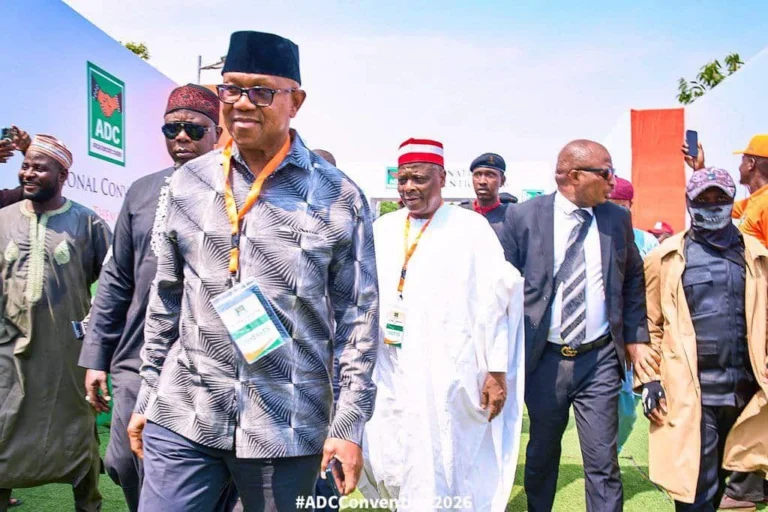
The Rainbow Events Centre in Abuja on Tuesday became the focal point of Nigeria’s political landscape, hosting the National Convention of the African Democratic Congress (ADC) where prominent opposition figures, including Peter Obi of the Labour Party (LP), Atiku Abubakar of the Peoples Democratic Party (PDP), and Rabiu Kwankwaso of the New Nigeria Peoples Party (NNPP), made a significant joint appearance. This convergence of formidable political rivals, alongside over 3,000 delegates and various political stakeholders, underscored the ADC’s intensified preparations and strategic positioning for the upcoming 2027 general elections, despite being mired in deep-seated internal disputes and logistical challenges that threatened to derail the event.
The convention, themed “So the Nation May Work,” was ostensibly designed to foster internal unity, outline comprehensive strategies for the 2027 polls, and address critical organizational matters such as leadership restructuring and the conclusion of pending state congresses. Among the other notable attendees were former Minister of Transportation Rotimi Amaechi and former Osun State governor Rauf Aregbesola, both stalwarts of the ruling All Progressives Congress (APC), whose presence sparked further speculation about potential political realignments. Senator David Mark, the factional National Chairman of the ADC, presided over the proceedings, which included the agenda to elect a new National Working Committee and resolve lingering organizational issues across various states. The atmosphere was one of anticipation, with delegates arriving from across the country for accreditation, all under the watchful eyes of heightened security personnel from the Department of State Services (DSS) and the Nigeria Police Force, ensuring a smooth, albeit tense, conduct of the event.
A Gathering of Political Titans: Implications for 2027
The attendance of Peter Obi, Atiku Abubakar, and Rabiu Kwankwaso at the ADC convention represents a potent symbol of the ongoing, albeit often fragmented, efforts to forge a formidable opposition bloc ahead of the 2027 presidential election. These three figures individually contested the 2023 presidential election, garnering substantial votes and demonstrating significant regional influence. Peter Obi, a former Governor of Anambra State and the standard-bearer for the Labour Party, electrified a significant segment of the youth population and urban voters, particularly in the South-South, South-East, and parts of the North-Central regions, securing over 6.1 million votes. Atiku Abubakar, a former Vice President and the perennial presidential candidate of the PDP, maintained his traditional strongholds across the North and parts of the South, securing over 6.9 million votes. Rabiu Kwankwaso, a former Governor of Kano State, leveraged his Kwankwasiyya movement to establish a significant presence, especially in Kano and other parts of the North-West, amassing over 1.4 million votes. Their combined showing in 2023, though individually insufficient to unseat the ruling party, highlighted the potential power of a united front against the incumbent.
Their presence at the ADC convention, a party that officially adopted its current coalition platform in July 2025 specifically to challenge President Bola Tinubu, signals a potential willingness to engage in broader discussions about alliances, mergers, or strategic cooperation. While their individual political ambitions remain a significant hurdle to full consolidation, their physical presence at a rival party’s convention, rather than solely focusing on their own party’s internal affairs, suggests a pragmatic recognition of the need for collective action. This signals a shift from the post-2023 electoral petitions and internal party squabbles towards a more outward-looking strategy aimed at challenging the ruling APC. The ADC, by hosting such figures, positions itself not merely as a standalone party but as a potential rendezvous point for a grand opposition alliance, a "third force" or "fourth force" that could potentially disrupt the traditional two-party dominance. The inclusion of figures like Rotimi Amaechi and Rauf Aregbesola, both former top officials in the APC government, further complicates the narrative, hinting at disaffections within the ruling party and potential cross-party alignments driven by diverse political calculations and aspirations for 2027.
Thematic Vision and Strategic Roadmaps
The convention’s theme, “So the Nation May Work,” encapsulates the ADC’s overarching vision and its critique of the current state of affairs in Nigeria. This slogan, beyond a mere catchphrase, implies a commitment to good governance, institutional reform, economic revitalization, and national cohesion – issues that resonate deeply with a populace grappling with economic hardship, insecurity, and political instability. The thematic emphasis on making the nation "work" suggests a focus on practical solutions and effective leadership, contrasting with what the opposition often portrays as the failures of successive administrations.
The strategic imperatives outlined at the convention are multi-faceted, reflecting both the internal challenges facing the ADC and its external ambitions. Strengthening internal unity is paramount, especially given the party’s ongoing leadership crisis. Without a cohesive internal structure, any external alliance efforts would be futile. The discussions on outlining strategies ahead of the 2027 polls likely encompassed a wide range of considerations, including:
- Alliance Building: Identifying potential partners and developing frameworks for collaboration with other opposition parties and political movements.
- Grassroots Mobilization: Strategies to expand the party’s reach beyond urban centres and connect with the rural electorate.
- Policy Alternatives: Developing credible policy blueprints that offer tangible solutions to Nigeria’s pressing challenges, providing a clear contrast to the incumbent government’s policies.
- Voter Education and Engagement: Campaigns to enlighten the electorate on their rights and the importance of participation.
- Fundraising: Securing financial resources necessary for a robust electoral campaign.
Furthermore, the agenda to restructure the party’s leadership framework and conclude pending state congresses is critical for legitimacy and operational efficiency. The absence of a properly constituted and recognized leadership structure, compounded by unresolved state-level elections, severely hampers the party’s ability to conduct primaries, nominate candidates, and present a united front. The election of a new National Working Committee (NWC) is therefore not just a procedural step but a fundamental requirement for the party to regain stability and present itself as a serious contender in the national political arena. Addressing unresolved organizational issues across states likely refers to disputes over party offices, membership registers, and disciplinary matters that can undermine internal cohesion and electoral preparedness.
Operational Hurdles and Political Sabotage Allegations
The ADC National Convention, despite its high-profile attendance, was not without its share of operational difficulties and allegations of political interference. Party officials openly claimed that access to preferred venues, specifically the iconic Eagle Square and the Moshood Abiola National Stadium, was denied. These venues, being government-controlled facilities, are traditionally used for major national events, including political conventions. The denial of access, according to ADC officials, was a deliberate attempt to "frustrate the gathering," implying a calculated move by elements within the state apparatus or the ruling party to hinder opposition activities. While no direct evidence was presented or official statements from the government on the matter, such allegations are not uncommon in Nigeria’s political history, where access to public facilities can be weaponized against opposition parties. This forced the ADC to relocate its convention to the Rainbow Events Centre, a move that likely entailed additional logistical challenges and expenses.
The heightened security around the Rainbow Events Centre, with visible deployments of DSS and Police personnel, underscored the tense political climate. While ostensibly for safety, such a significant security presence can also be interpreted as a deterrent or a means of surveillance, particularly for an opposition gathering. The process of accreditation, which continued throughout the day as delegates arrived from various parts of the country, highlighted the logistical complexity of organizing a large-scale national event under challenging circumstances. The successful conduct of the convention, despite these hurdles, was seen by some party members as a testament to their resilience and determination to push forward with their agenda, even in the face of perceived external pressures.
The Shadow of Internal Discord: A Leadership Crisis Unresolved
Perhaps the most significant challenge casting a long shadow over the ADC’s convention and its aspirations for 2027 is the deep-seated leadership dispute plaguing the party. The African Democratic Congress has been embroiled in a protracted internal crisis, primarily a factional struggle for control between two prominent figures: Senator David Mark, who currently serves as the factional National Chairman and presided over the convention, and Nafiu Bala Gombe, who also lays claim to the party’s leadership. This dispute has escalated into a series of ongoing court cases, with both factions seeking judicial validation of their legitimacy.
The Independent National Electoral Commission (INEC), the apex electoral body in Nigeria, has taken a decisive, albeit neutral, stance on the matter. Following the internal crisis and the multiplicity of court injunctions and counter-injunctions, INEC officially suspended formal recognition of either faction. This means that, as of the time of the convention, INEC does not officially acknowledge either Senator David Mark’s leadership or Nafiu Bala Gombe’s claim. The implications of this suspension are profound and far-reaching. Without INEC’s official recognition, the ADC faces severe operational limitations. It cannot officially conduct valid party primaries, submit lists of candidates for elections, or receive official communications and directives from the electoral body. This regulatory limbo effectively cripples the party’s ability to function as a legitimate political entity and participate meaningfully in the electoral process, including the crucial 2027 general elections.
The leadership crisis not only undermines the party’s administrative capacity but also severely impacts its public image and credibility. How can a party aspiring to unite the opposition and lead the nation effectively manage its own internal affairs? The very theme of "So the Nation May Work" seems ironic when the party itself is struggling to "work" due to internal divisions. This internal strife poses a significant deterrent to potential defectors from other parties and to the formation of serious alliances, as political actors typically seek stability and clear lines of authority. The resolution of this leadership dispute, through judicial determination or internal reconciliation, is an absolute prerequisite for the ADC to move forward with any credible plan for 2027.
ADC’s Genesis and the Quest for a Grand Opposition Coalition
The African Democratic Congress gained renewed prominence and was formally adopted in July 2025 as a coalition platform specifically designed for opposition figures seeking to mount a formidable challenge against President Bola Tinubu in the 2027 general elections. This adoption marked a strategic pivot for a party that had existed in various forms for years, now repurposed as a potential rallying point for disaffected politicians and a united front against the incumbent. The decision to form such a platform stems from a historical understanding of Nigeria’s political landscape, where fragmented opposition often plays into the hands of the ruling party. The 2023 presidential election results, which saw the opposition votes split among multiple strong candidates, provided a stark reminder of the imperative for unity.
The concept of a "mega-party" or a grand coalition is not new to Nigerian politics. The most successful example remains the formation of the All Progressives Congress (APC) in 2013, which brought together disparate opposition parties – the Action Congress of Nigeria (ACN), Congress for Progressive Change (CPC), All Nigeria Peoples Party (ANPP), and a faction of the All Progressives Grand Alliance (APGA) – to successfully dislodge an incumbent president in 2015. However, numerous other attempts at such grand alliances have faltered due to ego, ideological differences, regional loyalties, and the inability to agree on a common flag-bearer. The ADC’s current trajectory, therefore, is being watched keenly as a test case for whether the Nigerian opposition can finally overcome these perennial challenges. The underlying premise is that no single opposition party, in its current form, appears strong enough to defeat the ruling APC independently. Hence, the ADC’s ambition to serve as the vehicle for a united opposition, leveraging the strengths of various political figures and their respective support bases.
Broader Implications for Nigeria’s Democratic Health
The ADC National Convention, with its blend of high-level political attendance, ambitious strategic planning, and profound internal turmoil, carries significant implications for the future of Nigeria’s democratic landscape. For the 2027 general elections, the convention highlights the complex and often contradictory dynamics at play within the opposition. While the presence of Obi, Atiku, and Kwankwaso offers a glimmer of hope for a potential grand coalition, the ADC’s unresolved leadership crisis and INEC’s non-recognition present formidable obstacles that could undermine any such efforts. If the opposition fails to coalesce and resolve its internal differences, it risks repeating the fragmentation of votes seen in 2023, thereby inadvertently strengthening the incumbent’s position.
The ruling APC will undoubtedly be observing these developments closely. A disunited opposition, embroiled in internal squabbles and lacking official recognition, would be seen as a favorable scenario for the ruling party’s re-election bid. Conversely, any concrete steps towards a genuine, unified opposition front could galvanize public support and present a credible challenge, compelling the APC to recalibrate its own strategies.
From the perspective of Nigerian voters, the spectacle of prominent opposition figures meeting, even amidst party-specific challenges, might evoke mixed feelings. On one hand, it could foster hope for a viable alternative to the current government, especially among those disillusioned with the prevailing economic and security conditions. On the other hand, the persistent reports of internal disputes and logistical difficulties could fuel cynicism, reinforcing the perception that Nigerian politicians are primarily driven by personal ambition rather than a collective vision for national progress. A strong, coherent, and credible opposition is fundamental for a healthy democracy, acting as a check on governmental power, offering alternative policies, and holding the government accountable. The ADC’s journey towards 2027, therefore, is not just about the fate of one political party, but about the very vibrancy and effectiveness of Nigeria’s democratic system. The path ahead remains complex, fraught with obstacles, and contingent upon the ability of various political actors to transcend personal and factional interests for a broader collective goal.