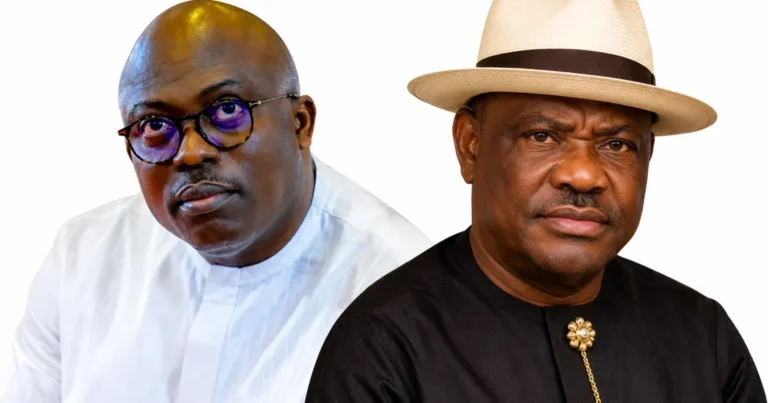
The recent reconciliation between Rivers State Governor Siminalayi Fubara and the Minister of the Federal Capital Territory, Nyesom Wike, marks a pivotal, if not controversial, turning point in the governance of one of Nigeria’s most oil-rich and politically volatile states. Following a protracted and often violent power struggle that saw the paralysis of legislative functions, the dissolution of state boards, and the intervention of the federal government, the current atmosphere of rapprochement has sparked intense debate. Observers are now scrutinizing the political survival of the governor’s former loyalists and questioning whether Fubara has effectively ceded his executive autonomy to his predecessor and former godfather.
A Chronology of Crisis and Intervention
The friction between Governor Fubara and Minister Wike did not emerge in a vacuum; it was the culmination of a widening rift regarding the control of the state’s political apparatus. The conflict reached a critical juncture in early 2025. Following a landmark Supreme Court judgment that nullified local government elections held under Fubara, the court recognized Martin Amaewhule—a staunch Wike loyalist—as the legitimate Speaker of the Rivers State House of Assembly. This judicial blow stripped the governor of his legislative support base and severely weakened his administrative grip.
The situation spiraled further as the tenure of local government chairmen aligned with Wike expired. Fubara’s attempt to fill this power vacuum by appointing caretaker administrators and subsequently conducting his own elections backfired when the judiciary intervened. The political instability reached its nadir when the State House of Assembly initiated impeachment proceedings against the governor. This move triggered civil unrest, with militant groups threatening to sabotage critical national oil infrastructure, a development that forced the hand of President Bola Tinubu.
In a move to prevent total anarchy, the President declared a six-month state of emergency, suspending both the governor and the legislature. An administrator, Ibok-Ete Ibas, was appointed to manage the state’s affairs. During this interim period, the state’s political architecture was systematically dismantled; boards were dissolved, and new local government elections—favorable to Wike’s faction—were conducted. By the time Governor Fubara returned to office in September 2025, the institutional landscape of the state had been fundamentally altered in favor of the FCT Minister.
The Dynamics of Surrender
The "reconciliation" that followed has been characterized by displays of deference that have stunned political analysts. During a high-profile unveiling of candidates for the Rainbow Coalition, Governor Fubara openly referred to Wike as "my oga" (my boss) and described the APC governorship candidate, Chinda, as his successor.
"I am aware that during the crisis, some of you, who followed me, would in your meetings refer to me as leader. We are now in one house. And, because we have one house, there is no issue about who is the leader," Fubara remarked. These statements suggest an attempt to de-escalate tensions, but they also serve as a public acknowledgement of a shift in the power hierarchy. By instructing his supporters to abandon the narrative of his own leadership, Fubara has effectively signaled a return to the political fold dictated by Wike.
The Fate of the Governor’s Loyalists
The most pressing question remains the status of those who stood by Fubara during the height of the crisis. Figures such as Edison Ehie, the former leader of the State House of Assembly who resigned his position to support the governor and was subsequently appointed as Chief of Staff, remain in a precarious position. When the cabinet was dissolved during the state of emergency, Ehie, along with other key allies like Dr. Tammy Danagogo, was sidelined.
The reinstatement of the three lawmakers—Victor Oko-Jumbo, Sokari Goodboy, and Timothy Oruibienimigha—who had remained loyal to the governor, serves as a symbolic gesture of peace. However, the absence of a comprehensive re-appointment strategy for the governor’s former cabinet members suggests that the "peace deal" is heavily skewed. Currently, the state government operates with a skeleton cabinet, lacking leadership in critical ministries such as Health, Information, and Justice. The political cost of this vacancy is high, as it hinders the delivery of governance and signals that the administration remains in a state of suspended animation.
Traditional Authority and Political Symbolism
The reappointment of Sergeant Chidi Awuse as the Chairman of the Rivers State Council of Traditional Rulers adds a layer of irony to the reconciliation. Only two years prior, Governor Fubara had publicly dismissed Awuse, labeling him an "unstable character" who played both sides during the conflict. Reinstating a figure he previously condemned as unfit for leadership is viewed by many as a tactical concession to appease the Wike camp, which holds significant sway over traditional institutions in the state.
Expert Analysis and Public Reaction
Political analysts remain divided on the implications of this realignment. Dr. Omenazu Jackson, Chancellor of the International Society for Social Justice and Human Rights, views the development as a natural correction. "He has just gone back to his natural camp and is doing what the camp asked him to do," Jackson noted, suggesting that the governor’s initial independence was the aberration, not the current submission.
Conversely, others view the development as a betrayal of the democratic mandate. Oscar Imeabe, President of the South-South Youths Initiative, argued that the governor has failed to justify the surrender of his constitutional powers. "Is the governor of Rivers State or the FCT minister deceiving Rivers people? We are yet to know the reason why His Excellency surrendered his constitutional rights so fast," Imeabe stated. He further questioned whether there exists a secret "agreement" that precludes the governor from seeking a second term, a concern that has gained traction in political circles across the state.
The Call for a Wider Reconciliation
Beyond the immediate Fubara-Wike binary, there is a growing sentiment that the peace in Rivers State will remain fragile unless it extends to other key stakeholders. A prominent politician, speaking on the condition of anonymity, suggested that the reconciliation is incomplete without the involvement of former Governor Dr. Peter Odili.
"If [Wike] can return to Odili, who is like a father to him, and reconcile with him, I believe the entire peace talks would make more sense," the source stated. Given that Dr. Odili is currently the subject of an investigation by the State House of Assembly regarding scholarship funds for his university, PAMO, the inclusion of his camp in the peace process could serve as a litmus test for the sincerity of the current reconciliation.
Broader Implications for Rivers State
The current political configuration in Rivers State raises fundamental questions about the nature of executive power in Nigeria’s federal system. When a sitting governor, who derives his mandate from the electorate, feels compelled to transfer his influence to a federal minister, it undermines the institutional integrity of the state government.
The economic implications are equally significant. Rivers State, being a primary hub for oil and gas production, requires a stable and decisive executive to manage its internally generated revenue and infrastructure projects. With a cabinet that remains largely unstaffed and a governor who appears to have deferred his decision-making authority, the state’s developmental agenda risks stagnating.
As the state moves forward, the "Rainbow Coalition" and the upcoming political cycles will serve as the ultimate proving ground for this alliance. Whether the current peace is a strategic consolidation that will lead to effective governance, or a permanent surrender of executive independence, remains to be seen. For now, the people of Rivers State are left to navigate a political environment where the lines between the governor’s office and the FCT Minister’s influence have become, at best, blurred, and at worst, indistinguishable.