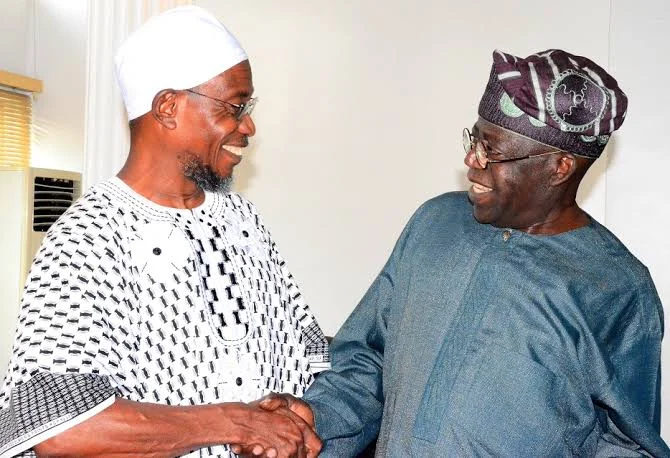
The complex and often unpredictable nature of Nigerian political alignments has once again taken center stage following recent disclosures by a former senator representing Osun Central, Prof. Olusola Adeyeye. Speaking extensively during a televised appearance on Channels Television’s political current affairs program, Politics Today, Adeyeye offered a rare and reflective look into the once-formidable political partnership between President Bola Ahmed Tinubu and former Osun State Governor, Rauf Aregbesola. According to the university professor-turned-politician, the historical bond shared by the two men was uniquely profound, asserting that Aregbesola held a level of personal devotion to Tinubu that surpassed that of any other contemporary political ally.
The interview illuminated the human elements behind high-stakes political fallouts, touching upon the emotional undercurrents of power dynamics in the ruling All Progressives Congress and the broader Southwest political landscape. While acknowledging the deep fissures that eventually drove the two men apart, Adeyeye maintained that President Tinubu likely misses the distinct political synergy they once shared, even if such sentiments remain unexpressed in the public sphere. As Nigeria’s political class recalibrates ahead of future electoral cycles, these historical reflections provide critical context into the forging—and fracturing—of some of the most influential political coalitions in the nation’s democratic history.
The Anatomy of a Historic Political Partnership
To fully grasp the magnitude of the remarks made by Prof. Adeyeye, one must examine the foundational years of the Tinubu-Aregbesola political alignment. Their association predates the return of civilian rule in 1999, rooting itself in the pro-democracy struggles of the National Democratic Coalition era against military dictatorship. When Tinubu assumed office as the Governor of Lagos State in May 1999, he brought Aregbesola into his administration as the Commissioner for Works and Infrastructure.
During his tenure in Lagos, Aregbesola was widely regarded as a central pillar of the Tinubu administration’s infrastructure revolution. His operational capacity and loyalty during those formative years cemented his status as an indispensable lieutenant within what would later evolve into the formidable political network commonly referred to as the "Mandate Group" or the broader Tinubu political family.
The apex of this partnership came when Aregbesola successfully transitioned from Lagos politics to reclaim his home state, Osun. Following a protracted three-year legal battle that overturned the initial declaration of the 2007 gubernatorial election, Aregbesola was sworn in as Governor of Osun State in November 2010. Throughout his two terms in office, the infrastructural and ideological blueprint of the Lagos governance model was largely replicated in Osun, with Tinubu remaining a guiding figure and political benefactor.
Chronology of Events: From Alliance to Divergence
The political trajectory of the Tinubu-Aregbesola relationship can be categorized into distinct phases that trace the evolution of Southwest politics over the past two decades:
- 1999–2007 (The Formative Alliance): Aregbesola serves as the Commissioner for Works and Infrastructure in Lagos State under Governor Tinubu, establishing a reputation for loyalty, strategic execution, and administrative competence.
- 2007–2010 (The Osun Mandate Struggle): Aregbesola contests the Osun State governorship under the platform of the Action Congress. Following a grueling legal battle against the incumbent Peoples Democratic Party administration, the courts validate his mandate, and he takes office in late 2010.
- 2010–2018 (Governance and Mutual Reinforcement): Aregbesola governs Osun State for two terms, aligning closely with regional integration policies championed by Tinubu and the broader progressive movement that culminated in the formation of the APC in 2013.
- 2018 (The Osun Succession Crisis): As Aregbesola concludes his second term, ideological and strategic divergences emerge regarding his successor. Tinubu and the state party leadership back Gboyega Oyetola, Aregbesola’s former Chief of Staff, setting the stage for underlying political friction.
- 2019–2022 (Widening Chasm): Following his appointment as the Minister of Interior by President Muhammadu Buhari in 2019, Aregbesola’s political influence in Osun faces internal challenges from the mainstream state party apparatus loyal to Oyetola. The friction peaks during the 2022 APC governorship primaries and subsequent general election, which Oyetola loses to the PDP candidate, Ademola Adeleke.
- 2023–Present (Realignment and New Horizons): Following the conclusion of the Buhari administration, Aregbesola positions himself outside the mainstream federal and state structures, eventually aligning with the African Democratic Congress, where he assumes the role of National Secretary alongside former Senate President David Mark as National Chairman.
Adeyeye’s Revelations and Inside Perspectives
Prof. Adeyeye, whose tenure in the upper chamber of the National Assembly coincided with significant political shifts in Osun, provided granular details regarding how the relationship was perceived by insiders. He noted that his interactions with both men were carefully calibrated to respect the hierarchy of their bond.
“When I came back, I saw that this magnitude of relationship was such that I told myself I would never go outside of Rauf to see Asiwaju because I didn’t want Rauf to be threatened by me. I also didn’t want Asiwaju to think that I was trying to undermine Rauf,” Adeyeye explained during the television interview.
The former lawmaker also addressed the irony of contemporary political realaments, drawing parallels to his own observations in the National Assembly. He highlighted Aregbesola’s current political home within the African Democratic Congress, where he serves alongside former Senate President David Mark. Adeyeye referenced historical legislative dynamics from their time in the Senate to illustrate how political exigencies frequently redefine personal relationships, famously remarking that “politics makes strange bedfellows.”
Furthermore, Adeyeye disclosed that he had previously expended considerable energy attempting to bridge the gap between the two former allies. He reiterated that despite the political fallout—which he attributed to the natural friction that occurs when powerful political actors interact over extended periods—Aregbesola’s personal esteem for Tinubu remained extraordinarily high. Quoting a popular Yoruba adage, Adeyeye observed, “20 children do not play for 20 years; things do happen in life; friends part, sometimes they come back again.”
Broader Implications for Nigerian Politics and Regional Dynamics
The public commentary by a political figure of Adeyeye’s stature carries several implications for the current political landscape, particularly within the progressive bloc in Nigeria:
- Re-evaluating Loyalty and Political Fractures: The narrative challenges monolithic views of intra-party conflicts, emphasizing that policy disagreements and succession battles often override historical personal loyalty.
- Strategic Realignments Ahead of 2027: Aregbesola’s active participation in the ADC signals an ongoing reconfiguration of opposition forces and disenchanted political actors as parties position themselves for the next general election cycle.
- Humanizing Statecraft: The discourse reminds observers that political institutions in Nigeria are frequently driven by interpersonal relationships, grievances, and emotional histories as much as by ideology or party manifestos.
As political analysts continue to parse the implications of Aregbesola’s transition to the ADC and the broader realignment of forces in the Southwest, reflections from elders and foundational figures like Prof. Adeyeye serve as a crucial window into the complex web of loyalties that continue to shape the nation’s democratic trajectory.