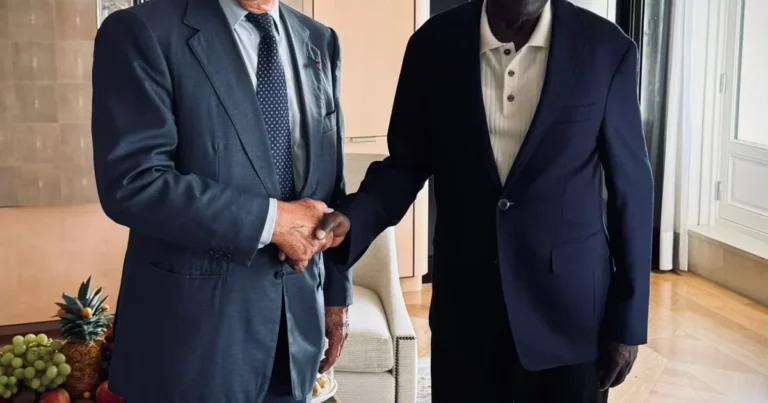
President Bola Ahmed Tinubu has intensified his economic diplomacy in Europe, holding high-level strategic talks in Paris with French industrialist and billionaire Vincent Bolloré, Chairman of the Bolloré Group. The discussions centered on securing massive foreign direct investments into Nigeria’s burgeoning creative sector, digital economy, and fiber optics infrastructure. The meeting, which took place during the second leg of the Nigerian leader’s working vacation in Europe, highlights the federal government’s aggressive push to transition Nigeria from a mere consumer of global entertainment to a primary producer and value-retaining hub.
The high-profile engagement brought together top executives from the Bolloré Group and key entities under its expansive corporate umbrella, including media giant Canal+, Universal Music Group, and MultiChoice Group. As Nigerian pop culture—spanning Afrobeats, Nollywood, fashion, and contemporary visual arts—enjoys unprecedented global prominence, the administration is leveraging this cultural renaissance to attract targeted capital that promises sustainable job creation and infrastructural development for the country’s youthful population.
Strategic Focus on Nigeria’s Creative and Digital Economy
During the strategic roundtable in the French capital, President Tinubu emphasized that Nigeria is experiencing a historic cultural awakening. He noted that the global appetite for Nigerian talent has never been higher, with indigenous music filling international stadiums and streaming platforms, and Nigerian cinematic productions capturing diverse global audiences. However, the President underscored that the ultimate objective of his administration is to convert this immense cultural capital into tangible, long-term economic value that directly benefits local creators and the broader Nigerian economy.
"We must turn this moment into lasting economic value for our people," President Tinubu stated via his official communication channels following the meeting. He stressed the imperative of localization, insisting that a significantly higher percentage of the value generated by Nigerian talent must remain within the country’s borders. This includes ramping up domestic production capabilities, injecting capital into local industries, building robust technological infrastructure, and creating employment opportunities for millions of young Nigerians.
The talks specifically targeted the expansion of operations by companies such as Canal+, MultiChoice—which maintains a massive footprint in Nigeria through DStv and GOtv—and Universal Music. By deepening their investments in fiber optics and digital infrastructure, these corporate giants are expected to provide the technological backbone necessary to support the rapid digitization of Nigeria’s media and entertainment landscape.
Corporate Footprint and the Canal+-MultiChoice Integration
The engagement with Vincent Bolloré carries substantial weight given the billionaire’s extensive influence in global media and logistics. The Bolloré Group holds a significant 30.4 percent stake in Canal+, the leading French pay-TV and content production network, alongside strategic investments in Universal Music Group and communication holding company Havas.
In recent years, Canal+ has executed an aggressive expansion strategy across the African continent, highlighted by its multi-billion-dollar acquisition efforts regarding MultiChoice Group. MultiChoice, headquartered in South Africa, operates the dominant subscription video-on-demand and satellite television services across Sub-Saharan Africa, with Nigeria serving as one of its most lucrative and vibrant markets.
By engaging directly with the leadership of these dominant media conglomerates, President Tinubu is proactively shaping the operational framework under which these corporations will function in Nigeria. For months, the Nigerian government has maintained a consistent policy stance advocating for greater localization of content, corporate governance, and operational expenditure by multinational corporations operating within the country’s borders. The Paris discussions represent a direct continuation of this policy, ensuring that foreign investors align their commercial growth trajectories with Nigeria’s national development objectives.
Chronology of the European Engagement
President Tinubu’s meeting with the French tycoon forms part of a broader diplomatic and economic itinerary during his three-week European working holiday, which commenced on August 30. The timeline of his engagements underscores a deliberate dual-track approach of personal rest interspersed with intensive high-level state diplomacy aimed at courting international capital:
- August 30: President Tinubu departs Abuja for the United Kingdom, initiating the first leg of his three-week scheduled vacation in Europe.
- Early September: Following his initial stay in London, economic and diplomatic teams lay the groundwork for high-profile investor meetings in continental Europe, focusing particularly on France, a key trade and diplomatic partner for Nigeria.
- Sunday, September: The President arrives in Paris, France, to commence the second leg of his European holiday.
- Thursday: President Tinubu holds a high-profile private dinner with French President Emmanuel Macron at the historic Élysée Palace in Paris. According to presidential aides, the meeting centered on bilateral cooperation, regional security, and strengthening the enduring strategic partnership between Nigeria and France.
- Friday: President Tinubu meets with Vincent Bolloré and executive leadership of the Bolloré Group in Paris, successfully lobbying for expanded investments in Nigeria’s film, entertainment, telecommunications, and digital sectors.
Economic Implications and Policy Analysis
The renewed diplomatic and commercial outreach in Paris arrives at a critical juncture for the Nigerian economy. As part of the broader macroeconomic stabilization program championed by the Tinubu administration—which includes the unification of foreign exchange rates, the removal of costly petroleum subsidies, and aggressive fiscal reforms—the government has continually stressed that foreign direct investment (FDI) must replace debt financing as the primary driver of sustainable national growth.
Analysts note that targeting the non-oil sector, particularly the creative economy and digital infrastructure, is a prudent strategy for diversification. Nigeria’s creative industry contributes significantly to the national Gross Domestic Product (GDP) and possesses an elastic growth ceiling. However, structural deficits, including inadequate broadband penetration, high costs of digital production equipment, and weak intellectual property monetization frameworks domestically, have historically limited the retention of wealth within the country.
By securing commitments from media powerhouses like Canal+ and Universal Music to invest directly in local infrastructure and home-grown production, the federal government aims to bridge these systemic gaps. Increased investment in fiber optics will concurrently lower data costs, enhance internet penetration, and support the burgeoning tech-startup ecosystem often referred to as "Silicon Lagoon."
Furthermore, pressure on multinational corporations like MultiChoice to localize their supply chains and content acquisition models ensures that Nigerian writers, directors, musicians, and technicians secure fairer compensation and broader professional development avenues. If successfully executed, the partnerships forged in Paris could serve as a blueprint for how developing nations can harness multinational capital to empower indigenous creative workforces without compromising national economic sovereignty.
Broader Bilateral Relations Between Nigeria and France
The series of high-level meetings in Paris also underscores the strengthening diplomatic axis between Abuja and Paris. France remains one of the leading European investors in Nigeria, with active commercial interests spanning energy, construction, logistics, and fast-moving consumer goods.
The private dinner between President Tinubu and President Emmanuel Macron at the Élysée Palace provided the political scaffolding necessary to reassure investors of the stability, safety, and profitability of the Nigerian market. French political leadership has consistently viewed Nigeria as an indispensable anchor for economic stability and democratic governance in West Africa.
As President Tinubu prepares to conclude his European vacation and return to Abuja, the tangible outcomes of his Paris engagements—particularly the anticipated framework agreements with the Bolloré Group, Canal+, and associated entities—will be closely monitored by economic analysts, industry stakeholders, and the Nigerian public alike. The ultimate success of these talks will be measured by how quickly corporate pledges translate into physical infrastructure projects, localized content investments, and sustainable employment opportunities for Nigeria’s massive demographic of creative and digital talents.