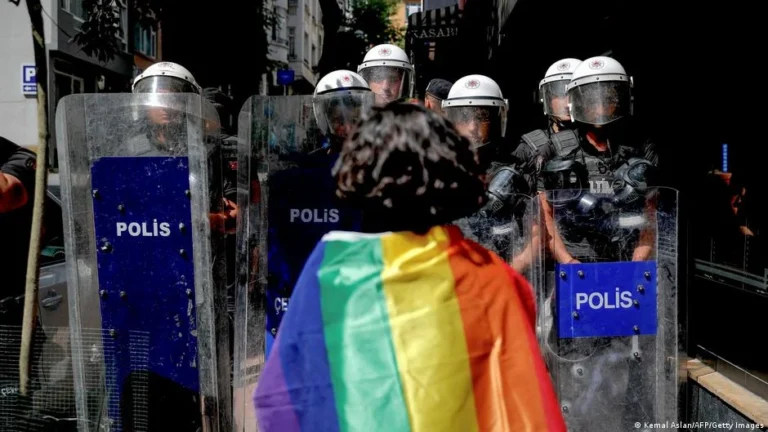
The Turkish government has launched a significant crackdown on the LGBTQ+ community, resulting in the arrest of 162 individuals across Istanbul, Ankara, and Izmir over the weekend. The operation, which also involved the mass blocking of over 100 social media accounts and digital platforms, marks a major escalation in the state’s efforts to marginalize queer activists and civil society organizations. Government officials have framed the crackdown as a "national security" measure under the auspices of the "Decade of Family and Population" scheme, a state-led strategy introduced in May 2025 to combat declining birthrates and reassert traditional family values.
The coordinated raids have triggered widespread condemnation from international human rights monitors, European Union officials, and a broad coalition of domestic trade unions and civil rights groups. As of Tuesday, protests erupted in Istanbul, where activists gathered to challenge the legality of the government’s actions, asserting that the right to organize and advocate for human rights remains a fundamental, albeit currently suppressed, freedom in the country.
Chronology of the Escalation
The recent wave of arrests is not an isolated event but the culmination of a multi-year shift in Turkey’s approach to civil society.
- May 2025: President Recep Tayyip Erdogan unveils the "Decade of Family and Population" scheme. The policy is explicitly designed to reverse demographic trends and promote traditionalist social structures.
- September 13, 2026: An Istanbul court issues a broad ruling providing the legal framework for the subsequent digital and physical suppression. The Bakirkoy Public Prosecutor’s Office authorizes the investigation of organizations accused of disseminating "obscene content and LGBTQ+ propaganda."
- Weekend of September 20-21, 2026: Turkish authorities conduct simultaneous raids in major urban centers. Initial reports confirm 162 arrests. Simultaneously, a digital blockade begins, targeting over 32 accounts on the first day, eventually expanding to more than 100 profiles and media outlets.
- September 22, 2026: A broad coalition of 120 women’s rights organizations issues a joint statement denouncing the raids as an authoritarian tactic to suppress dissent under the guise of family protection.
- September 23, 2026: Protests continue in Istanbul as human rights groups, the Turkish Medical Association, and political parties like the Workers’ Party of Turkey (TIP) call for the immediate release of detainees.
The Mechanism of Digital Censorship
The scope of the digital crackdown has been unprecedented, drawing criticism from international media watchdogs. By utilizing the justification of "national security," the government has successfully silenced a diverse array of organizations, including Amnesty International Turkey, the left-leaning newspaper Evrensel, the Academics for Peace initiative, and the Media and Law Studies Association (MLSA).
Legal experts point out that while homosexuality is not a criminal offense under the Turkish Penal Code, the government is utilizing the court system to achieve a "de facto" criminalization. By equating LGBTQ+ advocacy with "illegal activity" or "immorality," the state bypasses the need for legislative changes, instead relying on judicial rulings and executive orders to shrink the public sphere for non-conforming identities.
Socio-Economic Context and the "Family" Narrative
The government’s rhetoric, spearheaded by figures like Justice Minister Akin Gurlek, characterizes LGBTQ+ organizations as "criminal networks" that threaten the welfare of the nation’s youth. However, sociological experts argue that this narrative serves as a convenient distraction from systemic domestic challenges.
Yildiz Taghizade of Women for Women’s Human Rights (WWHR) argues that the government’s emphasis on "protecting the family" is fundamentally hollow when measured against current living conditions. "When we look at what is actually causing instability for families in Turkey, we see the impacts of chronic inflation, a severe housing crisis, and the disproportionate burden of care work placed on women," Taghizade noted. Critics argue that by targeting the LGBTQ+ community, the administration seeks to solidify its conservative base while deflecting blame for the country’s economic struggles.
Official Responses and International Repercussions
The international community has reacted with significant concern, particularly given Turkey’s status as a candidate for European Union membership. The European Commission issued a formal statement through spokesperson Christian Wigand, emphasizing that any nation seeking to join the EU must uphold the dignity and rights of all individuals, regardless of sexual orientation or gender identity. "Stigmatization and discrimination are fundamentally incompatible with the values of the Union," the statement read.

Domestically, the response from the medical and legal communities has been equally sharp. The Turkish Medical Association (TTB) issued a scathing rebuke, calling the raids a "gross violation of human rights." The TTB highlighted that the targeting of gender identity as a health or criminal issue contradicts the scientific and ethical obligations of a democratic society.
Erkan Bas, chairman of the Workers’ Party of Turkey (TIP), argued that the arrests demonstrate a broader intolerance for any form of opposition. "The judiciary and the police are being used to ‘call to order’ any group that dares to exist outside the government’s narrow ideological framework," Bas stated. "They would prefer to make ‘being an opponent’ a criminal offense in itself."
Implications for Civil Society
The long-term implications of these raids are profound for Turkey’s civil society. Human Rights Watch, represented by Turkey director Emma Sinclair-Webb, has identified this as a strategic effort to dismantle the institutional capacity of NGOs. By freezing the assets and blocking the communications of organizations like Kaos GL and Mor Dayanisma, the state is effectively cutting off the resources necessary for activists to provide legal aid, health resources, and social support.
The pattern of "criminalization without legislation" creates an environment of perpetual legal insecurity. Activists are now operating under the constant threat that routine administrative tasks—such as maintaining a social media presence or holding a meeting—could be reclassified as a breach of "national security."
Analysis: A Shift in Governance
The current climate represents a departure from traditional democratic discourse. By framing social issues as existential threats to the "family unit," the government has successfully polarized the public discourse, making it increasingly difficult for civil society groups to build cross-sectoral coalitions.
Data from the past year suggests that the "Decade of Family and Population" strategy is becoming the primary filter through which all human rights issues are viewed. As the government continues to consolidate control over both physical and digital spaces, the LGBTQ+ community faces a narrowing window for public engagement.
However, the rapid mobilization of 120 women’s rights organizations in response to the raids suggests that the crackdown may also have the unintended effect of strengthening solidarity among marginalized groups. By linking their own struggle for autonomy with that of the LGBTQ+ community, women’s rights advocates are framing the conflict as a broader battle for democratic participation in Turkey.
As the legal proceedings against the 162 detainees move forward, the eyes of the international human rights community remain fixed on the Turkish judiciary. Whether these arrests will lead to formal charges or serve as a tool of intimidation to force organizations into self-censorship remains the central question. For now, the events of the past week underscore a deepening divide between the state’s traditionalist agenda and the evolving demands of a diverse, modern society.