Senator Victor Umeh, representing Anambra Central at the National Assembly, has ignited a fresh political firestorm in the South-East region by branding any Igbo individual who opposes the 2027 presidential bid of Nigeria Democratic Congress (NDC) candidate Peter Obi as an “enemy” of the Igbo people. The senator’s incendiary remarks, delivered on Saturday during an event organized by the Knights of St. John International at St. Patrick Catholic Church, Awka, have deepened the widening rift within the political landscape of Anambra State.
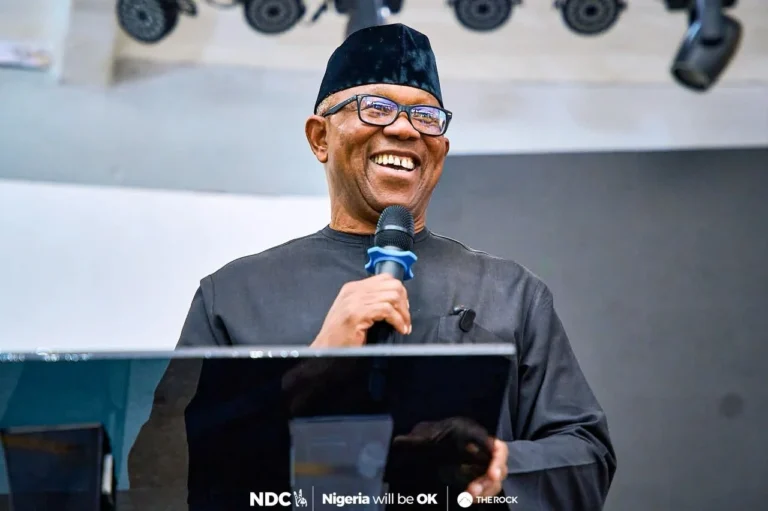
The declaration, which surfaced in a viral video on Monday, marks a significant escalation in the ongoing ideological and political battle between supporters of Peter Obi and the administration of Governor Chukwuma Soludo. Umeh, a seasoned political operator and former national chairman of the All Progressives Grand Alliance (APGA), framed his stance as a defense of regional collective interest, asserting that Obi represents the moral and political “conscience” of the Igbo nation in the upcoming 2027 electoral cycle.
The Context of the Escalating Rift
The tension between Senator Umeh and Governor Soludo is not a sudden development but rather the culmination of months of political friction regarding the regional leadership and the direction of the South-East in national politics. The crux of the current disagreement lies in the diverging paths taken by the state’s political elite. While many within the South-East have rallied behind Peter Obi, who has emerged as a formidable third-force candidate, the state government—led by Governor Soludo—has opted to align with the ruling party.
On Friday, during the official campaign flag-off for the All Progressives Grand Alliance in Awka, Governor Soludo made a definitive policy pronouncement: the party has adopted President Bola Tinubu as its preferred candidate for the 2027 presidential election. Soludo’s stated objective of securing at least 50 percent of the total votes in Anambra State for the incumbent president has been interpreted by supporters of Peter Obi as a direct sabotage of the region’s quest to produce a president of Igbo extraction.
Chronology of Political Alignments
The political history of Anambra State over the last two decades is characterized by intense internal rivalry and strategic shifting. To understand the gravity of Umeh’s recent statements, one must consider the timeline of political evolution in the region:
- 2003–2006: The emergence of Peter Obi as a key political figure in Anambra, setting the stage for his tenure as governor.
- 2013–2017: The consolidation of APGA as the dominant party in the state, with Victor Umeh serving as a primary architect of the party’s structure.
- 2021–2022: The transition of power to Professor Chukwuma Soludo, who was widely supported by the party hierarchy, including Senator Umeh, to succeed the then-incumbent Willie Obiano.
- 2023: The general election cycle, which saw a surge in support for Peter Obi’s presidential candidacy, creating a new political consciousness in the South-East that often conflicted with the interests of existing political structures.
- 2025–2026: The current period, marked by the formalization of the divide between the NDC-leaning faction and the APGA-aligned state government.
Senator Umeh’s Claims and the Allegation of Sabotage
Senator Umeh’s remarks at the church event carried a heavy tone of personal grievance and political disillusionment. He explicitly reminded his audience of his role as a “kingmaker” in the state’s political history, claiming that every governor of Anambra State since 2003 has required his input or endorsement to ascend to power.
"I have been hearing a lot of things going on in this state. This government in the state, I helped install it," Umeh stated. He further warned against what he termed "committing an abomination" by working against a fellow Igbo brother for political gain. By framing the support for President Tinubu as a form of "sabotage," Umeh is attempting to shift the narrative from a legitimate political disagreement to a matter of regional betrayal.
However, political analysts point out that this rhetoric complicates the governance of the state. Governor Soludo has previously defended his political decisions by citing the need for the state to maintain a working relationship with the federal government to secure infrastructure funding and economic development. The disagreement over whether the Igbo people should pursue an independent political identity through candidates like Obi or align with established national parties remains the defining debate of the region.

Official Responses and Public Reaction
The Anambra State Government has yet to issue a formal, detailed rebuttal to Senator Umeh’s specific accusations. However, sources within the government house have suggested that the administration views the governor’s endorsement of the president as a pragmatic move aimed at ensuring the state remains plugged into the national grid of patronage and developmental policy.
The public reaction, particularly on social media, has been polarized. Supporters of Peter Obi have hailed Umeh’s comments as a necessary call to unity, suggesting that the Igbo people cannot afford to be divided when a candidate of their own has a viable path to the presidency. Conversely, critics of Umeh argue that his language is exclusionary and anti-democratic, asserting that political pluralism is essential for the growth of the region and that individual politicians should be free to endorse candidates based on merit rather than ethnic identity.
Broader Impact and Implications for 2027
The standoff between Umeh and Soludo carries significant implications for the 2027 election. Firstly, it signals a potential fracture within the political apparatus of the South-East. If the region enters the 2027 election with a divided house, the efficacy of the "Obi factor" may be diluted, particularly in states where the sitting governors hold significant sway over local electoral machinery.
Secondly, the use of labels such as "enemy of the people" adds a dangerous layer of intolerance to the discourse. Historically, such rhetoric has been known to exacerbate volatility during election seasons. As the political temperature rises, the role of civil society and religious leaders—such as those who hosted the event in Awka—will become increasingly critical in de-escalating tensions.
From a data perspective, the 2023 election results showed that Peter Obi won by landslide margins in several South-East states, signaling a massive shift in voter behavior. However, the conversion of that voter sentiment into a national victory requires the support of established political structures. The current conflict suggests that the bridge between the grassroots support for Obi and the institutional support of regional political leaders is crumbling.
The Question of Political Loyalty vs. Regional Interest
The dilemma facing Igbo voters is clear: do they prioritize the "conscience" argument put forward by Senator Umeh, which emphasizes the moral imperative of supporting a regional candidate, or the "developmental" argument often favored by sitting governors who prioritize federal cooperation?
Senator Umeh’s assertion that Peter Obi is the "conscience" of the Igbo people is a powerful mobilizing tool, but it also places a high burden of expectation on the candidate. As the race toward 2027 intensifies, the ability of both factions to maintain civil discourse will determine whether the region acts as a unified bloc or falls prey to internal attrition.
The ongoing disagreement between the Anambra State government and the former governor, Peter Obi, regarding his past administrative records—which has seen the exchange of conflicting data on debt profiles and infrastructure spending—further suggests that this is a battle for the legacy of the state. As the debate moves from fiscal policy to personal loyalty, the electorate remains caught in the middle of a struggle that is as much about the future of Nigeria as it is about the internal politics of Anambra.
In conclusion, the remarks made by Senator Umeh have brought a long-standing subterranean conflict into the public light. Whether this leads to a reconciliation or a definitive split remains to be seen. What is certain, however, is that the political map of the South-East is being redrawn, and the coming months will likely see even more robust contestation as stakeholders jockey for position ahead of the 2027 presidential polls. The political stability of the region will depend heavily on whether leaders can move beyond identity-based rhetoric and focus on the substantive policy issues that concern the ordinary citizen.