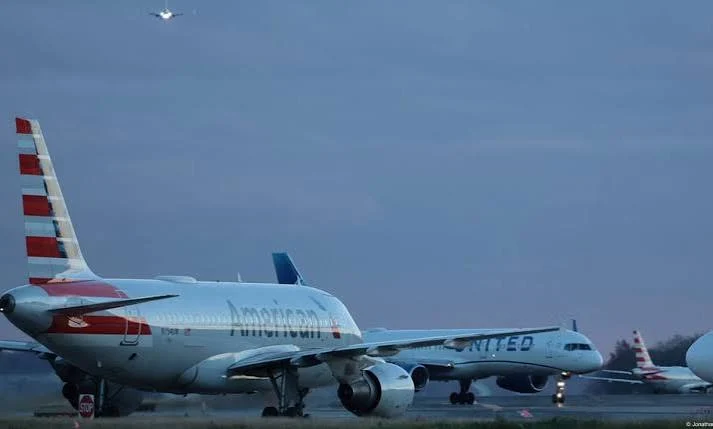
The United States aviation network faced historic disruptions over the weekend as major hubs struggled to recover from a catastrophic technical failure that forced a rare nationwide ground stop. The cascading operational crisis left millions of passengers stranded, disrupted international itineraries across the Atlantic, and exposed deep vulnerabilities within the nation’s aging air traffic management infrastructure.
Throughout Sunday, flight-tracking data revealed that thousands of flights remained canceled or severely delayed, compounding the chaos that began late last week. Transportation Secretary Sean Duffy warned the public that a full return to normal operations might not be achieved until Monday, as commercial airlines battle immense logistical hurdles to reposition aircraft and flight crews scattered thousands of miles away from their scheduled bases.
The sheer scale of the disruption has reignited intense debate in Washington over the funding, maintenance, and technological readiness of the systems governing American airspace, putting the spotlight directly on decades of deferred maintenance and federal budget allocations.
Chronology of the Crisis: From Initial Warning to Nationwide Ground Stop
The unprecedented crisis began unfolding on Friday when the Federal Aviation Administration (FAA) issued an urgent, mandatory order for all departing civil aircraft across the United States to remain grounded. The directive was triggered by sudden, cascading failures within a critical communication network utilized by pilots and ground-based air traffic controllers to manage safe separation and route coordination.
At the exact moment the FAA instituted the nationwide ground stop, more than 3,500 commercial and cargo aircraft were already airborne over the continental United States. This forced air traffic control centers to rapidly vector planes to alternate airports, while other flights managed to continue to their intended destinations under heavily restricted procedures.
The immediate result was widespread gridlock across major metropolitan airports, including Hartsfield-Jackson Atlanta International, Chicago O’Hare, Dallas/Fort Worth, and New York’s JFK. Passengers reported spending hours confined to aircraft on tarmac aprons, unable to taxi back to passenger gates due to congestion, while terminal buildings quickly overflowed with frustrated travelers attempting to rebook canceled itineraries.
By the close of Sunday, flight-tracking intelligence gathered by FlightAware indicated that the cumulative impact of the multi-day event had driven delayed flights to roughly 8,500, with total cancellations soaring past the 8,000 mark. The weekend alone accounted for more than 5,000 delays and approximately 2,000 cancellations, as airlines attempted to restart operations without a fully stable digital backbone.
International Knock-On Effects
While domestic travel bore the brunt of the FAA’s emergency order, the repercussions quickly spread globally. Major international carriers operating long-haul routes from London Heathrow, Paris Charles de Gaulle, Frankfurt, and other European hubs were forced to cancel or substantially delay eastbound and westbound flights.
Because aircraft and flight crews operate on tightly optimized, round-the-clock international schedules, the grounding of US airspace created a domino effect. Planes scheduled to cross the Atlantic were stranded at foreign departure gates or diverted mid-flight, leaving thousands of international passengers stranded away from home and straining customer service centers worldwide.
Root Cause Analysis: The El Dorado Router Failure
Speaking publicly on Sunday morning during appearances on national television networks, Transportation Secretary Sean Duffy provided preliminary insights into the technical trigger behind the system collapse.
According to early findings from engineering teams and systems analysts, the disruption originated from a computer router recently installed in El Dorado, Arkansas. The equipment had been deployed as part of an ongoing, multi-year federal initiative to upgrade the FAA’s legacy copper-wire communication infrastructure to high-speed fiber-optic technology.
Investigators determined that the newly installed router began transmitting erroneous, faulty data signals into the core network architecture. This data flood overwhelmed the system’s processing capacity, effectively blinding air traffic controllers to essential flight telemetry and communication streams. To prevent any risk of mid-air collisions or compromised safety protocols, the FAA elected to initiate the total ground stop.
Duffy noted that federal cybersecurity experts and hardware engineers are conducting a comprehensive forensic investigation to determine the exact sequence of events, verify whether software bugs or hardware defects were responsible, and assign accountability across the contracted equipment manufacturers.
Official Responses and Political Pressure
The systemic failure has drawn immediate responses from the highest levels of government, transforming an operational aviation crisis into a prominent political flashpoint regarding federal infrastructure spending.
President Donald Trump took to social media platform Truth Social on Sunday to demand immediate congressional action. He called on lawmakers to approve a substantial, dedicated funding package designed to overhaul the nation’s air traffic control apparatus comprehensively.
Trump argued that while preliminary modernization efforts have been initiated by the government, the piecemeal approach of gradual, incremental investments is inadequate. He described the core architecture of the system as being roughly half a century old, emphasizing that the modernization process must be accelerated through an intensive, unified national program rather than delayed by legislative gridlock.
Echoing these concerns, Secretary Duffy stressed during an interview on NBC’s Meet the Press that the federal government can no longer afford to ignore the structural deficits plaguing civil aviation.
"We have to make investments into a network that has been neglected for decades," Duffy stated, pointing out that successive administrations have struggled to secure bipartisan consensus for massive capital improvements to behind-the-scenes technologies that travelers rarely see, but upon which the entire economy depends.
Industry Analysis and Long-Term Implications
Aviation analysts and independent safety experts have long warned that the United States aviation sector operates under immense strain due to outdated technological foundations.
Renowned aviation analyst Miles O’Brien described the US air traffic control infrastructure as being in urgent need of radical revitalization. O’Brien noted that chronic underinvestment, compounded by bureaucratic delays in deploying next-generation software and hardware, has left the system vulnerable to unexpected hardware anomalies and cyber vulnerabilities.
Unlike modern commercial networks that utilize advanced redundancy and decentralized cloud architectures, much of the air traffic management framework relies on older, tightly coupled systems where a localized hardware failure in a remote location like Arkansas can cascade across the entire continental network.
The economic implications of the weekend’s disruption are expected to be severe. Major domestic airlines—already operating on tight profit margins—face millions of dollars in unexpected operational expenses, including passenger compensation, hotel accommodations, meal vouchers, and costly aircraft repositioning logistics. Furthermore, productivity losses across business travel sectors are likely to register significantly in upcoming economic indices.
As federal investigators sift through technical logs and congressional leaders debate funding mechanisms, the primary focus remains on stabilizing schedules and restoring absolute confidence in the safety and reliability of American skies. For millions of travelers caught in the weekend’s turbulence, however, the crisis serves as a stark reminder of the fragile technological threads supporting modern global mobility.