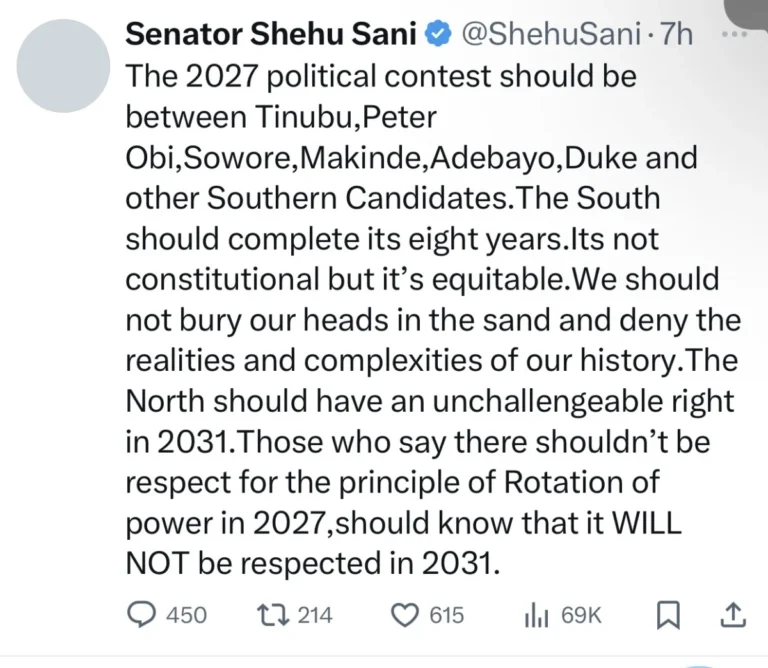
The debate surrounding the zoning of the Nigerian presidency has regained momentum following a provocative assertion by former Senator Shehu Sani, who recently argued that the 2027 general elections should be restricted to candidates from the southern geopolitical zones. Sani’s position, which specifically singles out President Bola Ahmed Tinubu and opposition figures like Peter Obi, seeks to exclude northern candidates, most notably former Vice President Atiku Abubakar, until the southern region completes an eight-year tenure. This call for "equitable" power rotation has reignited long-standing tensions regarding the unwritten but politically significant gentleman’s agreement that has governed Nigerian electoral politics since the return to democracy in 1999.
The Logic of Equitable Rotation
Senator Shehu Sani, representing Kaduna Central in the 8th National Assembly, took to the social media platform X to advocate for a political structure that prioritizes regional balance over raw constitutional interpretation. According to Sani, while the Nigerian Constitution does not explicitly mandate the zoning of the presidency between the North and the South, the preservation of national stability requires a respect for the "equitable" rotation of power.
"The 2027 political contest should be between Tinubu, Peter Obi, Sowore, Makinde, Adebayo, Duke, and other Southern candidates," Sani stated. "The South should complete its eight years. It’s not constitutional, but it’s equitable. We should not bury our heads in the sand and deny the realities and complexities of our history."
Sani’s argument is predicated on the belief that for Nigeria to maintain its fragile unity, the southern region must be allowed to fulfill a two-term mandate, effectively pushing the next Northern presidency to 2031. He issued a stern warning to political actors who might seek to bypass this convention, stating that those who disregard the rotation principle in 2027 should expect the same disregard to be applied to them in 2031.
Historical Context: The Evolution of Zoning in Nigeria
To understand the weight of Senator Sani’s proposal, one must examine the evolution of zoning within the Nigerian political landscape. Following the end of military rule in 1999, the People’s Democratic Party (PDP) famously adopted an internal zoning arrangement. This policy suggested that the presidency should rotate between the North and the South every eight years.

- 1999–2007: Olusegun Obasanjo (South-West) served two terms.
- 2007–2010: Umaru Musa Yar’Adua (North-West) was elected but died in office, leading to the ascension of Goodluck Jonathan.
- 2010–2015: Goodluck Jonathan (South-South) completed the tenure and won a subsequent term, which many in the North viewed as a violation of the party’s zoning arrangement.
- 2015–2023: Muhammadu Buhari (North-West) served two terms, effectively resetting the rotation clock.
- 2023–Present: Bola Ahmed Tinubu (South-West) assumed office, marking the beginning of the current southern cycle.
The historical volatility of these transitions demonstrates why figures like Sani argue that zoning is a prerequisite for regional peace. When the expectation of rotation is perceived to be violated, it often leads to deep-seated resentment, political instability, and a sense of alienation among the excluded geopolitical blocs.
The Atiku Abubakar Factor
The focal point of the current controversy is former Vice President Atiku Abubakar, who has remained a perennial contender for the presidency. Atiku, a northern politician, has maintained that the Nigerian Constitution is the supreme document and that no zoning arrangement can supersede a citizen’s right to seek elective office.
Supporters of Atiku argue that the country’s democratic growth depends on moving away from ethnic or regional quotas and toward a merit-based system. They contend that restricting the ballot box to specific regions based on geography—rather than policy efficacy or leadership capability—stifles the democratic process. However, critics, including Sani, argue that such an approach ignores the "complexities of our history," where political power is often viewed as a communal asset that must be shared to prevent the domination of one region over others.
Statistical Implications and Electoral Realities
The 2027 election cycle is already shaping up to be a high-stakes affair. Data from the Independent National Electoral Commission (INEC) regarding the 2023 elections highlighted a shift in voter behavior. The rise of Peter Obi’s candidacy, particularly among the youth demographic, demonstrated that the traditional two-party dominance of the All Progressives Congress (APC) and the PDP is no longer absolute.
If the 2027 field were to be limited to southern candidates, it would effectively force a restructuring of party manifestos. Political analysts suggest that such a move would necessitate a major realignment of party coalitions, as northern power brokers would have to decide whether to support a southern candidate or risk losing their leverage entirely. The economic data remains a critical variable; with Nigeria facing significant inflationary pressure, high unemployment, and currency devaluation, the electorate in 2027 is expected to be more focused on fiscal performance than the region of origin of the candidates.
Official Responses and Political Repercussions
While the main political parties have yet to issue formal policy statements on the specific "Sani Proposal," internal party dynamics suggest a period of intense lobbying. Within the APC, President Tinubu is widely expected to seek a second term, which would be consistent with the eight-year cycle. Within the opposition, the PDP and other smaller parties face a dilemma: whether to insist on an open primary that allows northern candidates to participate, or to adopt a zoning strategy to remain competitive in a southern-dominated electoral map.

Political observers note that the internal crisis within the PDP, which stems from the 2023 primary where the party abandoned its internal zoning, continues to weaken the party’s standing. Analysts argue that if the PDP fails to resolve its regional contradictions, it may struggle to find a candidate capable of galvanizing a national coalition in 2027.
Implications for National Cohesion
The debate over the 2027 presidency transcends mere electoral strategy; it strikes at the core of the Nigerian social contract. The "Federal Character" principle, enshrined in the Nigerian Constitution, mandates that government agencies and appointments should reflect the diversity of the country. Proponents of zoning argue that this principle should naturally extend to the presidency.
However, legal experts frequently point out the tension between this principle and Section 131 of the Constitution, which outlines the qualifications for the office of the President, none of which include a regional requirement. This legal reality makes any attempt to enforce zoning through legislation nearly impossible, leaving the practice as a strictly moral or political obligation.
Looking Toward 2031
Senator Sani’s assertion that the North should have an "unchallengeable right" to the presidency in 2031 is an attempt to provide a roadmap for the future. By advocating for a structured timeline, he hopes to avoid the chaotic, last-minute political scrambling that characterized the lead-up to the 2023 elections.
Whether or not this suggestion is adopted by the major political parties remains to be seen. Historically, Nigerian political parties have been fluid, with candidates often prioritizing personal ambition over party-mandated zoning agreements. As the country moves closer to the 2027 cycle, the electorate will be watching closely to see if the political class can reach a consensus that balances the need for regional equity with the fundamental right of every Nigerian to aspire to the highest office in the land.
The discourse initiated by Senator Sani serves as a reminder that in the Nigerian context, the "how" of power distribution is often just as significant as the "who." As the country grapples with economic reform and structural challenges, the consensus on who occupies the seat of power in 2027 will undoubtedly serve as a bellwether for the health and stability of the nation’s democracy for years to come.