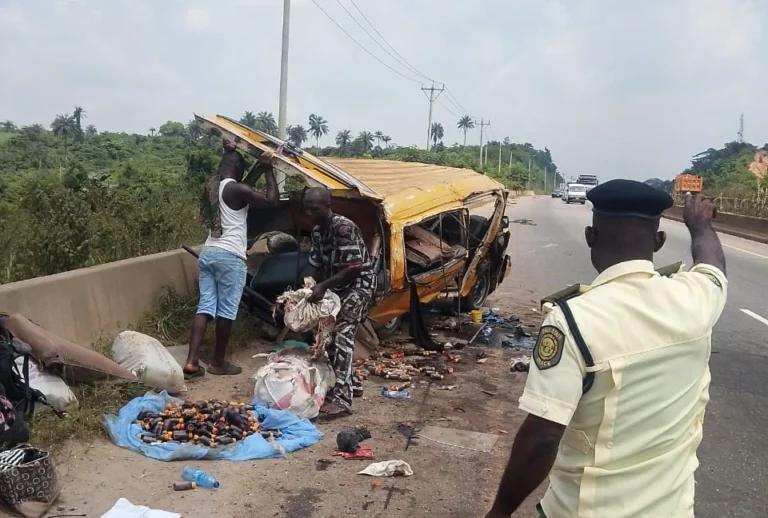
A major traffic incident occurred on Friday along the bustling Lagos-Ibadan Expressway, resulting in 13 injuries when a commercial passenger bus suffered a mechanical failure and collided with a concrete barrier. The accident, which took place in the Remo North Local Government Area of Ogun State, involved a Mazda bus carrying 18 passengers, triggering an immediate emergency response and renewed debates regarding road safety standards on one of Nigeria’s busiest transit corridors.
The incident, which occurred at approximately 12:30 pm on the inward-Lagos lane, highlights the persistent dangers associated with high-speed travel on this critical artery connecting the nation’s commercial capital to the rest of the country. According to official reports from the Ogun State Traffic Compliance and Enforcement Agency (TRACE), the vehicle, bearing registration number AKD 52 XY, was traveling at speed when one of its tyres suffered a catastrophic failure, leading to a loss of control.
Chronology of the Incident and Rescue Operations
The sequence of events unfolded rapidly on Friday afternoon. According to eyewitness accounts corroborated by official investigations, the bus was in motion when a tyre burst, causing the driver to lose steering control. The vehicle subsequently overturned and skidded across the road surface, eventually striking a concrete divider. Officials noted that the presence of the concrete barrier, while the site of the impact, inadvertently prevented the vehicle from careening into a deep ditch adjacent to the highway, which could have significantly increased the severity of the casualties.
By 12:48 pm—merely 18 minutes after the incident—emergency response teams from TRACE’s "Papa Oscar" unit and the Federal Road Safety Corps (FRSC) arrived at the scene. This rapid deployment was crucial in stabilizing the victims and managing the flow of traffic, which remained fluid despite the wreckage.
The medical evacuation process was executed in stages. The 13 injured passengers—comprising two men, eight women, and three children—were transported to three separate medical facilities to ensure immediate specialized care. One victim was stabilized and moved to the Olabisi Onabanjo University Teaching Hospital in Sagamu, nine were admitted to Divine Hospital in Ogere, and three were transported to Isara General Hospital. Follow-up reports later indicated that four of the victims had been treated and discharged from Isara General Hospital upon their own request, signaling that while the injuries were significant, they were not life-threatening.
Public Scrutiny and Agency Response
The accident gained significant public attention after Nollywood actor Kunle Afod, who was in the vicinity, utilized social media to raise concerns regarding the perceived latency in the arrival of emergency medical services. His public appeal, directed at the Ogun State Government and federal agencies, served as a catalyst for public discourse regarding the efficacy of emergency responses on the Lagos-Ibadan Expressway.
In response to these concerns, TRACE officials maintained that the rescue operation was conducted with standard efficiency. By providing a detailed timeline of their arrival and the subsequent triage of victims, the agency sought to reassure the public that protocols were followed. The bus involved in the crash has since been impounded and towed to the Papa Oscar facility, where it will undergo a technical inspection as part of an ongoing investigation into the mechanical failure.
Contextualizing Road Safety on the Lagos-Ibadan Corridor
The Lagos-Ibadan Expressway remains one of the most vital yet hazardous roads in Nigeria. As the primary gateway for goods and passengers moving between the Lagos ports and the northern and eastern regions of the country, the volume of traffic is immense. This high density, combined with the age and maintenance status of many commercial vehicles, creates a high-risk environment for commuters.

Data from the FRSC consistently identifies tyre failure and over-speeding as two of the leading causes of road traffic crashes (RTCs) in Nigeria. The incident involving the Mazda bus serves as a stark reminder of the "human-vehicle-environment" triad of road safety. In many instances, the economic pressure on commercial drivers to maximize daily trips leads to the neglect of basic maintenance, such as the replacement of worn-out tyres.
Furthermore, the expressway is currently undergoing various phases of rehabilitation and expansion, which often results in narrowed lanes and the installation of concrete barriers. While these barriers are designed to prevent head-on collisions, they also pose a risk to vehicles that lose control, as seen in this incident. The structural integrity of these barriers and their placement remain topics of interest for highway engineers and safety auditors tasked with minimizing the kinetic impact of such accidents.
Implications for Commercial Transport Regulations
This incident raises broader questions regarding the enforcement of road safety standards. Commercial transport unions and government regulatory bodies are frequently urged to implement stricter vehicle inspection regimes. In Nigeria, the "Roadworthiness Certificate" is a mandatory requirement, yet the frequency of accidents linked to mechanical failure suggests that the current oversight mechanisms may be insufficient to capture vehicles that have deteriorated between inspection cycles.
The fact that the bus was carrying 18 occupants suggests it may have been operating at or near its maximum capacity, which is standard for Mazda commercial buses. However, the presence of children among the casualties emphasizes the vulnerability of civilian passengers who rely on public transportation.
Following this accident, transport experts have advocated for several key policy interventions:
- Mandatory Tyre Quality Audits: Increased enforcement at motor parks to ensure that commercial vehicles are not operating on expired or retreaded tyres.
- Speed Limiting Technology: Consistent enforcement of speed limiters, which have been mandated by the FRSC but remain inconsistently applied across various commercial transport fleets.
- Enhanced Emergency Response Infrastructure: Increasing the number of ambulance points along the expressway to ensure that the "golden hour"—the critical period following a trauma when medical intervention is most effective—is respected even in remote stretches of the highway.
Conclusion and Ongoing Investigations
As the investigation into the Friday accident continues, the focus remains on determining the specific cause of the tyre failure. Was it due to substandard manufacturing, improper inflation, or simply the age of the tyre? The answers to these questions will be pivotal in determining liability and informing future safety directives for commercial transport operators in Ogun State.
For the survivors, the recovery process has begun, and the incident serves as a grim milestone for the thousands of daily commuters who traverse this route. While the absence of fatalities in this specific crash is a relief, the event serves as a call to action for both the government and the transport sector to prioritize vehicle maintenance and road safety awareness.
The Ogun State government and the FRSC are expected to release a comprehensive post-incident analysis once the mechanical report on the bus is finalized. Until then, the incident remains a potent reminder of the fragility of safety on one of Nigeria’s most essential, yet unforgiving, road networks. Travelers are encouraged to remain vigilant, insist on safety checks, and report hazardous driving behaviors to the appropriate authorities, as the collective responsibility for road safety remains a paramount concern for all road users.