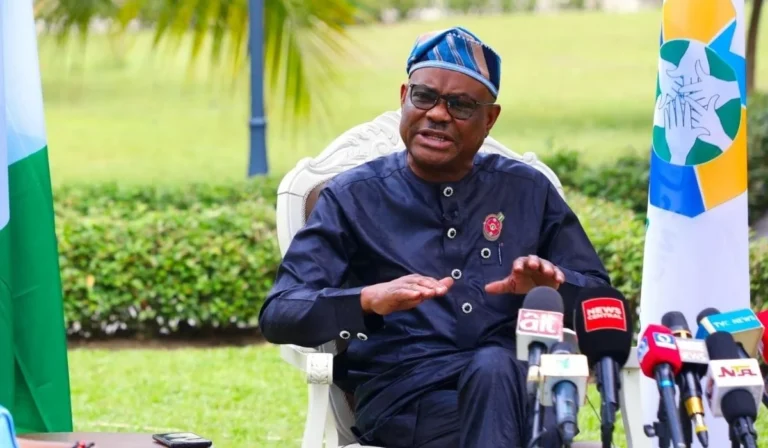
The political landscape of Nigeria continues to reverberate from the fiercely contested 2023 general elections, with high-ranking government officials revisiting past electoral outcomes to assert dominance and shape future political narratives. On a recent broadcast of the Television Continental (TVC) current affairs programme, Journalists Hangout, monitored closely in the nation’s capital, Abuja, the Minister of the Federal Capital Territory (FCT), Barrister Nyesom Wike, launched a scathing critique against the Labour Party’s 2023 presidential candidate, Mr. Peter Obi, and his support base, popularly known as the "Obidient" movement.
Minister Wike categorically dismissed claims by the Labour Party camp that they secured victory in Rivers State during the February 25, 2023, presidential election. According to the former Rivers State governor, such assertions lacked empirical backing and existed solely in the imagination of his political rivals. Wike maintained that electoral victories are neither determined by viral social media trends nor by localized street acclaim, but rather by certified polling unit results collated and officially declared by the Independent National Electoral Commission (INEC).
The intervention by the FCT Minister highlights the enduring friction between established political actors and the emergent populist movement that reshaped Nigeria’s electoral geography in 2023. As political coalitions begin to maneuver ahead of the 2027 general elections, statements of this nature serve as strategic posturing, signaling that the battle for the control of strategic geopolitical zones like Rivers State has already begun.
Decoding the Electoral Reality: Polling Units Versus Popular Perception
Addressing the controversy surrounding the Rivers State presidential election results, Wike challenged the methodology and evidence presented by the Labour Party to substantiate their claims of victory. He argued that isolated instances of crowd reception cannot substitute for comprehensive, statewide electoral documentation.
"They won in their imagination," Wike declared during the interview, reflecting on his deep familiarity with the country’s electoral architecture. "Nobody declared them to have won. I have been in this system; I am in this game. When Obi went to the Timber Market or somewhere in Rivers State and they were shouting ‘Obi! Obi!’, is that how you win an election?"
The FCT Minister drew attention to the sheer scale of Rivers State’s electoral map to contextualize why anecdotal evidence of popularity is insufficient. With over 7,000 polling units distributed across the 23 Local Government Areas (LGAs) of the oil-rich state, Wike argued that premature declarations based on a fraction of results are misleading.
"Out of over 7,000 polling units, until all results have come in, even if 200 polling units come out and say Obi or Atiku has won, it does not convince me," he stated. He further challenged his critics regarding their legal pursuit at the Presidential Election Petition Tribunal, asking whether they were able to tender sufficient and credible evidence to convince the judiciary of an outright victory in the state. "You can win on social media, but I am not interested in social media winning. I am interested practically in the results on the ground, who won, and who was declared."
A Chronological Retrospective of Wike’s Electoral Battles
To reinforce his assertion of political invincibility, Wike took viewers through a historical retrospective of his political career, which spans over two decades. He noted that his trajectory within Nigeria’s democratic dispensation has been fraught with intense opposition, beginning from his tenure as a local government chairman in 1999 through his emergence as the governor of Rivers State in 2015 and his turbulent reelection bid in 2019.
"I started this game in 1999 as a local government chairman. In all my elections, it has never been easy," Wike reflected. He recalled the severe political hostilities that characterized the 2015 gubernatorial contest, where he defied heavy opposition to clinch victory. Furthermore, he highlighted the unprecedented tension of the 2019 general elections, pointing to the deployment of state security apparatuses and federal might against his administration.
In a candid revelation, the FCT Minister shared a personal anecdote from the volatile period preceding the 2019 elections. He disclosed how his late friend and business mogul, Herbert Wigwe, driven by concern for his safety amidst intense federal pressure, strongly advised him to flee the state temporarily. Wike revealed that he rebuffed the counsel, chose to stay, and ultimately secured his mandate at the polls.
This historical recounting was deployed by the minister to project resilience, aiming to signal to current adversaries that institutional pressure or orchestrated opposition would fail to diminish his political capital in Rivers State.
Looking Ahead to 2027: Confidence Amidst Coalition Threats
The discourse quickly pivoted to the horizon of Nigerian politics, specifically the fast-approaching 2027 general elections. Rumors of subterranean political realignments and ganging up by local and national rivals seeking to dislodge Wike’s influence in Rivers State have dominated political circles in recent months. However, the minister met these speculations with unalloyed optimism.
Rather than expressing apprehension over the coalition of forces forming against him, Wike boldly predicted that the 2027 electoral cycle would prove to be his easiest political contest since joining active governance. He attributed this anticipated outcome to the tangible records of past administrations and the lack of a compelling counter-narrative from his detractors.
"Anybody telling you today that people are fighting me in Rivers and that it will be difficult, brother, I have never had an election that has been easy, but this one will be the easiest election as far as I know," Wike asserted. "The factors are clear. What are you going to tell Rivers people now? What will you present to them that will make them believe that following you will be more beneficial than what they have today?"
By framing his political strength around tangible governance deliverables and grassroots connection, Wike sought to delegitimize the coalition against him, portraying it as an alliance of self-serving elites devoid of a genuine development agenda for the populace.
Background Context: The 2023 Rivers State Presidential Contest
To fully appreciate the weight of Minister Wike’s remarks, it is essential to examine the context of the 2023 presidential election in Rivers State. The electoral contest in the state was fiercely triangular, involving the ruling All Progressives Congress (APC), the Peoples Democratic Party (PDP)—under whose platform Wike served as governor—and the surging Labour Party (LP) led by Peter Obi.
Official results announced by INEC declared the candidate of the APC, Bola Ahmed Tinubu, as the winner of the national presidential election, while various states recorded diverse voting patterns. In Rivers State, official INEC collated results gave victory to the APC candidate, sparking immediate controversy and subsequent legal challenges from opposing parties, including the PDP and the Labour Party. Both opposition camps alleged massive irregularities, manipulation of result sheets, and non-compliance with the Electoral Act at various collation centers.
The "Obidient" movement, a largely youth-driven digital and physical mobilization network, maintained that Peter Obi won the popular mandate across several urban centers in Rivers State, particularly in Port Harcourt and its environs. This narrative gained traction on social media platforms, creating a parallel perception of victory that directly conflicted with the officially declared outcomes. The divergent perspectives on the 2023 ballot have since remained a major flashpoint in Nigerian political discourse, frequently invoked by political actors to either validate the credibility of the polls or underscore systemic electoral flaws.
Broader Implications and Political Analysis
Minister Wike’s recent television appearance carries significant implications for the internal dynamics of Nigerian politics, particularly concerning the ruling party, opposition restructuring, and the future of regional control in the Niger Delta.
First, Wike’s continuous verbal sparring with the Labour Party and the Obidient movement underscores the lingering psychological impact of the 2023 elections. Despite the conclusion of judicial processes at the Presidential Election Petition Tribunal and the Supreme Court—which affirmed Tinubu’s victory—political actors remain deeply engaged in a war of legitimacy. For Wike, neutralizing the narrative of an alternative victory in his home state is vital to sustaining his political hegemony.
Second, the minister’s posture toward 2027 sets the stage for a protracted proxy war within Rivers State. As a serving minister under an APC-led federal administration while retaining complex historical ties to the opposition PDP, Wike occupies a unique and powerful position. His ability to dismiss opposing coalitions as toothless demonstrates his reliance on local political machinery, patronage networks, and grassroots loyalty over federal coattails.
However, political analysts caution that dismissing populist movements entirely could underestimate the shifting demographics of the Nigerian electorate. The 2023 elections demonstrated the capacity of social media mobilization and urban discontent to upend traditional political calculations. While Wike emphasizes institutional results and structural dominance at the polling units, the growing discontent among urban youths and the persistence of alternative political platforms suggest that future elections in Rivers State and across Nigeria will remain fiercely competitive.
As the political class gradually transitions its focus toward the 2027 polls, statements from influential figures like Nyesom Wike serve as both tactical salvos and indicators of the high-stakes battles ahead. Whether the upcoming electoral cycle validates his prediction of an effortless victory or proves to be as unpredictable as its predecessor remains a subject of intense speculation among observers of the Nigerian democratic experiment.