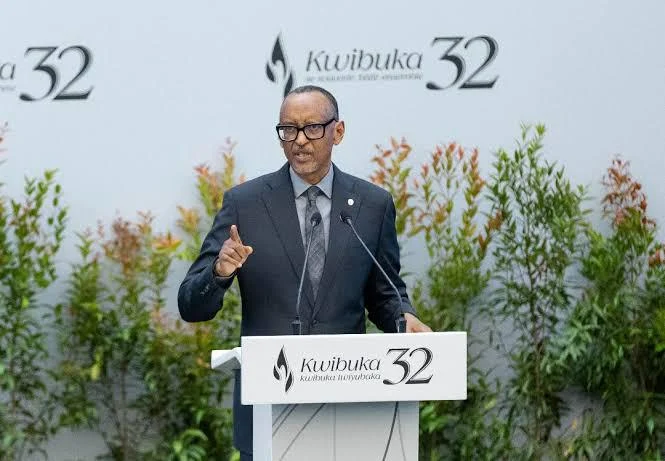
Rwandan President Paul Kagame delivered a powerful address at the Kigali Genocide Memorial on Tuesday, marking the 32nd commemoration of the 1994 Genocide against the Tutsi, known as Kwibuka32. Speaking before thousands, President Kagame launched a staunch defense of Rwanda’s security forces, unequivocally rejecting recent US sanctions and asserting the nation’s sovereign right to self-defense against persistent threats, particularly from the Democratic Forces for the Liberation of Rwanda (FDLR). His remarks underscored a deep-seated conviction in the strength and integrity of Rwanda’s defense capabilities, even as he critiqued the international community’s perceived selective engagement and historical indifference.
Defiance Amidst International Sanctions
In a direct challenge to recent international pressure, President Kagame declared that sanctions imposed on Rwandan defense and security forces would not diminish their effectiveness or honour. "They are among the finest that can be found anywhere," he asserted, praising the military’s professionalism and dedication. This defiant stance comes in the wake of significant measures taken by the US Department of the Treasury’s Office of Foreign Assets Control (OFAC) on March 2. The US announced sanctions against the Rwanda Defence Force (RDF) and four of its senior officials, citing accusations of active support, training, and fighting alongside the M23 rebel group in the eastern Democratic Republic of Congo (DRC).
President Kagame vehemently denies these accusations. Instead, he framed Rwanda’s military presence and actions as essential defensive measures, designed to safeguard the nation and its citizens from the persistent threats posed by the FDLR. The FDLR, a militia group with deep roots in the perpetrators of the 1994 Genocide against the Tutsi, has long been a source of instability and cross-border incursions into Rwanda. Kagame’s administration maintains that its operations are solely aimed at neutralising this existential threat, rather than engaging in proxy conflicts in the DRC. The imposition of sanctions, he argued, not only misrepresents Rwanda’s intentions but also inadvertently emboldens the very extremist groups that threaten regional stability.
The relationship between the United States and Rwanda has been complex, often balancing strategic cooperation with points of contention over human rights and regional interventions. While the US has historically been a significant donor and partner to Rwanda, particularly in post-genocide reconstruction and development, recent accusations regarding Rwanda’s alleged involvement with M23 have strained diplomatic ties. The US position reflects a broader international concern about the escalating conflict in eastern DRC and its humanitarian consequences, which has seen millions displaced and a resurgence of violence involving numerous armed groups. However, Rwanda views the sanctions as a punitive measure that fails to acknowledge its legitimate security concerns and historical trauma.
The Enduring Threat of the FDLR and Regional Instability
A central theme of President Kagame’s address was the ongoing danger posed by the FDLR. This notorious militia was formed by remnants of the former Rwandan army (FAR) and Interahamwe militias, who fled into eastern DRC (then Zaire) following their defeat in July 1994, taking with them millions of Hutu civilians, many of whom were coerced. Within the refugee camps, these genocidal forces regrouped, rearmed, and subsequently launched a sustained cross-border insurgency against the new Rwandan government. Their stated aim has consistently been to destabilise Rwanda, overthrow the current government, and complete the genocide against the Tutsi.
For decades, the FDLR has conducted numerous incursions into Rwanda, targeting citizens and critical infrastructure. These attacks have caused significant loss of life, displacement, and economic disruption, particularly in Rwanda’s western border regions. The Rwandan government, through concerted efforts by the army and local residents, managed to secure its western border by the end of the 1990s. However, the presence of the FDLR in eastern DRC, operating alongside other armed groups, continues to be a profound security concern for Kigali. Kagame reiterated that Rwanda’s defensive measures are perpetually maintained to ensure that "such attacks can never again be made across our borders."
The humanitarian crisis in eastern DRC is inextricably linked to the activities of the FDLR and other non-state armed groups. Millions of Congolese citizens have been displaced, and countless lives have been lost in a conflict that has simmered for decades. Kagame specifically raised concerns about the spread of genocidal ideology, hate speech, and targeted violence against Congolese Tutsi and the Balamulenge communities in eastern DRC. These concerns have been echoed by UN officials, who have warned of potential genocidal acts in the region. The President lamented that despite numerous UN resolutions identifying the FDLR as a terrorist group that should be dismantled, the international community appears to be ignoring the plight of refugees and the escalating violence. He called for international partners to join Rwanda in combating extremism rather than penalising the nation for defending itself, drawing a stark parallel to the failures of intervention during the 1994 genocide.
Kwibuka32: A Call for Vigilance and Memory
The 32nd commemoration, Kwibuka32, served as a poignant reminder of the unfathomable loss and the imperative of memory. Held at the Kigali Genocide Memorial, a sacred site where over 250,000 victims are laid to rest, the event is a national moment of reflection, mourning, and recommitment to the principle of "Never Again." The memorial, with its stark exhibition rooms detailing the systematic nature of the genocide, stands as a testament to Rwanda’s resilience and its determination to educate future generations about the dangers of hatred and indifference.
President Kagame’s address resonated with the theme of vigilance. He employed a powerful analogy of a farmer whose field catches fire, with neighbours initially ignoring the small flames, believing the wind would change or that it wasn’t their concern. Meanwhile, a "pyromaniac is secretly adding fuel to the fire," causing it to spread uncontrollably. Only when the fire engulfs towns and forests do people react. This metaphor served as a sharp critique of the international community’s historical inaction during the genocide and its current perceived indifference to the threats posed by groups like the FDLR. He argued that leaving such problems to Rwanda alone only rewards those who perpetrate threats while penalising Rwanda for its self-preservation.
The President also addressed cynical views that suggest Rwanda exaggerates the threats of genocide ideology for ulterior motives. He dismissed this as "false" and symptomatic of the "deep cynicism that led to the tragedy we commemorate today." For Rwanda, the unity of its people and the conviction that they, like all others, have the right to live in safety, dignity, and peace, are the bedrock of its continued existence and progress. The annual Kwibuka ceremonies are not merely historical commemorations but active commitments to ensuring that the lessons of the past are never forgotten and that the seeds of division and hatred are never allowed to take root again.
Battling Genocide Denial and Historical Revisionism
A significant portion of President Kagame’s speech was dedicated to combating genocide denial and historical distortion, which he identified as insidious threats to truth and reconciliation. He stressed that the facts of the 1994 Genocide against the Tutsi are "well-documented and could not be erased." This documentation includes the exhaustive work of international courts, such as the International Criminal Tribunal for Rwanda (ICTR), which convicted numerous individuals for their roles in the genocide, and the monumental Gacaca community courts. The Gacaca courts, a traditional justice system adapted for post-genocide Rwanda, processed millions of cases, generating an unparalleled archive of testimonies and evidence from across the country.
"The proof is undeniable. And yet, we still find people throwing doubt and twisting the facts up to today," Kagame lamented. He highlighted that genocide denial is not a post-facto phenomenon but often begins long before massacres, through a pattern of ignoring warning signs and normalising dangerous rhetoric. This process involves the transformation of hateful speech into violent acts, the rationalisation and minimisation of abhorrent behaviour, and ultimately, the creation of a false moral equivalence between the victims and the perpetrators.
Kagame firmly rejected claims that the genocide was a spontaneous outbreak of violence. He underscored that it was a systematically planned and meticulously executed campaign. Militias were trained, weapons stockpiled, and dissenting voices silenced long before the killings began. Early massacres were deliberately used to desensitize and normalise the systematic extermination, all while the international community largely remained indifferent or actively withdrew. This historical context forms the core of Rwanda’s insistence on international accountability and its deep-seated distrust of external narratives that seek to dilute or distort the truth of its past.
Regional Dynamics and International Responsibility
The complex geopolitical landscape of the Great Lakes region forms a critical backdrop to Rwanda’s security concerns. The porous borders, the presence of numerous armed groups, and the historical grievances between nations create a volatile environment. Rwanda’s critique of the international community extends beyond past inaction to current perceived inconsistencies. While the United Nations has passed resolutions condemning and calling for the dismantling of the FDLR, effective action has often been elusive, leaving Rwanda to bear the brunt of its activities.
Kagame’s call for partners to fight extremism, rather than punishing Rwanda for its self-defense, reflects a broader plea for a more coherent and equitable international approach to regional security. The intricate web of alliances and rivalries in eastern DRC, involving local militias, foreign armed groups, and national armies, makes any intervention highly sensitive. Rwanda’s leadership frequently emphasizes that stability in the region is a shared responsibility, arguing that a failure to address the root causes of conflict and disarm genocidal forces ultimately undermines peace for all.
The implications of the US sanctions are multi-faceted. They could potentially complicate regional security initiatives that require Rwandan participation and cooperation. Furthermore, they risk alienating a key player in the ongoing efforts to stabilise a highly volatile region. For Rwanda, the sanctions are seen as an affront to its sovereignty and a betrayal of its efforts to prevent a recurrence of the atrocities of 1994. The country’s strong commitment to its defense forces, which it views as instrumental in its post-genocide recovery and current stability, means that such external pressures are unlikely to deter its strategic objectives.
Rwanda’s Vision for the Future
Concluding his address, President Kagame articulated a powerful vision for Rwanda’s future, one built on the lessons of its tragic past. He emphasized the paramount need to ensure that Rwanda remains secure and peaceful for future generations. "We owe future generations of Rwandans more than survival. They deserve to inherit a secure, united and bold country and an integrated and confident Africa," he stated. This aspiration transcends national borders, envisioning a continent free from conflict and united in its pursuit of progress.
Kagame’s own legacy as the leader of the Rwandan Patriotic Front (RPF/RPA) in stopping the genocide and liberating Rwanda from the extremist regime is a cornerstone of national identity. While he acknowledges that some have reservations about fully acknowledging this historical truth, he insists on its undeniable factual basis. His leadership has been credited with transforming Rwanda from a shattered nation into one of Africa’s most stable and rapidly developing countries. This transformation, however, has been underpinned by a strong security apparatus and a firm stance against any threats to national unity and peace.
The 32nd Kwibuka commemoration, therefore, was more than just a remembrance of a horrific past; it was a reaffirmation of Rwanda’s unwavering commitment to its present and future. It was a platform for President Kagame to articulate Rwanda’s security doctrine, challenge international narratives, and reiterate the nation’s steadfast resolve to protect its hard-won peace and sovereignty, even in the face of external pressure. The enduring spirit of "Never Again" continues to define Rwanda’s path, guiding its policies and shaping its interactions on the global stage.