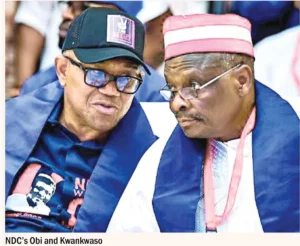
The Presidency has formally alleged that Peter Obi, the presidential candidate of the Labour Party in the 2023 general elections, has strategically adopted a new political approach ahead of the 2027 polls by consistently asserting that his life is under threat. This claim was spearheaded by Daniel Bwala, the Special Adviser to President Bola Tinubu on Media and Public Communications, who articulated this perspective in a detailed post on his verified X (formerly Twitter) handle on Saturday. Bwala’s assertions emerged in direct response to recent remarks made by Obi during an engagement in Berlin, Germany, where the former Anambra State governor stated there had been an attempt on his life related to a planned visit to Benue State scheduled for April 2025.
Bwala vehemently dismissed Obi’s allegation, characterizing it as part of a recurring pattern of similar claims, which he suggested lacked substantiation. "The desperation of Peter Obi is palpable. He recently travelled to Europe and was quoted to have alleged that the Governor of Benue wanted to kill him. Imagine lies from someone who said he wants to govern a country like Nigeria," Bwala wrote, underscoring the Presidency’s skepticism regarding the sincerity and veracity of Obi’s statements. This public denunciation by a senior presidential aide signals a significant escalation in the political rhetoric between the ruling All Progressives Congress (APC) and the opposition Labour Party, particularly as the political landscape begins to shape itself for the next electoral cycle.
The Allegation Unpacked: A Pattern of Claims
The Special Adviser further elaborated on his argument, drawing parallels to a recent controversy involving Obi’s claims of intimidation at a Nigerian airport. According to Bwala, Obi had wrongly accused airport authorities of threatening his life when, in fact, he had allegedly violated airport traffic regulations. This incident, along with the latest claim from Berlin, forms the basis of the Presidency’s argument that Obi is employing a deliberate strategy. Bwala asserted, "The other day he falsely accused airport officials of threatening his life when in fact he violated airport traffic rules. Lately his newfound allegation on life may appear to be his strategy to use his Obidient movement to threaten people’s lives like they have been doing on us." This statement suggests that the Presidency views Obi’s claims not merely as expressions of personal security concerns but as a calculated maneuver designed to galvanize his formidable support base, known as the ‘Obidient Movement,’ against perceived political adversaries. The implication is that these allegations are intended to foster a confrontational environment, potentially leading to increased tension and antagonism in the political arena.
Peter Obi’s Recent Claims: Context and Controversy
Peter Obi, a former two-term governor of Anambra State, emerged as a significant political force during the 2023 presidential elections under the banner of the Labour Party. His campaign resonated deeply with a segment of the Nigerian populace, particularly youth, who were drawn to his message of fiscal prudence, accountability, and a departure from traditional politics. Despite securing a substantial number of votes, Obi eventually lost to President Bola Tinubu of the APC. Since the conclusion of the elections and the Supreme Court’s affirmation of Tinubu’s victory, Obi has remained an active voice in national discourse, often critiquing government policies and raising concerns about various national issues.
His recent remarks in Berlin, Germany, where he alleged an attempt on his life during a planned visit to Benue State in April 2025, have ignited a fresh wave of controversy. While details of the alleged plot remain vague, Obi’s statement has been widely reported and has generated considerable debate among political stakeholders and the public alike. Benue State, located in Nigeria’s North Central region, has a complex political landscape often characterized by ethno-religious dynamics and security challenges, including farmer-herder clashes. Any allegation of a politically motivated threat within this context carries significant weight and can quickly inflame tensions.
The airport incident Bwala referenced also contributed to this perceived pattern. Although specific details regarding the alleged traffic violation and the subsequent accusation of intimidation remain contested, the incident highlighted a growing narrative of security concerns from Obi’s camp and a counter-narrative from government officials challenging the veracity of these claims. These episodes collectively form the backdrop against which the Presidency’s current allegations are being made, suggesting a deliberate and sustained effort by Obi to project an image of vulnerability and victimhood.
Background: The ‘Obidient Movement’ and Post-Election Dynamics
The ‘Obidient Movement’ represents a unique phenomenon in Nigerian political history. Comprising a diverse demographic, largely but not exclusively youth, the movement coalesced around Peter Obi’s candidacy in the lead-up to the 2023 elections. Characterized by its vibrant social media presence, grassroots mobilization, and a fervent belief in Obi’s vision for Nigeria, the movement significantly disrupted the traditional two-party dominance of the APC and the Peoples Democratic Party (PDP). Even after the elections, the ‘Obidients’ have remained a vocal and influential force, actively engaging in political discourse, critiquing government policies, and defending Obi’s public image.
The post-2023 election period in Nigeria has been marked by heightened political tensions and ongoing debates about the integrity of the electoral process. The legal challenges mounted by Obi and the Labour Party, alongside the PDP, against Tinubu’s victory, extended for several months, culminating in the Supreme Court’s final judgment. This period of intense legal and political wrangling has left a lingering sense of polarization within the polity. In this environment, any statement from a major political figure, especially one related to personal security, is meticulously scrutinized and often becomes fodder for partisan interpretations.
The Presidency’s allegation that Obi intends to leverage the ‘Obidient Movement’ through these claims speaks to the perceived power and influence of this group. The movement’s ability to quickly disseminate information, mobilize supporters, and shape narratives on social media platforms is a well-established fact. Therefore, a strategy that seeks to rally this base through claims of threats could be seen as a potent, albeit controversial, political tool.
Chronology of Key Events and Allegations
- Prior to 2023 Elections: Peter Obi, as the Labour Party presidential candidate, gains significant traction, largely due to the emergence of the ‘Obidient Movement.’
- February 25, 2023: Presidential elections held, with Bola Tinubu of the APC declared winner, followed by Obi (Labour Party) and Atiku Abubakar (PDP).
- Post-Election Period (March – October 2023): Obi and Labour Party challenge election results at the Presidential Election Petition Tribunal and subsequently at the Supreme Court, alleging widespread irregularities. Both appeals are ultimately dismissed.
- Recent Past (Undisclosed Date): Alleged incident at a Nigerian airport where Peter Obi claims intimidation by airport officials, while the Presidency (via Bwala) asserts Obi violated traffic rules.
- Recent Past (Undisclosed Date, Berlin, Germany): Peter Obi makes remarks alleging an attempt on his life related to a planned visit to Benue State in April 2025.
- Saturday (Specific Date Not Provided): Daniel Bwala, Special Adviser to President Tinubu, makes a public post on X, accusing Peter Obi of adopting a new political strategy involving repeated claims of life threats, citing the Berlin remarks and the airport incident.
Reactions from Other Stakeholders: Inferred Perspectives
While specific official reactions from all parties are yet to fully emerge, logical inferences can be drawn based on the nature of Nigerian politics and past incidents:
- Peter Obi’s Camp (Labour Party/Obidient Movement): It is highly probable that Obi’s media team and supporters would strongly refute the Presidency’s characterization of his claims as a political strategy. They would likely reaffirm the genuineness of his security concerns, emphasizing the volatile nature of Nigerian politics and the potential for real threats against prominent opposition figures. They might also call for thorough investigations into Obi’s allegations rather than dismissing them. The ‘Obidient Movement’ would likely rally in support of Obi, viewing Bwala’s statement as an attempt to discredit their leader and suppress dissent.
- Benue State Government: The office of the Benue State Governor would most likely issue a categorical denial of any involvement in or knowledge of a plot against Peter Obi. They might express readiness to provide security for Obi should he visit the state and possibly request Obi to provide concrete evidence to substantiate his serious claims. Such allegations against a state governor, especially concerning a potential assassination plot, are grave and demand clear responses.
- Airport Authorities: The relevant airport authorities would likely reiterate their commitment to safety and adherence to operational procedures. They might provide further clarification regarding airport traffic regulations and deny any acts of intimidation, perhaps offering to review surveillance footage if available to address Obi’s earlier claims.
- Civil Society Organizations (CSOs) and Human Rights Groups: These bodies would likely express concern over the escalating political rhetoric and the seriousness of allegations of threats to life. They might call for all parties to engage in responsible political discourse, urge security agencies to investigate credible threats irrespective of political affiliation, and emphasize the importance of evidence-based claims to avoid unnecessary alarm and political instability.
- Political Analysts and Commentators: Analysts would likely dissect the implications of these exchanges for the 2027 elections. Some might view the Presidency’s claims as an attempt to preemptively delegitimize Obi’s future campaigns, while others might critique Obi for making unsubstantiated claims that could inflame political passions. The consensus would likely revolve around the need for verifiable facts and a cooling of political temperatures.
Broader Implications and Analysis
The public exchange between the Presidency and Peter Obi regarding alleged life threats carries significant implications for Nigeria’s political landscape, particularly as the nation gradually shifts its focus towards the 2027 general elections.
1. Heightened Political Temperature: Such serious allegations and counter-allegations inevitably contribute to an already charged political atmosphere. In a country with a history of political violence, even unsubstantiated claims of threats can heighten anxieties, potentially leading to social unrest or deepening existing divisions. The discourse risks becoming toxic, hindering constructive dialogue on critical national issues.
2. Erosion of Trust and Credibility: When prominent political figures make serious claims that are then publicly dismissed by government officials as mere political strategy, it can lead to a pervasive erosion of trust. The public may become cynical, struggling to discern truth from politically motivated rhetoric. This ‘cry wolf’ scenario, if left unchecked, can undermine the credibility of genuine security concerns in the future.
3. The Role of Social Media as a Battleground: Bwala’s use of X (formerly Twitter) to launch his allegations underscores the platform’s critical role as a primary arena for political communication and conflict in Nigeria. Social media allows for rapid dissemination of information, but also for the quick spread of unverified claims and partisan narratives. This environment can make it challenging for the public to access objective information and form informed opinions.
4. Impact on the ‘Obidient Movement’: The Presidency’s accusation that Obi intends to use his movement to "threaten people’s lives" is a direct challenge to the ‘Obidient Movement’s’ image. While the movement prides itself on being peaceful and driven by democratic ideals, such an accusation, if it gains traction, could potentially alienate some moderate supporters or provide ammunition for critics to portray the movement in a negative light. Conversely, it could also galvanize the base further, reinforcing a narrative of victimhood and political persecution.
5. Security Agencies Under Scrutiny: The repeated claims of threats, whether deemed genuine or strategic, place Nigeria’s security agencies in a difficult position. They are expected to ensure the safety of all citizens, including political figures. If credible threats are not adequately addressed, or if security concerns are politicized, it can lead to questions about their impartiality and effectiveness. There is a clear need for security services to operate independently and to investigate all serious claims without bias.
6. Shaping the Narrative for 2027: Both the claims of threat and the counter-claims of strategic manipulation are essentially attempts to shape the narrative ahead of 2027. For Obi, highlighting security concerns might be an attempt to project vulnerability or rally sympathy, positioning himself as a target of the establishment. For the Presidency, discrediting these claims serves to portray Obi as an alarmist or manipulative, thereby undermining his public standing and potentially weakening his future political prospects. This pre-election posturing suggests that the next few years will be characterized by intense political maneuvering and narrative warfare.
In conclusion, the allegations by the Presidency regarding Peter Obi’s alleged new political strategy represent a significant development in Nigeria’s pre-2027 political landscape. These exchanges underscore the deep-seated mistrust and fierce competition between the ruling party and the opposition. As the country moves closer to the next general elections, the imperative for political actors to engage in responsible, fact-based discourse, and for security agencies to ensure a safe and impartial environment, becomes increasingly critical to fostering a stable and democratic society. The ongoing controversy demands careful monitoring, as its implications could resonate far beyond the immediate political sparring.