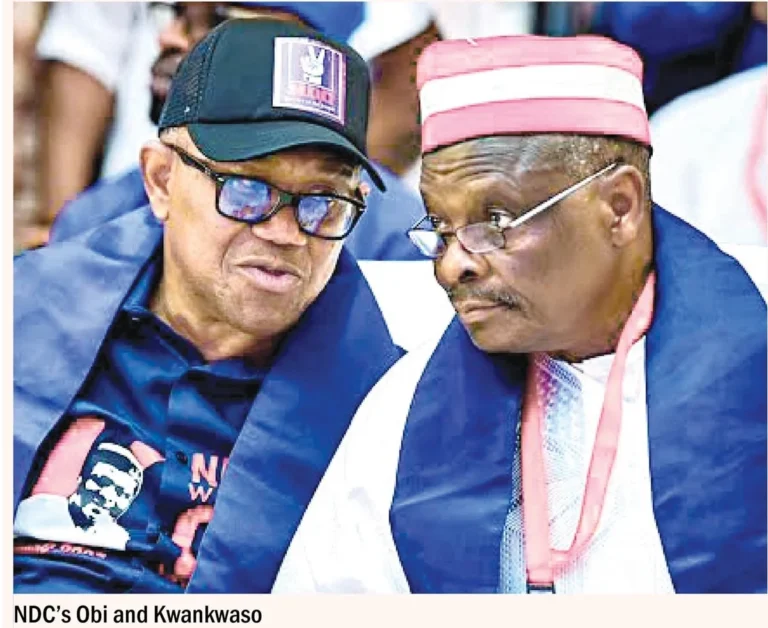
The landscape of Nigerian politics has shifted into an earlier-than-usual gear as political coalitions and grassroots movements begin positioning themselves for the fiercely anticipated 2027 general elections. Amid a complex socio-economic environment marked by structural reforms, inflationary pressures, and evolving party dynamics, the Obi-Kwankwaso (OK) Movement has officially inaugurated its Presidential Campaign Council. This strategic milestone marks a definitive step forward for the coalition, setting in motion a nationwide mobilization campaign designed to take its political agenda from urban centers down to the most remote grassroots communities across the federation’s 774 local government areas.
The inauguration, announced through an official statement signed by the National Secretary of the movement, Saadatu Sani, framed the appointment of the council members not merely as political selections, but as a solemn call to duty, sacrifice, leadership, and national service. The movement’s leadership underscored that the newly formed council carries the profound responsibility of translating the vision and aspirations of its principals into tangible engagements with the Nigerian electorate. By establishing a comprehensive administrative architecture that spans geopolitical zones, states, and wards, the OK Movement is signaling its intent to build a formidable, structured alternative ahead of the 2027 ballot.
A Vision Beyond Personal Ambition
At the core of the movement’s messaging is an explicit rejection of personalized politics. In its foundational briefing, the national leadership emphasized that the OK Movement is not constructed around individuals seeking personal recognition or transient political offices. Instead, the coalition describes itself as an enterprise driven by a larger, overarching national vision: mobilizing Nigerians around the pragmatic possibility of cultivating a better, more prosperous, united, and functionally efficient nation.
Addressing the newly appointed council members, the national leadership urged a posture characterized by strict discipline, unwavering loyalty, humility, personal courage, and an uncompromising commitment to the collective objectives of the movement. Strategic thinking, grassroots mobilization, effective communication, and seamless intra-organizational cooperation were highlighted as the indispensable pillars upon which the 2027 campaign must rest. The core mandate remains straightforward yet vast: ensuring that the message of their principals permeates every demographic stratum of Nigerian society and that the collective voice of the citizenry resonates clearly from the creeks of the South-South to the plains of the North-East.
Leadership Structure and Key Appointments
To steer this expansive political machinery, the OK Movement has assembled a diverse leadership team combining seasoned administrators, strategic thinkers, and regional coordinators. John Ughulu has been appointed as the Director-General of the campaign, tasked with the day-to-day oversight of operational strategies, field logistics, and political alignment. Alongside him, Saadatu Sani continues her pivotal role as the National Secretary, ensuring administrative continuity and institutional memory within the campaign secretariat.
The operational architecture of the campaign is further reinforced by a specialized directorate system designed to handle specific facets of modern political campaigning. These directorates reflect a nuanced understanding of contemporary electoral requirements, integrating technical competence with traditional grassroots mobilization techniques.
Among the key directorial appointments are Sabo Gashua, who assumes office as the Director of Grassroots Mobilization, and Glory Adayi, tasked with leading the Directorate of Women Affairs to harness the crucial demographic power of female voters. Kabir Yahaya takes charge as the Director of Contact and Engagement, while Abdumumini Tijjani serves as the Director of Mobilization. Recognizing the increasing intersection of technology, law, and strategy in modern Nigerian elections, the council appointed Sunmisola Adebayo as the Director of Information Technology to oversee digital infrastructure and data management. Kingdom Okere steps in as the Director of Legal Affairs to navigate electoral compliance and jurisprudence, and Abiodun Dabiri takes the helm as the Director of Strategy and Planning.
Furthermore, security remains a paramount concern in the volatile landscape of Nigerian political campaigns. Richard Enemona, a retired Chief Superintendent of Police (CSP), has been appointed as the Director of Security and Intelligence to safeguard personnel, events, and strategic assets. Aisha Abdulrahaman assumes responsibility as the Director of Administration, ensuring institutional efficiency. To address the country’s delicate socio-religious fabric, Rev. Mike Agbon has been named the Director of the Inter-Ethics Group in Northern Nigeria, signaling an intentional effort to foster inclusivity and bridge inter-communal divides across the northern geopolitical zones.
Geopolitical Coordination and Zonal Leadership
The effectiveness of any nationwide political campaign in Nigeria rests heavily on its decentralized zonal and state-level structures. The OK Movement has meticulously mapped out its coverage of the country, appointing specific coordinators for the six geopolitical zones, the Federal Capital Territory (FCT), and all thirty-six states.
In the North Central zone, Suleiman Abubakar has been designated as the zonal coordinator. He is supported by a robust team of state coordinators, including Maiyaki Samson (Kogi), Tokji J. Mandim (Plateau), Yusuf Abdullahi (Nasarawa), Aliyu Tershaku (Benue), Awal Goma (Niger), and Kazeem Olawuyi (Kwara).
Moving to the North West—traditionally one of the country’s most critical voting blocs characterized by massive numerical strength—Hashimu Dungurawa has been named as the zonal coordinator. He will oversee state-level operations supported by designated coordinators for Kaduna, Sokoto, Kano, Zamfara, Jigawa, Kebbi, and Katsina states.
The North East zone will be coordinated by Amadu Gwambe, who will direct efforts alongside state coordinators assigned to Adamawa, Gombe, Taraba, Bauchi, Yobe, and Borno states, navigating regions that require careful security considerations and development-focused messaging.
In the southern half of the country, the South West zone falls under the coordination of Dr. Adebayo Adefolaseye, with specialized representatives appointed for Osun, Oyo, Ekiti, Ogun, Lagos, and Ondo states, targeting the densely populated and politically vibrant urban centers of the region.
Christopher Ighodaro has been entrusted with the South South zone, overseeing state-level coordination across Cross River, Akwa Ibom, Edo, Delta, Bayelsa, and Rivers states, where economic resource control and infrastructural development typically dominate political discourse. Finally, the South East zone will be steered by El-shaddai Ikeh, working hand-in-hand with Chukwudi Onyejekwe (Anambra), Nwanebu Christian Onyinyechi (Imo), Roland Edeh (Ebonyi), Victor Onyia (Enugu), and Prof. Zulu Ofoelue (Abia).
Background Context: The Evolution of the Third-Force Phenomenon
The unveiling of the OK Movement’s Presidential Campaign Council comes against the backdrop of significant political realignments that began taking shape during the fiercely contested 2023 general elections. The political ecosystem in Nigeria has historically been dominated by two major legacy parties—the All Progressives Congress (APC) and the People’s Democratic Party (PDP). However, the 2023 cycle demonstrated a historic disruption of this bipartisan status quo, driven by widespread public exhaustion with economic stagnation, insecurity, and institutional decay.
Figures associated with the current OK Movement played central roles in reshaping the electoral map during the last general election cycle, capturing significant popular imagination and mobilizing millions of young, urban, and disillusioned voters. The fusion of political bases represented by the movement’s principals points toward a sustained effort to consolidate these gains. Rather than waiting for the official Independent National Electoral Commission (INEC) timetable for party primaries and campaigns, emerging political coalitions are opting for early institutional building, recognizing that organizational depth and grassroots penetration are prerequisites for challenging entrenched political machinery.
Implications for the 2027 Political Calculus
The early activation of the OK Movement’s campaign machinery carries several strategic implications for the evolving 2027 electoral race.
First, it signals to the ruling party and the traditional opposition that the architecture of dissent and alternative governance is shifting from loose, reactive alliances to permanent, structured political formations. By institutionalizing directorates ranging from IT and legal affairs to intelligence and grassroots mobilization, the movement is attempting to professionalize its operations to withstand the rigorous legal and logistical demands of Nigerian elections.
Second, the geographic breadth of the appointments indicates a deliberate push to build a truly national footprint. Historically, third-force movements in Nigeria have often struggled with structural deficits at the grassroots level, frequently performing strongly in specific regional enclaves while failing to secure the mandatory spread across the federation required by constitutional provisions for presidential victories. By assigning specific coordinators down to state levels across all six geopolitical zones, the OK Movement is proactively addressing the historical Achilles’ heel of non-mainstream political coalitions.
Third, the economic climate within which this campaign is unfurling will undeniably shape its reception. With the federal government implementing sweeping, albeit painful, macroeconomic reforms—including the removal of fuel subsidies, foreign exchange harmonization, and tight monetary policies—the cost of living has surged, creating widespread economic anxiety. Political movements positioning themselves as viable alternatives are likely to capitalize on these fiscal realities, framing their electoral proposition around restructuring the economy, curbing inflation, and restoring social security.
Outlook and the Road Ahead
As the political class looks toward 2027, the unveiling of the OK Movement’s campaign council serves as an early indicator of a protracted, highly competitive electoral cycle. The challenge ahead for the movement lies in maintaining internal cohesion, managing divergent regional interests, and translating its structural appointments into active, persuasive engagement with everyday citizens who remain skeptical of political promises.
In its concluding remarks to the newly inaugurated council, the national leadership sought to inspire a sense of historical urgency, capturing the gravity of the task ahead with a succinct declaration: “The journey has begun. The assignment is clear. The mission is Nigeria.” Whether this meticulously planned structure will successfully disrupt the established political order and rewrite Nigeria’s electoral history in 2027 remains one of the most compelling narratives to watch in the nation’s unfolding democratic journey.