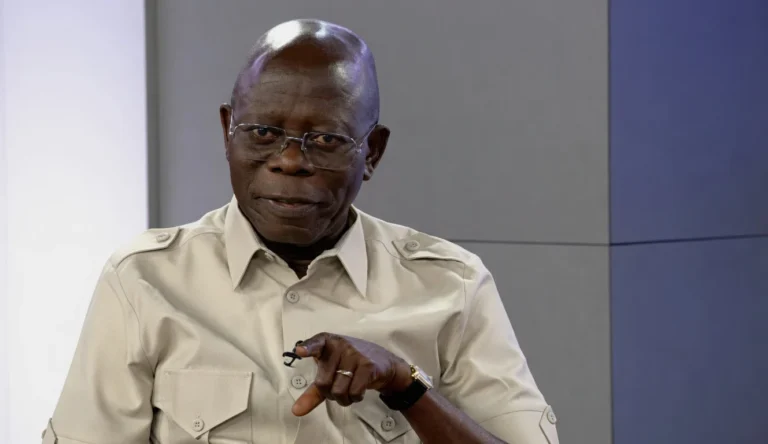
Senator Adams Oshiomhole, representing Edo North, has launched a scathing critique of Peter Obi, the 2027 presidential candidate of the Nigeria Democratic Congress, labeling him a "trader" whose economic philosophy is inherently limited to short-term turnover. Speaking during a high-profile interview on Channels Television’s flagship current affairs program, Politics Today, on Thursday, the former Edo State governor and stalwart of the ruling All Progressives Congress questioned Obi’s capacity to present a credible, long-term alternative to the economic reforms spearheaded by President Bola Tinubu’s administration.
The remarks arrive at a critical juncture in Nigeria’s political landscape, as prospective candidates begin positioning themselves for the 2027 general elections. With macroeconomic reforms continuing to dominate national discourse—ranging from the removal of the petrol subsidy to foreign exchange unification and new social intervention policies like the student loan scheme—the debate over leadership styles, economic ideologies, and policy consistency has intensified among
Nigeria’s political elite.
Oshiomhole’s critique centers on what he perceives as a fundamental divergence between the mindset of a commercial trader and that of a nation-building statesman. According to the senator, while a merchant evaluates success through immediate margins and rapid inventory turnaround, a national leader must focus on multi-generational institutional building, structural resilience, and sustainable development.
Questioning Policy Consistency and Economic Strategy
Throughout the interview, Oshiomhole dissected various aspects of Obi’s public platform, challenging the former Anambra State governor to clarify his stance on several cornerstone policies currently being implemented by the federal government. The senator pointed specifically to the student loan scheme and the management of Nigeria’s foreign exchange regime.
"Will you abolish the student loan scheme? You think President Tinubu would have introduced a student loan if he thought every Nigerian parent can afford it? Will the new people come who are looking for the job, would they abolish it?" Oshiomhole asked rhetorically, emphasizing that difficult administrative decisions are often necessitated by socio-economic realities rather than political convenience.
Furthermore, Oshiomhole targeted Obi’s historical and contemporary statements regarding the removal of the petrol subsidy and macroeconomic governance. He highlighted perceived policy contradictions between Obi and other opposition figures, noting that shifting alliances and strategic realignments among opposition leaders make it difficult for the electorate to pin down a unified economic blueprint.
Recalling recent political developments, Oshiomhole drew comparisons between Obi’s policy positions and those of former Vice-President Atiku Abubakar, the Peoples Democratic Party’s 2023 standard-bearer. He argued that public pronouncements regarding whether to retain, modify, or restore the petrol subsidy have shifted frequently depending on political expediency.
"Then you look at the contradiction within one month. Atiku said he will restore it. Obi said no, he will not. Then when he had this agreement with his running mate, he said, ‘Okay, he and Atiku, they are more or less saying the same thing.’ You can’t pin him to anything," Oshiomhole stated.
The former labor union leader maintained that effective democratic governance requires absolute transparency and the courage to communicate unvarnished truths to the populace, regardless of whether those policies generate immediate political friction or short-term hardship.

"The most important thing about leadership is being courageous enough to tell your followers, your countrymen and women, the truth. However bitter that truth is," he added.
Allegations Concerning Offshore Assets and Taxation
In a more contentious segment of the interview, Oshiomhole raised questions regarding Obi’s personal financial history and tax compliance. The Edo North senator alleged that the presidential hopeful has maintained substantial assets in offshore jurisdictions known as tax havens, claiming that this practice conflicts with the moral authority required of someone seeking the nation’s highest office.
"Do you know that Peter Obi has not paid tax in Nigeria? He kept his money in a tax haven," Oshiomhole alleged, asserting further that the former governor had previously acknowledged these financial arrangements in public discourse.
The issue of offshore wealth and transparency has long been a sensitive topic in Nigerian politics. While holding assets abroad is not inherently illegal under Nigerian law unless tied to illicit funds or non-compliance with tax obligations, critics frequently weaponize such disclosures to question a candidate’s commitment to the domestic economy. Representatives for Peter Obi have historically maintained that his business dealings complied with applicable laws, though an immediate, formal rebuttal to Oshiomhole’s specific tax allegations on Thursday night was still pending as political analysts awaited responses from the Obi camp.
Background and Political Chronology
To fully understand the weight of Oshiomhole’s criticisms, it is essential to examine the broader political trajectories of both figures.
Adams Oshiomhole rose to national prominence as the charismatic and combative President of the Nigeria Labour Congress, where he frequently locked horns with federal administrations over fuel prices, workers’ rights, and economic policy. He later transitioned into electoral politics, serving two terms as the governor of Edo State from 2008 to 2016 under the platform of the Action Congress of Nigeria, which later merged into the APC. He also served as the national chairman of the APC, cementing his status as one of the most vocal strategists within the ruling party.
Peter Obi, conversely, built his early reputation in the corporate and banking sectors before serving two terms as the governor of Anambra State from 2006 to 2014, initially under the All Progressives Grade Alliance. Renowned for his fiscal conservatism, frugal governance style, and frequent emphasis on redirecting public spending from consumption to production, Obi experienced a meteoric surge in popularity during the 2023 presidential election. Running as the presidential candidate of the Labour Party, he galvanized a massive youth movement colloquially known as "Obidients," ultimately finishing third behind Bola Tinubu of the APC and Atiku Abubakar of the PDP.
In May 2026, following internal realignments within the opposition coalition, Obi transitioned to the Nigeria Democratic Congress, emerging swiftly as the party’s presumptive standard-bearer for the upcoming 2027 presidential race. This ongoing repositioning has transformed him once again into a primary target for critiques from the ruling establishment.
Broader Implications for the 2027 Election Cycle
Oshiomhole’s pointed remarks reflect the emerging tactical battlelines for the 2027 polls. As the Tinubu administration continues to weather public scrutiny over the high cost of living, inflation, and structural adjustment policies, the ruling party is pivoting from defense to offense. By aggressively challenging the policy coherence, ideological depth, and personal integrity of leading opposition contenders like Obi, the APC aims to preemptively dismantle the narrative that the opposition offers a readily superior alternative.
Political analysts note that the 2027 election is shaping up to be an ideological referendum on state-led economic restructuring. While the administration points to long-term gains from foreign exchange unification, infrastructure financing, and targeted social programs like student loans, opposition figures like Obi continue to advocate for expenditure rationalization, enhanced support for local production, and robust poverty alleviation mechanisms.
However, as Oshiomhole’s interview underscores, the ability of opposition candidates to translate popular dissatisfaction with current economic hardships into a cohesive, unassailable governance alternative remains a central friction point. As campaigns gradually gather momentum, the discourse between seasoned political actors like Oshiomhole and reform-minded technocrats like Obi will likely define the parameters of the national debate, setting the stage for a fiercely contested electoral season.