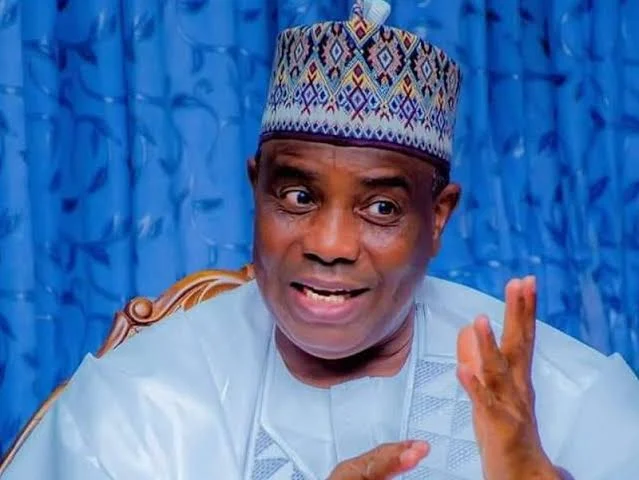
Former Sokoto State Governor and current Senator representing Sokoto South, Aminu Waziri Tambuwal, has issued a stern warning against the escalating climate of political intolerance in Sokoto State. Speaking during a high-level meeting with the Social Democratic Party (SDP) presidential candidate, Prince Adewole Adebayo, Senator Tambuwal voiced deep concerns regarding the reported harassment of opposition figures and the suppression of democratic activities within the state.
The meeting, which took place in Sokoto on Monday, served as a platform for both political stalwarts to address the shrinking space for democratic engagement. Tambuwal, a former Speaker of the House of Representatives, emphasized that the state’s historical identity as a bastion of intellectualism and political maturity is currently being threatened by partisan aggression.
Allegations of State-Sponsored Suppression
The core of Senator Tambuwal’s grievance centers on specific incidents involving state-recognized security outfits, including the Sokoto Marshal and the Community Guards. According to the former governor, these groups have been instrumentalized to intimidate opposition candidates and stifle political expression.
Specifically, Tambuwal cited the forceful sealing of the African Democratic Congress (ADC) campaign office as a major affront to the democratic process. Furthermore, he highlighted the physical assault of the ADC’s governorship candidate, Manir Muhammad Dan’iya, by state-aligned personnel. Such actions, Tambuwal argued, are a departure from the long-standing tradition of political accommodation that has historically defined Sokoto’s governance landscape.
"Sokoto belongs to all Nigerians," Tambuwal stated. "It must remain a welcoming environment where people from different political backgrounds can freely interact and promote their ideas, particularly those relating to democracy and good governance. The restriction of opposition activities and the violation of freedom of movement are not merely local issues; they are threats to the health of our national democracy."
The Visit of the SDP Delegation
Prince Adewole Adebayo, the SDP presidential candidate, utilized the visit to reinforce the necessity of political inclusivity. The delegation, which included prominent figures such as the SDP National Chairman, Professor Abubakar Sadiq Gombe; the party’s vice-presidential candidate, Dr. Usman Bugaje; and the Deputy National Chairman (South), Senator Ugochukwu Uba, arrived in Sokoto with a dual agenda.
Beyond the political discussions, the primary purpose of the delegation’s visit was to pay homage to the Sultan of Sokoto, Alhaji Muhammad Sa’ad Abubakar III, on the occasion of his 20th anniversary on the throne. Adebayo described the Sultanate as an essential pillar of Nigerian history and intellectual heritage.
"We see Sokoto not just as a Caliphate but as a seat of intellect," Adebayo remarked during the interaction. "No Nigerian should be prevented from visiting any part of the country or exercising political rights because of party affiliation. We are here to ensure that the tradition of hospitality and intellectual discourse that Sokoto represents is preserved for future generations."
Historical Context and Political Realignment
Senator Tambuwal’s current stance is informed by his own extensive political evolution. Reflecting on his transition from the All Progressives Congress (APC) back to the Peoples Democratic Party (PDP) during the administration of former President Muhammadu Buhari, Tambuwal noted that his shifts were always predicated on the perceived direction of the country.
He framed his current opposition to the state government’s tactics as a continuation of his commitment to democratic principles. By aligning with figures like Adebayo, despite being in different political parties, Tambuwal is advocating for a "government of national unity" mindset—a concept where the progress of the nation takes precedence over individual or party victory.
"If you defeat my candidate and you are ready to work with us, we will join you," Tambuwal noted, underscoring a bipartisan approach to national development. "And if we defeat you because of the ideas that you hold and your love for Nigeria, we will invite you into the government. Nigeria’s progress depends on cooperation, mutual respect, and a shared commitment to democratic principles."
Fact-Based Analysis of the Political Climate
The situation in Sokoto reflects a broader trend of political tension observed across various Nigerian states during election cycles. The use of sub-national security outfits, such as state-funded "marshals" or "guards," has become a point of contention in recent years. While these entities are ostensibly created to combat insecurity and banditry—a significant challenge in the Northwest region—critics argue that they are increasingly repurposed for political control.
Data from the Independent National Electoral Commission (INEC) and various civil society organizations suggest that when the political space is restricted, voter participation tends to decline. In states where opposition offices are sealed or candidates are physically harassed, the resulting "chilling effect" discourages grassroots mobilization and reduces the choices available to the electorate.
For Sokoto, a state that has historically served as a bridge between the North and the South in national politics, the suppression of opposition voices could have long-term implications for its influence at the federal level. Political scientists note that the "Sokoto model" of governance has historically thrived on consensus-building. Deviating from this toward a more authoritarian approach could alienate moderate voters and erode the state’s democratic credentials.
Implications for Democratic Stability
The allegations leveled by Senator Tambuwal highlight several critical issues that the Nigerian state must address:
- The Neutrality of Local Security: There is an urgent need to ensure that state-recognized security outfits operate within the bounds of the constitution, focusing on public safety rather than partisan interests.
- Freedom of Political Association: The constitutional right to form and participate in political parties is absolute. Any attempt by state governments to seal campaign offices or restrict movement is a direct violation of these rights and necessitates legal intervention.
- National Unity and Cooperation: The dialogue between Tambuwal and Adebayo serves as a template for how political discourse should be conducted—focusing on policy ideas and mutual respect rather than personal attacks or physical confrontation.
Chronology of Events and Reactions
- Early 2025: Reports of increased activity by state-recognized security outfits (Sokoto Marshal) emerge, with opposition parties raising concerns over potential overreach.
- Mid-2025: The African Democratic Congress (ADC) reports the sealing of its campaign office and the physical assault of its governorship candidate, Manir Muhammad Dan’iya.
- August 11, 2025: Prince Adewole Adebayo and the SDP delegation visit Sokoto to congratulate the Sultan and meet with political stakeholders.
- August 12, 2025: Senator Aminu Tambuwal releases a statement condemning the state government’s actions and calling for the preservation of democratic space in Sokoto.
As of the time of reporting, the Sokoto State Government has not issued an official response to the specific allegations of political intimidation. However, the intervention of a high-profile figure like Senator Tambuwal is likely to escalate the issue to the national level, potentially drawing the attention of federal security agencies and human rights organizations.
The call for a "welcoming environment" in Sokoto is not merely a request for political decorum; it is an appeal for the survival of the democratic process in one of Nigeria’s most significant political centers. Whether this will lead to a change in the state’s enforcement policies remains to be seen, but the event underscores the growing consensus among opposition leaders that the preservation of Nigeria’s democracy requires constant vigilance against the encroachment of local authoritarianism.
As the nation looks toward future electoral cycles, the events in Sokoto serve as a microcosm of the challenges facing the Nigerian political system. The ability of the state to manage its security challenges without infringing on the rights of its citizens will remain the ultimate test of its commitment to the rule of law and the fundamental tenets of the democratic project.