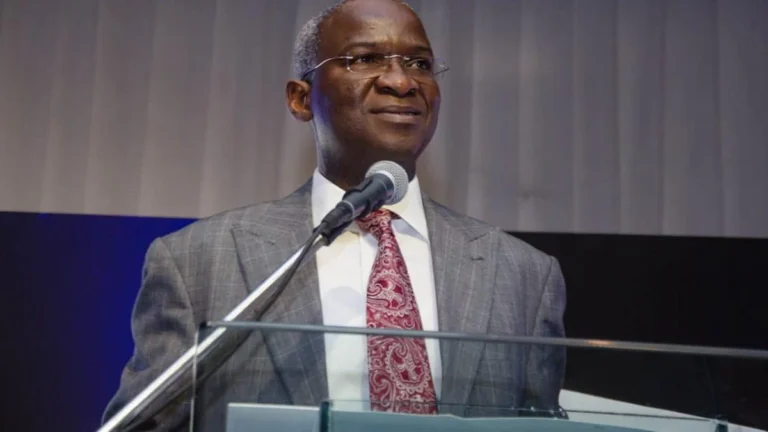
Former Lagos State Governor and immediate past Minister of Works and Housing, Babatunde Fashola, has unequivocally stated that he harbors no aspirations for Nigeria’s highest office, firmly declaring that a presidential bid is not part of his future plans. This definitive pronouncement, made during a recent interview on TVC, puts an end to widespread speculation that had gathered momentum among political observers and a segment of the public who view him as a technocratic leader with a proven track record.
A Definitive Stance: No Presidential Bid for Fashola
The clarification came during a segment of the TVC interview on Wednesday where Fashola was directly asked about his intentions to contest for the presidency. His response was succinct and immediate: "No." When pressed further by the interviewer for elaboration on such a significant declaration, the former governor, known for his calm demeanor and intellectual approach, offered a light-hearted yet firm retort, "President of what? I’m president at home." This statement, delivered with a smile, effectively underscored his disinterest in the highest political office, framing his current priorities within the domestic sphere rather than the national political arena.
The dismissal of presidential ambition by Fashola, a figure widely respected for his administrative acumen and perceived integrity, is noteworthy given his impressive public service record. His name has frequently surfaced in informal discussions about potential future leaders, particularly among those advocating for competence and performance-driven governance. For many, Fashola represents a blend of intellectual rigor and practical execution, qualities that often fuel calls for his elevation to more significant national roles.
A Distinguished Career: From Legal Luminary to National Statesman
Babatunde Fashola’s journey in public service is a testament to a career marked by significant responsibilities and notable achievements, positioning him as one of Nigeria’s most prominent technocrats. Born on June 28, 1963, Fashola initially built a formidable reputation in the legal profession, graduating from the University of Benin with a Bachelor of Laws degree in 1987 and being called to the Nigerian Bar in 1988. His legal career saw him specialize in areas such as corporate governance, real estate, and public litigation, laying a foundation for the meticulous approach he would later bring to public administration.
Transformative Leadership in Lagos State (2007-2015)
Fashola’s foray into mainstream politics began in 2002 when he was appointed Chief of Staff to the then Governor of Lagos State, Bola Ahmed Tinubu. This role provided him with invaluable insight into the machinery of state governance and a close working relationship with a seasoned political strategist. It was from this vantage point that he was tapped to succeed Tinubu, eventually serving two terms as the Governor of Lagos State from 2007 to 2015.
His tenure as governor is widely regarded as a period of significant transformation for Lagos, a megacity grappling with immense population growth and infrastructural deficits. Fashola’s administration embarked on ambitious projects that redefined urban development and public service delivery in the state. Key initiatives included:
- Infrastructure Development: A massive overhaul of the state’s road network, including the construction of iconic bridges and flyovers, significantly eased traffic congestion in critical areas. The expansion of the Bus Rapid Transit (BRT) system revolutionized public transportation, offering a more structured and efficient alternative for millions of commuters.
- Urban Renewal and Environmental Management: Fashola championed aggressive environmental sanitation campaigns, transformed blighted areas into aesthetically pleasing public spaces, and initiated robust waste management reforms. The greening of Lagos, through extensive tree planting and garden projects, not only beautified the city but also contributed to environmental sustainability.
- Security Reforms: Recognizing the critical link between security and economic prosperity, his administration established the Lagos State Security Trust Fund, a public-private partnership model that effectively funded and equipped security agencies, leading to a noticeable improvement in public safety.
- Education and Healthcare: Significant investments were made in renovating schools, improving teacher welfare, and expanding access to quality healthcare services, including the construction of new general hospitals and primary healthcare centers.
- Eko Atlantic City Project: Though a long-term vision, Fashola’s government actively supported and promoted the Eko Atlantic City project, an ambitious land reclamation and urban development initiative aimed at creating a new financial hub and residential district, showcasing a bold vision for Lagos’s future.
His administration’s achievements earned him national and international acclaim, burnishing his reputation as a high-performing and results-oriented leader. His association with Bola Tinubu, whom he succeeded, cemented a political alliance that has endured, with Fashola often referred to as a key protégé and trusted ally.
National Service as Minister of Works and Housing (2015-2023)
Following his successful tenure as governor, Fashola was appointed by President Muhammadu Buhari in 2015 as the Minister of Power, Works and Housing, a super-ministry encompassing three critical sectors. In 2019, he was re-appointed as the Minister of Works and Housing, a role he held until the end of the Buhari administration in 2023.
In these capacities, Fashola was tasked with addressing Nigeria’s vast infrastructure deficit. His work involved overseeing the construction and rehabilitation of thousands of kilometers of federal roads, including major arterial routes critical for economic connectivity. Notable projects under his supervision included:
- The Second Niger Bridge: A monumental infrastructure project that had been conceptualized for decades, its completion under his watch was a significant milestone, easing traffic and fostering economic development in the South-East region.
- Lagos-Ibadan Expressway: A critical economic artery, the comprehensive rehabilitation and expansion of this expressway saw substantial progress during his ministerial tenure.
- Abuja-Kano Road: Another vital link, its reconstruction was a key focus, aiming to improve transportation and trade between the North and South.
- Housing Initiatives: The ministry also pursued various affordable housing programs across the country, aiming to reduce the national housing deficit.
While these projects faced challenges, including funding constraints and logistical complexities inherent in large-scale infrastructure development in Nigeria, Fashola’s efforts in these demanding portfolios further solidified his image as a dedicated public servant committed to national development.
Understanding the Presidential Speculation
The persistent speculation surrounding Babatunde Fashola’s potential presidential ambition is not without basis. His impressive resume as a two-term governor of Nigeria’s most economically vital state, coupled with his impactful tenure as a federal minister overseeing critical infrastructure, has naturally positioned him as a strong candidate in the public’s imagination. Analysts often point to his intellectual capacity, articulate communication style, and perceived non-corruptible stance as qualities that Nigerians often seek in their leaders, particularly in a political landscape often criticized for a lack of vision and execution.
Furthermore, Fashola’s ability to navigate complex administrative challenges and deliver tangible results in high-pressure environments, such as managing Lagos’s intricate urban dynamics, contributed to the perception that he possesses the requisite skills for national leadership. In a country constantly searching for competent leadership, technocrats with a proven track record, like Fashola, frequently become subjects of such speculation. His close ties to President Bola Tinubu, a political titan and the current occupant of the presidential office, also fueled theories about a potential succession plan or a natural progression within the same political lineage. However, Fashola’s recent declaration unequivocally shuts down these conjectures, at least for the foreseeable future.
Reflections on Service and Inspiring the Next Generation
During the interview, Fashola also offered profound reflections on his years in public office, describing the opportunity to serve as an "unimaginable privilege." This statement resonates deeply, highlighting a sense of gratitude and humility often rare in the political sphere. He expressed a sincere hope that his journey would, in some way, inspire younger Nigerians to embrace the possibilities that the country offers and to consider contributing their talents to public service.
His narrative of public service is intertwined with a broader message of hope for Nigeria. Fashola emphasized that the country continues to offer immense opportunities for those willing to strive and work diligently. He pointed out that Nigeria is a land rich with stories of "rags to riches and grass to grace," a testament to the resilience and entrepreneurial spirit of its people. By celebrating these domestic success stories, he aimed to counter the tendency to exclusively look "across the Atlantic" for examples of dreams realized, asserting that Nigeria itself is a fertile ground for ambition and achievement. This perspective serves as an encouragement for youth to look inward, harness local opportunities, and contribute to national growth, rather than seeking greener pastures abroad.
His stance on how history should remember him—"Let history write whatever history wants to write. It is not in my place"—is a classic articulation of a statesman who has completed his service and is content to allow posterity to be the ultimate judge. This humility suggests a focus on the work done rather than on personal glorification, aligning with the principles of selfless service he often espouses.
Continued Influence: Role in the Lagos GAC and the Nuance of Political Engagement
Despite stepping down from federal ministerial duties, Babatunde Fashola confirmed his continued involvement in the Lagos State Governance Advisory Council (GAC). The GAC is an influential, informal advisory body comprising prominent political elders and leaders within the All Progressives Congress (APC) in Lagos State. It plays a significant role in shaping the political direction of the state, advising the governor, and resolving internal party issues. Its pronouncements often carry substantial weight in Lagos’s political landscape, making membership a clear indicator of continued political relevance and influence.
Fashola’s affirmation of his GAC membership underscores his enduring commitment to the political processes within his home state. However, he also introduced a crucial caveat, stressing the need to respect boundaries in governance. "There is a thin line between intervention and interference," he stated. This profound observation speaks to the delicate balance that former officeholders and influential party figures must maintain. It implies a recognition of the authority of current officeholders while asserting the legitimate role of experienced leaders in offering guidance and counsel. This nuanced perspective suggests a desire to contribute constructively without undermining the executive authority of the incumbent administration, thereby ensuring stability and smooth governance. His continued presence in the GAC signifies that while he may not seek the presidency, his voice remains a powerful one in Lagos and, by extension, within the national political discourse of the APC.
Advocating for Key National Reforms and Policy Directions
Beyond personal political ambitions, Fashola used the platform to articulate his views on several critical national issues, offering insights rooted in his extensive experience. His commentary reflects a consistent engagement with policy and governance challenges facing Nigeria.
Upholding the Judiciary and a Robust Opposition
Fashola called for stronger protection of the judiciary, a cornerstone of any democratic society. In Nigeria, where the judiciary often plays a decisive role in electoral disputes and upholding the rule of law, its independence and integrity are paramount. His advocacy highlights concerns about potential political pressures or attempts to undermine judicial autonomy, emphasizing the need for robust institutional safeguards.
Concurrently, he advocated for a vibrant opposition, recognizing its essential role in a healthy democracy. A strong opposition provides checks and balances, holds the government accountable, and offers alternative policy perspectives, thereby enriching public discourse and promoting better governance. This stance reflects a mature understanding of democratic principles, where constructive criticism and diverse viewpoints are seen as strengths rather than threats.
The Imperative of State Police
A long-standing and often contentious debate in Nigeria is the establishment of state police. Fashola reiterated his support for this reform, aligning himself with a growing number of advocates who believe it is crucial for addressing the nation’s escalating security challenges.
The arguments for state police are compelling: proponents contend that localized policing, controlled by state governments, would be more responsive to specific community needs, understand local nuances better, and improve intelligence gathering. It is also seen as a solution to the overstretch and perceived inefficiency of the centralized Nigeria Police Force. Opponents, however, raise concerns about potential abuse by state governors, who might use such forces for political intimidation or settle personal scores. There are also questions regarding funding, training, and the potential for a fragmented security architecture. Fashola’s support likely stems from his experience as a governor who actively grappled with state-level security issues, understanding the limitations of a centrally controlled force in a diverse and complex nation.
Addressing Urban Challenges: The Lagos Flooding Conundrum
Commenting on a perennial issue in Lagos, Fashola stressed that addressing flooding requires a dual approach: a combination of government intervention and active citizens’ cooperation. His perspective is informed by his eight years as governor, during which his administration invested heavily in drainage infrastructure and urban planning to mitigate the impact of seasonal deluges.
He acknowledged that while government must play its part through robust infrastructure development, enforcement of building codes, and effective waste management, citizens also bear a significant responsibility. This includes proper waste disposal, avoiding the construction of structures on waterways, and adherence to environmental regulations. His balanced view underscores the complexity of urban environmental challenges, which demand both top-down policy solutions and bottom-up civic responsibility.
A Measured Endorsement of the Tinubu Administration’s Reforms
Speaking on the current administration, Fashola offered a measured yet significant assessment of President Bola Tinubu’s government. He noted that President Tinubu is undertaking critical fiscal and monetary reforms while simultaneously shouldering broader national responsibilities.
This endorsement from a prominent figure within the ruling All Progressives Congress (APC) and a close associate of the President carries weight. The "critical fiscal and monetary reforms" undoubtedly refer to key policies such as the removal of fuel subsidies and the unification of exchange rates. While these reforms have been lauded by economists as necessary for long-term economic stability, they have also led to immediate hardships for many Nigerians. Fashola’s statement implicitly acknowledges the difficulty of these decisions while affirming their strategic importance. His recognition of Tinubu’s "broader national responsibilities" encompasses the myriad challenges of governance, including security, social welfare, and political stability. This commentary serves to reinforce confidence in the direction of the current administration from a respected peer and party stalwart.
Beyond Ambition: Fashola’s Enduring Political Voice
Babatunde Fashola’s definitive dismissal of a presidential ambition marks a pivotal moment, shifting the focus from his potential future candidacy to his enduring role as an elder statesman and influential policy advocate. By opting out of the highest office, Fashola reinforces a public image of a leader driven by service and intellectual contribution rather than a relentless pursuit of power.
His continued engagement through platforms like the GAC and his readiness to speak on critical national issues demonstrate that his influence in Nigerian politics is far from diminished. Instead, he positions himself as a respected voice of experience, offering insights and guidance on governance, policy, and national development. This trajectory suggests a transition from direct executive power to a more advisory, thought-leadership role, a path often taken by respected former leaders. In a political landscape constantly seeking direction, Fashola’s continued contributions, devoid of the immediate pressures of electoral politics, are likely to shape discourse and inspire future generations of public servants in Nigeria.