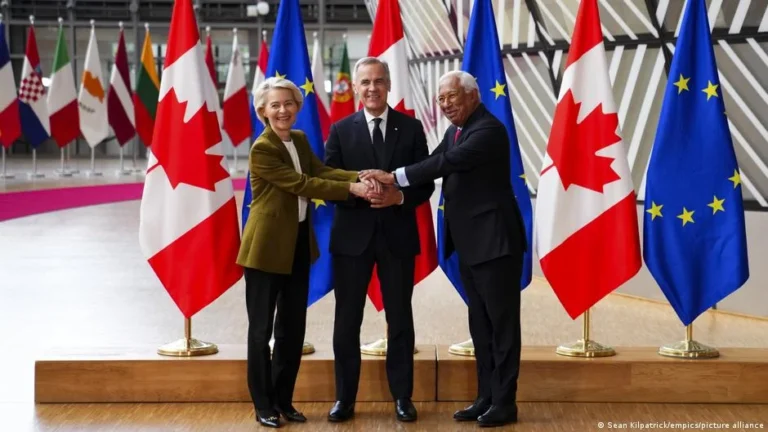
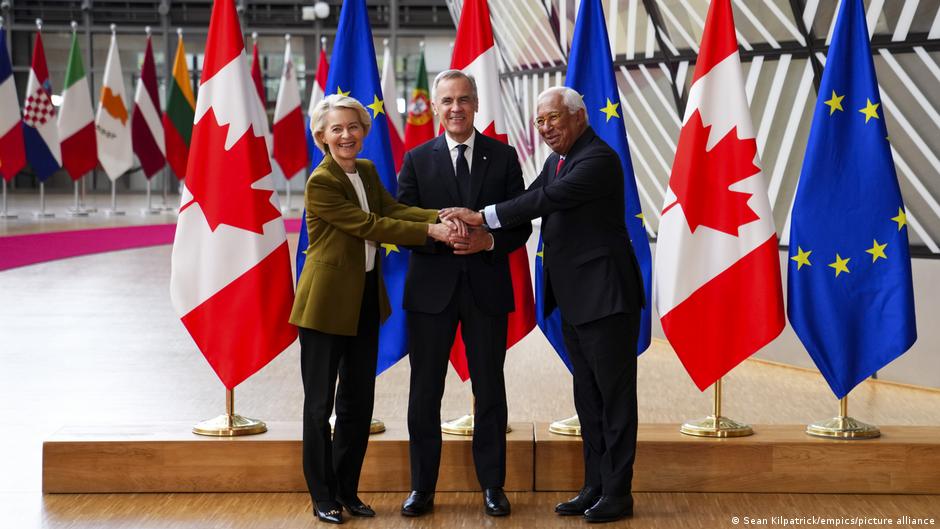
The geopolitical landscape of the North Atlantic is undergoing a significant transformation as Canadian Prime Minister Mark Carney initiates a formal push to forge a "unique alliance" with the European Union. While speculation regarding an "associate membership" status for Canada has circulated in international media, the core of the diplomatic mission is focused on a deep-rooted, multi-sector integration that transcends traditional trade agreements. This initiative, underscored by a speech at the European Parliament, signals a strategic pivot for Ottawa as it seeks to hedge against the uncertainties of its traditional reliance on the United States.
European Commission President Ursula von der Leyen, speaking during her State of the European Union address in Strasbourg, offered a receptive posture toward this deepening partnership. Her remarks, which emphasized the autonomy of democratic nations to choose their strategic partners, suggest that Brussels is increasingly viewing Canada as a vital anchor for European security and economic resilience.
A Chronology of Strategic Realignment
The current diplomatic momentum is not an isolated event but rather the culmination of years of mounting global volatility.
- September 2017: The Comprehensive Economic and Trade Agreement (CETA) between the EU and Canada enters into force on a provisional basis, establishing the bedrock for current trade relations.
- January 2026: At the World Economic Forum in Davos, Prime Minister Mark Carney articulates the necessity for a new global posture, famously warning of a "rupture in the world order" and urging "middle powers" to consolidate influence.
- Mid-2026: Tensions escalate in the US-Canada trade corridor, marked by a series of import bans and retaliatory tariffs, further incentivizing Ottawa to diversify its economic dependencies.
- September 2026: Prime Minister Carney travels to Strasbourg to formally propose a structured, long-term partnership with the European Union, moving beyond the existing CETA framework.
The Scope of the Proposed Alliance
The proposed partnership is expansive, covering eleven primary pillars of cooperation. These include advanced manufacturing, critical minerals, battery technology, artificial intelligence, quantum computing, cybersecurity, and energy security. By diversifying supply chains in these high-tech sectors, both Canada and the EU aim to reduce their reliance on third-party powers, particularly in the production of dual-use technologies essential for both economic growth and national security.
In the realm of energy, Canada’s vast oil and gas reserves, coupled with its burgeoning green hydrogen sector, offer the EU a reliable alternative to historical energy dependencies. This energy-security nexus is increasingly viewed as a critical component of the bloc’s long-term sustainability and independence goals.
Defense Cooperation and the SAFE Program
Perhaps the most sensitive, yet critical, area of the proposed alliance is defense. Canada’s entry into the EU’s Security Action for Europe (SAFE) program has opened doors to joint military procurement, though it remains a complex endeavor. The program, which commands a budget of €150 billion, requires high levels of European content in defense production.
Canada’s participation, facilitated by a membership fee, allows Canadian firms to bypass some of the more restrictive procurement rules. However, security analysts note that the integration of defense industries remains a work in progress. Anand Sundar, an analyst at the European Council on Foreign Relations, notes that Canada’s defense spending—currently 2% of its GDP—positions it as an "underrated power."
"Canada is essentially looking to get more bang for its buck," Sundar explains. "By aligning its procurement with European standards and joint projects, Canada can move away from its nearly 70% reliance on US-made equipment, while the EU gains access to a stable, resource-rich partner with a significant defense budget."
The commitment by Canada to reach a 5% GDP defense spending threshold by 2035—with 3.5% specifically earmarked for military equipment—places the country in a league that makes it an attractive partner for European industrial giants.
Economic Implications and the CETA Bottleneck
While CETA has successfully reduced tariffs, experts like Patrick Leblond of the University of Ottawa argue that the agreement has not yet reached its full potential. Leblond notes that many Canadian enterprises remain tethered to the US market, often overlooking the opportunities within the EU’s single market.
"The hurdle is not necessarily the legal framework, but the lack of market penetration," Leblond says. "A new, deeper alliance would likely focus on lowering non-tariff barriers, aligning regulatory standards in emerging tech sectors, and fostering institutional cooperation that makes doing business across the Atlantic as seamless as doing business between EU member states."
However, Leblond cautions against equating this potential alliance with full EU membership. "Canada is not seeking to adopt the acquis communautaire or join the customs union," he clarifies. "Such a move would be impractical given Canada’s geographical location and its existing obligations under the North American trade framework. The goal is a strategic alliance, not institutional integration."
Protecting the Arctic and Critical Infrastructure
Beyond military hardware and trade, the alliance seeks to secure the northern periphery. Discussions are already underway regarding the joint operation of satellite constellations and the protection of subsea fiber-optic cables that traverse the North Atlantic.
As the Arctic becomes a focal point of global strategic competition, the collaborative maintenance of critical infrastructure is viewed as an existential necessity. The ability to monitor, defend, and maintain these assets in a remote, harsh environment requires the pooling of technological resources and intelligence—a task for which Canada and the EU are uniquely positioned to collaborate.
Broader Implications for Global Middle Powers
The movement toward a Canada-EU partnership carries profound implications for the global order. For the EU, the alliance provides a template for how it can engage with non-member states that share its values but cannot or will not join the bloc. For Canada, the shift is an act of geopolitical survival. The mantra "if we’re not at the table, we’re on the menu," cited by Prime Minister Carney, reflects a growing consensus in Ottawa that the era of relying solely on the American security and economic umbrella is entering a period of significant revision.
As the discussions in Strasbourg continue, the focus will likely remain on the "concrete initiatives" mentioned by government officials. The success of this alliance will not be measured by the rhetoric of the signing ceremonies, but by the extent to which Canadian and European industries can successfully integrate their supply chains, coordinate their defense procurement, and solidify a unified front in a fractured global environment.
The path forward, however, is not without its domestic and international challenges. Skeptics point to the logistical difficulties of aligning regulatory frameworks between two distinct legal systems, as well as the potential for friction with existing trade partners. Yet, given the current trajectory of global affairs, both Brussels and Ottawa appear to have calculated that the benefits of this unique alliance outweigh the risks of inaction.
As the European Parliament prepares to debate the specifics of the proposed cooperation, the world is watching to see if this "unique alliance" will indeed serve as a model for how middle powers can assert their autonomy and collective strength in an increasingly polarized world. For now, the commitment remains firm: a collaborative future, forged in the interest of economic security, technological advancement, and regional stability.