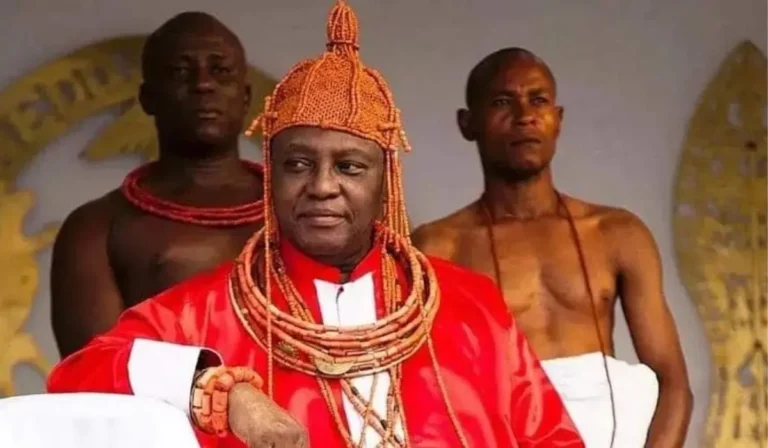
The historic city of Benin played host to high-stakes political consultations on Tuesday as the revered Oba of Benin, Omo N’Oba N’Edo Uku Akpolokpolo, Oba Ewuare II, welcomed a powerful delegation from the Presidential Campaign Council (PCC). Led by its Director-General and former Zamfara State Governor, Abdulaziz Yari, the high-powered political team visited the ancient palace to seek royal blessings, spiritual guidance, and political support for President Bola Ahmed Tinubu’s anticipated 2027 re-election bid.
Against the backdrop of intensifying early political realignments across Nigeria, the royal audience transformed into a platform for profound national reflection. Rather than engaging in partisan rhetoric, the traditional ruler utilized the global platform of the Benin throne to deliver a stern and statesmanlike message: that national interest must permanently supersede political division. While underscoring the strict political neutrality of the Benin traditional institution, Oba Ewuare II challenged both ruling and opposition figures to embrace a model of constructive governance that transcends party lines.
The high-level visit highlights the growing trend of political actors courting traditional rulers early in the electoral cycle. As political parties position themselves for the 2027 general elections, traditional institutions remain critical nodes of influence, moral authority, and community mobilization. However, the monarch’s intervention reframed the dialogue, shifting the focus from electoral victory to the urgent necessity of socio-economic cohesion and national stability.
Royal Call for Bipartisan Cooperation and Constructive Dialogue
Addressing the visiting PCC delegation, prominent political officeholders, and members of his royal court, Oba Ewuare II articulated a vision of democratic governance rooted in cooperation rather than perpetual hostility. He noted that while multiparty democracy inherently demands an opposition to keep the government in check, opposition status should never translate into obstructionism or blind antagonism toward policies that benefit the common citizen.
"In democracy there must be opposition when a party comes to power. I don’t see why an opposition party can’t support the ruling party," Oba Ewuare II declared, emphasizing that nation-building is a collective enterprise requiring the input of all stakeholders regardless of party affiliation.
Drawing from his extensive international exposure and training as a diplomat in the United States and Great Britain, the monarch urged former governors, serving senators, and political actors across the divide to cease excessive and unconstructive criticism of leaders. He reminded the political class of human fallibility, noting that perfection is an unattainable standard in public service.
"Is there anybody who is so perfect as I am talking now? Nobody. I love and like peace and tranquillity. I am American and British trained as a diplomat, and I say it the way it is," the Oba stated candidly. His remarks resonated deeply within the palace walls, drawing quiet nods from the assembled politicians and setting a sober tone for the strategic engagements that followed.
Campaign Council Presents Economic Scorecard and 2027 Agenda
Earlier in the proceedings, Abdulaziz Yari formally laid out the mission of the PCC delegation before the monarch. Beyond seeking royal prayers for President Tinubu, Yari used the platform to present an aggressive defense of the administration’s economic policies, pointing to what he characterized as significant macroeconomic improvements since the current administration assumed office in May 2023.
Presenting data to substantiate the campaign’s re-election platform, Yari claimed that Nigeria’s annual Gross Domestic Product (GDP) growth rate had experienced an upward trajectory, rising from 2.7 percent in 2023 to 3.9 percent. Furthermore, he argued that inflationary pressures, which have severely strained household budgets nationwide, were beginning to ease, citing a claimed decline in headline inflation figures from 22.9 percent to 15.9 percent. The former governor also highlighted the stabilization of the foreign exchange market as a critical milestone achieved through systemic fiscal and monetary reforms spearheaded by the federal government under Tinubu’s stewardship.
"President Bola Ahmed Tinubu is the right person to steer the ship of this country," Yari asserted, urging Nigerians to evaluate the administration objectively based on its structural reforms and projected economic indicators. The presentation of these figures formed the bedrock of the council’s narrative that continuity is vital for the consolidation of the administration’s long-term developmental blueprint.
Regional Politics and the Case for Southern Equity
The political dimensions of the visit were further amplified by Edo State Deputy Governor, Rt. Hon. Dennis Idahosa, who spoke on behalf of the state government and the ruling party architecture in the region. Idahosa expressed deep appreciation to the Oba for his continuous prayers and counsel, while firmly anchoring his support for President Tinubu’s second-term ambition on principles of political equity, fairness, and federal character.
According to the Deputy Governor, considerations of geopolitical balance strongly favor the Southern region retaining the presidency for another term to complete a stable eight-year cycle, mirroring historical power rotations. Idahosa also used the occasion to consolidate the domestic political structure in Edo State, affirming that Governor Monday Okpebholo remains the undisputed political leader of the state. He assured the national campaign team that the people of Edo State would reciprocate the federal government’s developmental efforts by delivering a massive electoral victory for President Tinubu in 2027.
"For us in Edo State, Governor Monday Okpebholo is the leader and he is leading well as we have a lot of projects to campaign with, and the people of Edo State will vote massively for President Tinubu to enable him win the 2027 Presidential election," Idahosa maintained.
Background Context: The 2027 Electoral Landscape and Traditional Diplomacy
The high-level engagement between the Presidential Campaign Council and the Benin monarch occurs against a broader socio-political backdrop characterized by early campaign positioning and intense economic anxiety across Nigeria. Ever since the grueling general elections of 2023, the political space has remained fluid. While opposition parties continue to organize and critique government policies—particularly regarding the removal of fuel subsidies and the floating of the naira—the ruling All Progressives Congress (APC) has steadily ramped up its structural consolidation ahead of 2027.
Traditional rulers in Nigeria, though constitutionally barred from partisan politics, occupy a unique and influential position as custodians of cultural heritage and moral barometers of society. Consequently, political actors frequently seek their endorsement not merely for electoral votes, but for legitimacy and social capital. The palace of the Oba of Benin, given its historical significance and moral authority, remains one of the most coveted stops for national politicians seeking to project national acceptance.
Oba Ewuare II’s persistent advocacy for non-partisan cooperation addresses a critical vulnerability in Nigeria’s democratic experiment: the tendency for intense political competition to degenerate into governance paralysis and deep social polarization. By urging political figures to look beyond the ballot box, the monarch’s message serves as a timely reminder that the challenges of national development—ranging from insecurity to infrastructure deficits—require bipartisan consensus.
Implications and Analytical Outlook
The dialogue at the Benin Palace carries significant implications for the trajectory of political engagement as Nigeria marches toward 2027.
First, the emphasis placed by the campaign council on macroeconomic indicators such as GDP growth and inflation points to the central theme of the upcoming electoral contest. As the administration seeks a renewed mandate, its political messaging will inevitably hinge on convincing a weary electorate that the painful structural reforms implemented in the early years of the tenure are yielding sustainable dividends. However, while campaign councils often highlight favorable statistical trends, the lived reality of everyday citizens—shaped by the cost-of-living crisis and purchasing power erosion—remains the ultimate testing ground for public approval.
Second, the Oba’s intervention establishes a high benchmark for political discourse. By calling out the dangers of excessive, unconstructive criticism while simultaneously reminding leaders of their human limitations, the monarch challenged both the ruling establishment and the opposition to elevate the quality of public debate. In a polarized media environment where political discourse is frequently dominated by sensationalism and mudslinging, the royal admonition champions a culture of accountability coupled with institutional patriotism.
Finally, the alignment expressed by the Edo State government leadership underscores how sub-national dynamics will heavily influence the 2027 presidential map. With the APC consolidating its governance footprint in Edo State under Governor Okpebholo, the ruling party is positioning the state as a strategic stronghold in the South-South geopolitical zone.
As the election cycle progresses, interactions of this nature will likely multiply. Yet, the enduring takeaway from the Benin Palace visit remains the timeless counsel of Oba Ewuare II: that partisan ambitions must ultimately yield to the overarching imperatives of peace, unity, and national progress.