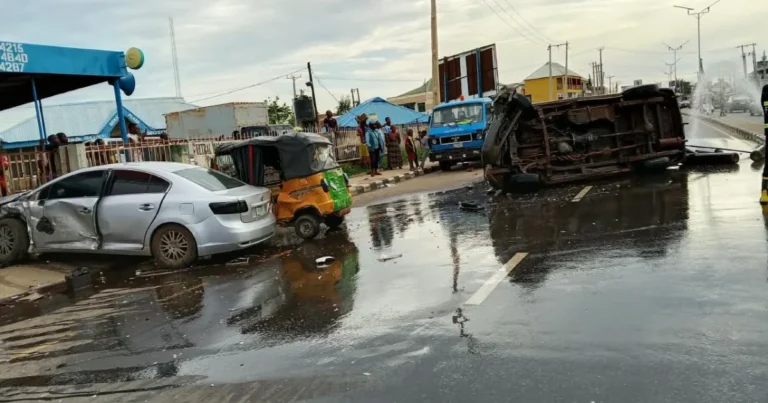
The tranquil atmosphere of Ibrahim Taiwo Road in Ilorin, the capital of Kwara State, was shattered on Wednesday evening when a high-stakes traffic incident threatened to turn into a localized catastrophe. At approximately 5:00 p.m., near the bustling Stadium Complex Gate, a Toyota Sienna bus laden with volatile hazardous materials experienced a total mechanical failure, triggering a multi-vehicle collision that left the surrounding community in a state of high alert.
The vehicle, a Toyota Sienna with registration number LEM 95 XB, was not merely a passenger transport; it was effectively a mobile bomb, carrying 23 industrial-grade gas cylinders and six drums of highly reactive calcium carbide. As the vehicle navigated the busy thoroughfare in front of Bekki & Sons Ltd, the driver reported a sudden and complete failure of the braking system. In a desperate bid to bring the heavily weighted vehicle to a halt, the driver attempted a maneuver toward the road divider. However, the momentum of the heavy load proved insurmountable. The bus vaulted over the divider, crossed into the opposing lane, and overturned, subsequently colliding with a Toyota Avensis (SMK 530 JB), a commercial tricycle (SHA 503 VD), and a motorcycle (ARP 405 VE).
A Chronology of the Emergency Response
The incident, which occurred during the peak of evening transit, triggered an immediate response from the Kwara State Fire Service. According to the timeline established by official reports, the agency was alerted to the scene within minutes of the crash. The primary concern for emergency responders was not merely the physical trauma of the collision, but the volatile combination of leaking petroleum from the damaged vehicles, the structural compromise of the gas cylinders, and the presence of carbide, which, when exposed to moisture or extreme heat, can produce highly flammable acetylene gas.
Upon arrival, firefighters found the scene in a precarious state. The overturned Sienna was leaking fuel, creating a potential ignition source that could have triggered a secondary explosion of the gas cylinders. The operational priority was immediately shifted from standard traffic clearance to hazardous materials mitigation. The Kwara State Fire Service, under the guidance of the Chief Fire Officer, Alabi Muhammed, implemented a cordoning strategy, restricting traffic flow to prevent any external sparks or congestion from exacerbating the situation.
By 6:30 p.m., the agency had successfully managed the fuel leak and secured the hazardous cargo, effectively neutralizing the risk of a fire outbreak. Following a thorough safety assessment, the debris was cleared, and the road was reopened to public transit by late evening.
The Anatomy of Hazardous Materials Transport
The incident on Ibrahim Taiwo Road has reignited a critical conversation regarding the regulation of hazardous material transportation in urban centers. In Nigeria, the transport of volatile substances such as gas cylinders and chemical agents is often subject to strict regulatory frameworks; however, enforcement remains a persistent challenge.
The materials involved in Wednesday’s crash present significant logistical and safety hurdles. Calcium carbide, for instance, is a chemical compound primarily used in the production of acetylene gas and as a ripening agent for fruit. It is inherently unstable when exposed to water or high humidity, posing a chemical burn and fire risk. When coupled with pressurized gas cylinders—which can act as projectiles if they fail under stress—and the presence of motor fuel, the potential for a large-scale disaster is significant.
Data from the Federal Road Safety Corps (FRSC) suggests that brake failure remains one of the leading causes of road traffic accidents in Nigeria, often attributed to poor vehicle maintenance and the overloading of vehicles beyond their manufacturer-specified capacity. The Sienna bus involved in the Ilorin accident was clearly being utilized for commercial cargo transport, a practice that often involves stripping internal seating to maximize storage space, thereby altering the vehicle’s center of gravity and braking dynamics.
Official Statements and Regulatory Implications
Hassan Adekunle, the Public Relations Officer for the Kwara State Fire Service, emphasized the professional rigor applied by his team to contain the threat. "The accident was a perfect storm of hazardous factors," Adekunle stated. "We were dealing with structural wreckage, flammable fuel, and high-pressure gas. Our primary objective was to prevent a catastrophic fire that would have undoubtedly caused widespread casualties given the proximity of the Stadium Complex and surrounding business entities."
Chief Fire Officer Alabi Muhammed commended the bravery of the responding personnel, noting that the incident could have been far worse had the fire service not acted with the speed and precision that they did. "This event serves as a stark reminder to all transport operators," Muhammed remarked. "Vehicles conveying inflammable and hazardous materials must adhere to the highest standards of roadworthiness. Maintenance is not a luxury; it is a public safety requirement."
The Kwara State government is expected to review the protocols surrounding the movement of such materials through residential and commercial zones. There is a growing call from safety advocates for the establishment of designated transit windows for vehicles carrying hazardous cargo, ensuring they avoid peak traffic hours to minimize the potential impact of any unforeseen mechanical failure.
Broader Societal Impact and Public Safety Advisory
The disruption on Ibrahim Taiwo Road caused a ripple effect across the city’s traffic grid. Motorists traveling from Baboko, Surulere, and Adewole were forced to seek alternative routes, causing significant delays during the evening commute. The fire service’s proactive decision to restrict access to the area was deemed essential for protecting the public, yet it underscored the vulnerability of the city’s infrastructure to such incidents.
In the aftermath of the crash, the Kwara State Fire Service has issued a series of directives for both transport operators and the general public:
- Mandatory Pre-Trip Inspections: Operators of vehicles carrying flammable or hazardous cargo must undergo rigorous mechanical checks, specifically focusing on braking systems, tire integrity, and suspension, before every journey.
- Emergency Cooperation: The agency stressed that when an accident involving hazardous materials occurs, the public must adhere to cordons and instructions from emergency personnel. Onlookers often inadvertently obstruct critical rescue operations and place themselves at unnecessary risk.
- Regulatory Compliance: There will be renewed scrutiny on the licensing and inspection of commercial vehicles that have been repurposed for the transport of chemicals and gas cylinders.
- Vigilance: Motorists are encouraged to report vehicles that appear to be leaking or operating in an unsafe manner, particularly when such vehicles are clearly transporting dangerous goods.
The Ilorin accident acts as a cautionary tale for urban planning and traffic management. As the city continues to grow, the density of traffic on arterial roads like Ibrahim Taiwo Road increases the statistical probability of mechanical failure-related incidents. The ability of the Kwara State Fire Service to prevent a fire in this instance highlights the importance of investing in rapid-response capabilities and well-trained emergency personnel.
While the driver of the Sienna bus sustained injuries in the crash, the fact that no bystanders or passengers in the other vehicles were critically harmed is being viewed as a narrow escape. As the investigation into the vehicle’s maintenance history continues, the incident stands as a powerful testament to the necessity of strict vehicle safety compliance. For now, the road is open, and the immediate danger has been mitigated, but the event leaves behind a lingering question about how to better insulate the public from the inherent risks of hazardous goods transportation in a modern, developing urban environment.