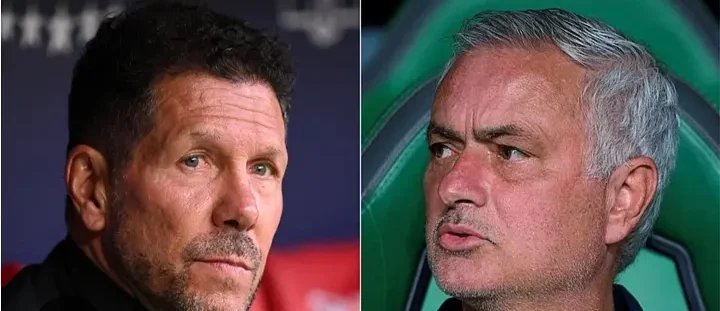
The fierce and enduring rivalry of the Spanish capital reached yet another boiling point over the weekend, culminating in a dramatic 2-1 victory for Atletico Madrid over arch-rivals Real Madrid at a raucous Wanda Metropolitano. The aftermath of the fixture, however, quickly shifted from the pitch to the press room, where traditional tactical post-match analysis was entirely overshadowed by refereeing controversies and fiery verbal exchanges between the two rival managers. Atletico Madrid head coach Diego Simeone has publicly cautioned his Real Madrid counterpart, Jose Mourinho, urging the Portuguese tactician to exercise extreme caution when casting public aspersions on officiating crews.
The match itself was a quintessential Madrid derby: high-intensity, physical, fiercely contested, and laden with high stakes as both clubs navigate the rigorous and unforgiving landscape of the current LaLiga campaign. Yet, the definitive narrative of the evening crystallized in the wake of the final whistle, setting off a chain reaction of disciplinary debates, media scrutiny, and renewed discourse surrounding the delicate relationship between high-profile managers and match officials in Spanish professional football.
Chronology of the Derby Drama
The fixture began with the characteristic tension associated with one of world football’s most prestigious fixtures. Both sides traded blows in the opening exchanges, testing each other’s defensive resilience and tactical setups. However, the pivotal turning point of the contest arrived midway through the first half when Real Madrid found themselves severely compromised.
Defender Dean Huijsen, thrust into the heat of a Madrid derby crucible, received his marching orders following a decisive intervention from the referee. The red card dealt to the young defender forced Real Madrid into a severe tactical retreat, altering the complexion of the match entirely. Down to ten men, Los Blancos struggled to maintain their initial equilibrium against a relentlessly pressing Atletico side that sensed blood in the water.
Capitalizing on their numerical advantage, Atletico Madrid seized control of the tempo and territory. The pressure soon yielded dividends when defender Alejandro Grimaldo broke the deadlock, finishing with clinical precision to put the hosts ahead. Buoyed by the opening goal and the fervent backing of the home supporters, Atletico doubled their advantage shortly after through star forward Jonathan David, whose composed finish left the Real Madrid defense exposed and trailing 2-0.
Despite the daunting deficit and numerical disadvantage, Real Madrid showcased their trademark resilience. Late in the second half, German international center-back Antonio Rudiger hauled his team back into contention. Rising highest inside the penalty area, Rudiger met a pinpoint delivery to power a trademark header past the Atletico goalkeeper, narrowing the deficit to 2-1 and setting up a frantic, nail-biting conclusion.
Nevertheless, Diego Simeone’s men demonstrated immense tactical discipline and defensive organization to weather the late storm. Atletico successfully managed the remaining minutes of regulation and stoppage time, securing a famous and vital three points that sent shockwaves through the upper echelons of the LaLiga table.
Mourinho’s Post-Match Outburst and Refereeing Grievances
While the players embraced or trudged off the pitch, the true fireworks ignited during the post-match press conferences. Jose Mourinho, visibly frustrated by the evening’s events and the decisive turning points of the match, did not mince words when addressing the media. The veteran manager launched a scathing critique of the officiating crew, centering his grievances primarily on the referee’s appointment and background.
Mourinho characterized the match referee as excessively young and inexperienced for an encounter of such magnitude and global consequence, arguing that putting a high-pressure fixture in the hands of a novice official invited controversy. Furthermore, the Real Madrid manager directed his ire toward the Video Assistant Referee (VAR) booth. Mourinho publicly questioned the rationale behind selecting the specific VAR official for the derby, claiming that the individual in question had a documented history of involvement in several highly controversial decisions adversely affecting Real Madrid in previous high-stakes fixtures.
The remarks were swiftly picked up by international media, reigniting age-old debates concerning institutional bias, referee protection, and the psychological warfare frequently deployed by elite managers to deflect scrutiny away from on-field performance and onto external factors.
Diego Simeone’s Response and the Call for Caution
Faced with Mourinho’s explosive accusations, Diego Simeone adopted a measured yet firm posture during his own media obligations. Addressing the media shortly after his counterpart, the Argentine manager chose not to engage in a war of words regarding the specific refereeing decisions, but instead issued a direct and pointed warning to the Real Madrid boss.
Simeone emphasized that managers occupying positions of such immense influence carry a profound responsibility regarding how they speak about match officials. Pointing to the volatile nature of modern football culture, the Atletico manager suggested that public criticisms of referees by high-profile figures can dangerously undermine the integrity of the sport, incite unnecessary hostility from supporters, and place undue pressure on officials who are already operating under microscope-like scrutiny.
While acknowledging that emotions run high immediately following a derby defeat, Simeone made it unequivocally clear that there are professional boundaries that must be respected. His warning underscored a broader philosophy: that systemic complaints about refereeing should be channeled through appropriate institutional and administrative pathways rather than weaponized in public press conferences to manipulate narratives.
Supporting Data and Context of the Fixture
To understand the weight of this latest chapter in the Madrid derby, one must examine the broader statistical and competitive context. Matches between Atletico Madrid and Real Madrid consistently rank among the most intensely monitored fixtures in European sport. Over the past decade, encounters at either the Wanda Metropolitano or the Santiago Bernabeu have frequently featured high disciplinary counts, including numerous red cards and contentious VAR interventions.
Real Madrid entered this particular derby boasting a statistically robust defensive record, yet the integration of younger personnel like Dean Huijsen into high-intensity fixtures has occasionally exposed them to vulnerabilities. Conversely, Atletico Madrid’s tactical evolution under Simeone has seen them blend their traditional defensive solidity with increasingly potent attacking transitions, heavily utilizing players of the caliber of Alejandro Grimaldo and Jonathan David to exploit numerical advantages when opponents are reduced.
Historical data from LaLiga disciplinary committees indicates that public criticism of match officials frequently results in regulatory investigations. The Spanish Football Federation (RFEF) maintains strict protocols regarding statements made by club managers that question the impartiality, competence, or integrity of referees. Mourinho’s remarks, therefore, carry potential financial and sporting ramifications, as league authorities routinely review post-match press transcripts for breaches of conduct.
Broader Impact and Implications for LaLiga
The fallout from this fiery derby extends far beyond the immediate three points claimed by Atletico Madrid. In the broader context of the LaLiga title race, the result significantly tightens the standings, injecting fresh momentum into Atletico’s campaign while dealing a psychological and mathematical blow to Real Madrid’s aspirations of maintaining a comfortable cushion at the summit.
More pressingly, the exchange between Simeone and Mourinho highlights an ongoing cultural crisis within elite European football concerning the treatment of match officials. As the implementation of VAR continues to evolve, debates surrounding subjective interpretations, protocol consistency, and technological transparency remain fierce. When iconic managers utilize their platform to question the competence or selection of referees, it triggers a cascading effect that reverberates across sports media, fan communities, and regulatory bodies.
The immediate implications for Real Madrid involve navigating potential disciplinary actions from the RFEF should Mourinho’s comments be deemed a violation of sporting decorum. For Atletico Madrid, the victory serves as a monumental morale booster, validating Simeone’s tactical pragmatism and reinforcing their status as genuine contenders for domestic supremacy.
As the dust settles on another unforgettable Madrid derby, the footballing world is left to ponder not only the goals scored and the tactical battles fought on the green turf, but also the enduring war of words off it. With both managers steering their respective clubs through a grueling season, the psychological skirmishes between Simeone and Mourinho have only added another layer of compelling drama to an already enthralling LaLiga title race.