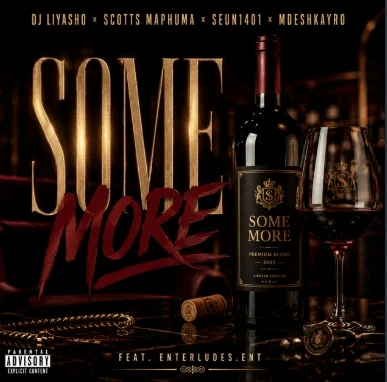
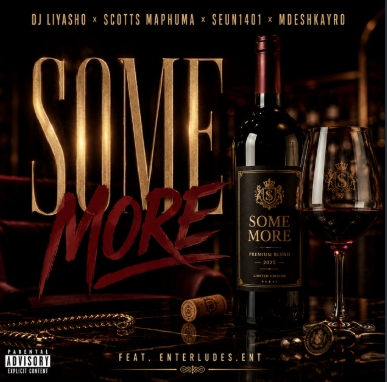
The track, which serves as a testament to the thriving creative synergy within the Amapiano movement, brings together a diverse assembly of talent. Featuring the production prowess of DJ LIYASHO, Scotts Maphuma, Seun1401, and Mdeshkayro, alongside the vocal contributions of Enterludes.ENT, the single is designed to dominate dancefloors through its meticulously crafted 114 BPM groove.
Musical Composition and Technical Analysis
At its core, "Some More" is a study in contemporary Amapiano production. The track spans 4:40, a duration carefully chosen to sustain momentum without succumbing to the fatigue often associated with extended club edits. The production architecture is defined by a deep, resonant bassline that serves as the foundation for complex, rolling percussion patterns—a hallmark of the modern Amapiano sound.
The incorporation of punchy, melodic piano stabs provides a rhythmic counterpoint to the low-end frequencies. This technical layering is augmented by the vocal performance of Enterludes.ENT, who injects a distinct character into the record. By balancing instrumental clarity with vocal charisma, the production team has achieved a sound that is both commercially viable and artistically rigorous. The tempo, set at a steady 114 BPM, sits firmly in the "sweet spot" for modern house music, allowing for seamless integration into diverse DJ sets, from high-energy festival stages to intimate, mid-tempo lounge environments.
The Rise of the Collaborative Model in Amapiano
The release of "Some More" highlights a growing trend within the South African music industry: the shift toward large-scale collaborative projects. Unlike the solitary production models of the past, contemporary Amapiano is increasingly defined by the "super-group" or "collective" approach. By pooling the resources and stylistic influences of multiple artists—in this case, DJ LIYASHO, Scotts Maphuma, Seun1401, and Mdeshkayro—the track benefits from a broader spectrum of creative input.
This collaborative model has effectively mitigated the risks associated with independent releases. By leveraging the combined social media reach and fan bases of four distinct artists, the track is positioned to gain traction far more rapidly than a solo endeavor. This strategy is not merely an artistic choice but a calculated market maneuver in an increasingly saturated digital streaming landscape.
Artist Background and Trajectory
Scotts Maphuma has been particularly visible in recent months, cementing his status as one of the genre’s most sought-after vocalists and collaborators. His recent appearance on the track "Barrman," alongside industry heavyweights like LeeMcKrazy, Mellow, Sleazy, and DJ Njabsta, served as a precursor to the release of "Some More." These back-to-back high-profile appearances demonstrate a strategic push by Maphuma to remain at the forefront of the Amapiano discourse.
Similarly, DJ LIYASHO has been methodically building a reputation for clean, resonant production. The integration of Seun1401 and Mdeshkayro adds layers of texture that suggest a deliberate effort to diversify the sonic palette of the track. For Enterludes.ENT, this feature represents a significant opportunity to showcase vocal versatility within a high-stakes, professional production environment.
Chronology of the Amapiano Phenomenon
To understand the significance of "Some More," one must view it within the broader chronology of the Amapiano movement. Originating in the townships of South Africa around 2012, Amapiano spent years as an underground phenomenon before exploding into the mainstream consciousness around 2018-2019.
- 2012–2017: The Formative Years. Amapiano develops as a fusion of deep house, jazz, and lounge music, characterized by its signature "log drum" basslines.
- 2018–2020: The Mainstream Pivot. Major labels begin scouting local producers. Tracks like "Labantwana Ama Uber" bring the genre to national radio.
- 2021–2023: Global Expansion. The genre gains international acclaim, with collaborations involving global artists. Streaming platforms like Spotify and Apple Music report exponential growth in Amapiano-related content.
- 2024–Present: Structural Refinement. The current era is defined by high-fidelity production, tighter arrangements, and the formalization of collaborative networks, of which "Some More" is a prime example.
Market Implications and Distribution
The release of "Some More" arrives at a time when the digital distribution of music has reached a saturation point. In 2024, the success of a track is measured not just by total streams, but by playlist placement and social media virality (specifically on platforms like TikTok).
Data from music industry analysts suggests that the average listener’s attention span for new music is decreasing. Consequently, the 4:40 runtime of "Some More" is a strategic choice; it provides enough depth for a complete listening experience while remaining concise enough to encourage repeat listens—a critical metric for streaming algorithms. The accessibility of the track, available through various digital distribution channels and peer-to-peer file-sharing platforms like Pixeldrain, ensures that it reaches both traditional streaming audiences and the grassroots DJ circuit that remains the heartbeat of the South African music scene.
Cultural and Social Significance
Beyond the numbers, "Some More" serves as a cultural artifact of the post-pandemic social environment. The track’s "party atmosphere" is a reflection of the renewed demand for music that facilitates social interaction, cruising, and club culture. As public gatherings and nightlife sectors continue to stabilize, artists are increasingly focusing on music that provides a sense of escapism and communal joy.

The professionalization of the production quality in this track also speaks to the rising standards of the South African music industry. Independent artists are no longer content with "bedroom production" values; they are utilizing high-end software and professional mixing techniques to compete on a global scale. This shift has forced major international labels to pay closer attention to the South African market, leading to increased investment and more equitable distribution agreements for local talent.
Future Projections for the Artists
The collaborative success of "Some More" is expected to have a tangible impact on the future projects of all involved parties. For the producers, this track serves as a calling card that can open doors to higher-budget collaborations and international touring opportunities. For the vocalists, it reaffirms their relevance in a fast-paced market.
The trajectory of the Amapiano genre remains upward, though experts caution that the market will likely undergo a phase of consolidation. As the genre becomes more crowded, tracks that rely on high-quality production and strong, rhythmic hooks—like "Some More"—will likely be the ones that sustain long-term relevance. The ability of these artists to combine their unique strengths into a cohesive, high-energy product is a positive indicator for their individual careers and the collective health of the Amapiano movement.
Conclusion
"Some More" is more than just a dance track; it is a clear indicator of the maturity and sophistication of the current Amapiano scene. Through its expert blend of deep bass, rhythmic vocal layering, and precise arrangement, the track satisfies both the technical requirements of the professional DJ and the aesthetic desires of the casual listener. As these artists continue to navigate the complexities of the modern music industry, their collaborative efforts remain a vital component of the cultural conversation, driving the genre forward with each release. By maintaining a focus on high-energy, infectious rhythms, the collective has successfully created a piece of music that is well-positioned for both immediate chart performance and lasting impact within the genre’s canon.