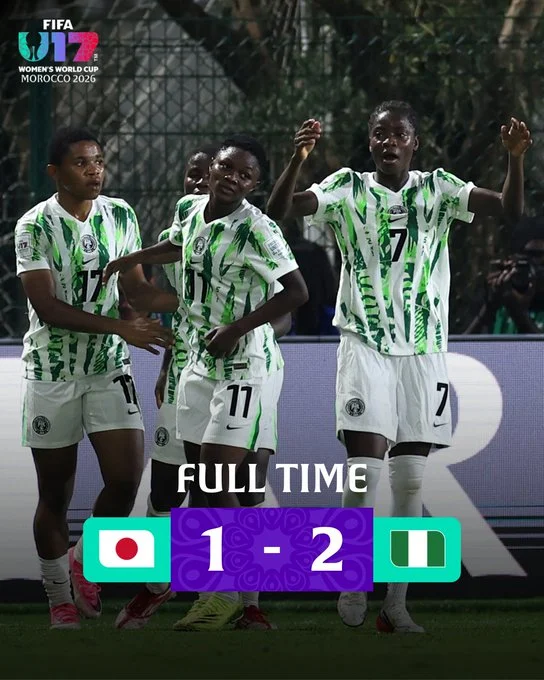
Nigeria’s First Lady, Senator Oluremi Tinubu, joined millions of proud citizens across the globe in throwing her full weight behind the nation’s U-17 women’s national team, the Flamingos, as they faced off against powerhouse Japan in a thrilling and fiercely contested FIFA U-17 Women’s World Cup final. Demonstrating passionate patriotism from her official residence, the First Lady was captured in a widely circulated video actively watching the high-stakes encounter, offering enthusiastic applause, and chanting “Nigeria! Nigeria!” as the young athletes battled for global supremacy on the pitch. Her visible support mirrored the collective heartbeat of a football-obsessed nation waiting with bated breath for history to be written.
The momentous final match, hosted at the prestigious Mohammed VI Football Complex, culminated in a stunning 2-1 victory for Nigeria over Japan. This extraordinary triumph not only secured the coveted global trophy for the West African nation but also etched the Flamingos’ names into the annals of football history as the very first African country to ever lift the FIFA U-17 Women’s World Cup. The match itself was a masterclass in resilience and tactical discipline, showcasing the immense potential, raw talent, and unyielding spirit inherent in Nigerian youth sports.
A Chronological Journey to Global Glory
The path of the Flamingos to the zenith of international youth football was anything but straightforward, making their ultimate championship win all the more remarkable. The tournament script read like a dramatic sports epic, featuring early adversity, remarkable tactical adjustments, and an inspirational turnaround that will be remembered for generations.
The campaign began with a jolt of harsh reality when the Flamingos stumbled in their opening group-stage fixture, suffering a narrow and disheartening 2-1 defeat at the hands of Poland. For many observers, this early setback cast a shadow of doubt over the team’s prospects in the tournament, raising familiar questions about mental toughness and consistency on the global stage. However, rather than letting the defeat derail their ambitions, the technical crew and the players regrouped, recalibrated their strategies, and embarked on an unrelenting march toward redemption.
By navigating the remainder of the group stages with renewed vigor, the team advanced through the knockout rounds, displaying a lethal combination of defensive solidity and dynamic attacking flair. This steady momentum culminated in the grand finale against a formidable Japanese side renowned for its technical proficiency and tactical organization.

When the referee’s whistle blew to signal the start of the final, both teams immediately engaged in a high-tempo tactical battle. It was Nigeria that drew first blood in the 39th minute. Forward Awawu Bashiru capitalized on a defensive lapse by the Japanese backline, unleashing a brilliant strike that nestled comfortably into the back of the net, sending the Nigerian bench and supporters worldwide into absolute ecstasy. The 1-0 lead proved crucial as it gave the Flamingos a psychological advantage heading into the halftime interval.
The second half barely had time to breathe before Nigeria struck again. Just two minutes after the restart, in the 47th minute, Oluebube Umejiaku rose to the occasion, doubling the Flamingos’ lead with a superbly executed goal that stunned the Japanese defense. Armed with a comfortable two-goal cushion, the Nigerian side controlled large swathes of the tempo, frustrating their opponents with disciplined defensive blocks and swift counter-attacks.
Japan, true to their resilient football culture, refused to surrender. As the match entered its closing stages, the Asian side ratcheted up the offensive pressure. Their persistence paid off in the 80th minute when Fuki Ito found a breakthrough, firing past the Nigerian goalkeeper to narrow the deficit to 2-1. The final ten minutes plus stoppage time transformed into a nerve-wracking defensive rearguard action for the Flamingos. Despite intense pressure and wave after wave of Japanese attacks, the Nigerian defense held firm, expertly managing the game until the final whistle signaled the historic triumph.
Breaking Records and Setting New Standards
The victory over Japan was not merely a standalone sporting achievement; it fundamentally reshaped the landscape of international women’s football. By securing the title, the Flamingos accomplished feats that had eluded every other African nation since the inception of the tournament.
Most notably, Nigeria became the first African country—male or female—to win the FIFA U-17 World Cup across both categories. While Nigerian male teams, the Golden Eaglets, have historically dominated the men’s U-17 World Cup with a record five titles, the female equivalent had long remained an elusive frontier for the continent. The Flamingos have now bridged that historical gap, proving that African women’s football has reached a parity level capable of conquering the world.
Furthermore, the Flamingos etched their names in the record books by becoming the very first team in the entire history of the FIFA U-17 Women’s World Cup to lose their opening match of the tournament and still go on to lift the championship trophy. Recovering from an opening-day defeat to Poland requires an extraordinary level of psychological fortitude, tactical flexibility, and self-belief. This unprecedented turnaround serves as a powerful testament to the character embedded within the squad.

Official Reactions and National Pride
Following the final whistle, congratulatory messages poured in from various high-ranking government officials, sports administrators, and prominent public figures across Nigeria. The enthusiastic reaction of First Lady Senator Oluremi Tinubu captured the national mood, highlighting the unifying power of sports in a diverse society. Her active participation in cheering the team from her residence underscored the high-level political goodwill and governmental appreciation currently being directed toward youth and women’s sports development.
Sports analysts and football administrators have noted that this victory is the culmination of sustained, albeit often overlooked, talent identification programs at the grassroots level across various states in Nigeria. Stakeholders have emphasized that the success of the Flamingos should serve as a wake-up call for increased investment in female sports infrastructure, better remuneration, and structured pathways for transitioning talented youth players into the senior national team, the Super Falcons.
Broader Socio-Economic and Sporting Implications
The historic victory of the U-17 women’s team carries profound implications that extend far beyond the immediate joy of lifting a trophy. On a socio-cultural level, the success of these young women serves as a powerful inspiration for millions of girls across Nigeria and the broader African continent. It challenges traditional gender stereotypes regarding sports participation, demonstrating clearly that athletic excellence knows no gender boundaries.
Economically and diplomatically, athletic triumphs of this magnitude elevate the national brand on the international stage. Football remains one of Nigeria’s most potent soft-power exports. When young ambassadors hoist a global trophy against traditional sporting giants like Japan, it projects an image of resilience, talent, and untapped potential to the international community.
From a structural perspective, this global title places immense responsibility on the Nigeria Football Federation and relevant sports ministries. The challenge moving forward will be to capitalize on this momentum by ensuring that the championship-winning generation is not lost to the bureaucratic hurdles that have historically plagued youth football development in the region. Proper monitoring, academic support, and professional European or domestic club integration will be critical to safeguarding the futures of these young athletes.
As the Flamingos prepare to return home to a hero’s welcome, the echoes of their historic campaign in Morocco—where the Mohammed VI Football Complex played host to their crowning moment—will resonate for decades. Their journey from a disheartening opening loss against Poland to the absolute pinnacle of global football stands as an enduring reminder of what can be achieved through discipline, unity, and unwavering national spirit.